

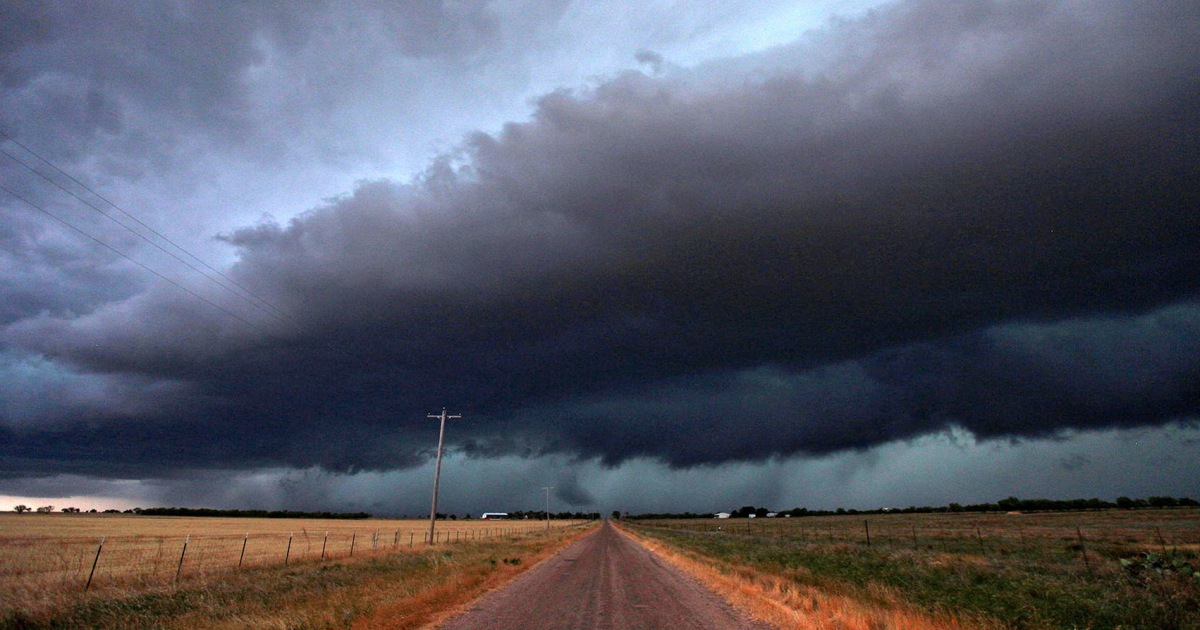
State Farm reduced its payouts to policyholders by more than a billion dollars as massive storms tore up the rooftops of houses in Oklahoma, according to company documents released as part of an ongoing series of lawsuits.
The documents, released last week, are at the heart of a yearslong legal battle embroiling State Farm and nearly 1,000 homeowners. The lawsuits allege that the insurance giant developed a secret internal scheme in 2020 to pre-deny claims of hail damage. Complaints filed against it by the Oklahoma homeowners say the company secretly narrowed its definition of hail damage to reduce the number of full roof replacements it covered without updating policy terms, essentially creating a reality in which insurance claims were denied before they were filed.
“This decision reflects simple greed: maximizing profits for State Farm at the expense of its insureds,” one of the lawsuits argues.
In a statement to NBC News, the company denied any wrongdoing, and said it has paid more than $1 billion to Oklahoma customers for wind and hail damage over the past two years.
The documents include internal presentations, instant messages and email correspondence, some between State Farm and some of its insurance agents highlighting how the alleged changes to claims handling frustrated not just policyholders, but also agents tasked with selling coverage.
One internal email credits a new strategy on wind and hail claims, referred to within the company as the “playbook,” with saving State Farm more than a billion dollars in just one year.
“Volume down while severity up quite a bit,” a claims manager wrote in an email. “About a $1.4B decrease in indemnity from 2020 to 2021.”
“When we started this work, we were replacing roofs at a rate of 5.6 to every 1 we repaired. In 2021 we landed at 2.0 for every 1 and 2022 increased to 2.2 to every 1,” the email continued.
An uptick in severe storms that scientists say are becoming more common in a warming climate has put insurance companies under pressure. In some parts of the United States, insurance companies have stopped offering home insurance.
Oklahoma was hit by a series of storms in 2020 that brought tornadoes and hail across the state, leaving many with significant damage to their homes. One April 2020 storm was so severe that State Farm set up a conference call with all of its agents in Oklahoma to set up new catastrophe claim groups, according to a calendar invite email included in the documents.
Lawyers representing the Oklahoma homeowners say the documents show how the company changed its handling of roof claims and the fallout that came after that change was implemented. While corporate leadership tracked a reduction in roof replacement coverage and more than a billion dollars in savings, customers and State Farm agents voiced frustrations with the new ways claims were being handled, with one agent telling a company sales leader that trying to get claims information out of the insurer’s representatives was like trying to deal with a “secret society.”
In a hearing earlier this month over whether these documents should remain confidential, the company defended its actions as standard business practice, saying that their contents went “to the heart of State Farm’s business” and didn’t show anything nefarious.
“State Farm believes a plain reading of the documents shows that it was only evaluating if they were properly paying claims,” a lawyer for the company said, adding that the insurance giant was paying for claims when there was “no evidence of damage.”
“Plaintiff’s counsel make statements and they misconstrue documents as if that scheme theory is fact. It’s not fact. It’s merely argument,” she said.
A judge ruled to lift the protective order on a handful of documents, but hundreds of thousands remain under seal.

A State Farm spokesperson said what the company called “bad-faith” lawsuits make up only about 1% of the approximately 30,000 claims it has responded to each year, on average, over the last five years.
“State Farm provides the benefits available to individual customers under their policies. A court ruling on document confidentiality during litigation does not undermine that fact,” a company spokesperson said. “We continuously seek to enhance our processes to serve customers consistent with our commitments. Each claim is fairly and diligently evaluated based on its specific facts.”
The playbook
The documents contain emails and text exchanges between corporate employees that laid out a “hypothesis” — that State Farm was replacing roofs damaged by small hail and light wind more frequently than its competitors. Improving “accuracy” on those payouts, says one conversation between two senior employees, was an opportunity to bring down how much the company was paying out.
A business plan from 2020 said roofs made up 70% of claims and 57% of what State Farm was paying out. The document said that changes to roofing claims were the “greatest opportunity to impact enterprise results.”
“If in fact Full Roof Replacements is our biggest bucket of opportunity,” says one exchange between two claims managers, “We think our best option is to first focus on small hail/light wind.”
Another message estimated savings of about $15,000 per denial with an average of 5,000 claims per percentage point drop in approvals.
“Each % point difference is about 5k claim, so if we didn’t pay for 1% of claims that did not have damage and were not covered but would have been paid for before based on lack of skill/will, that is 5k claims at $15,768 avg severity of $78.8 million,” said the message from an executive.
The documents show that State Farm contracted with Haag Engineering, a consulting firm that specializes in investigating severe weather and property damage, to create training materials for employees on how to assess roof damage.
However, the metrics by which Haag tracked roof damage were different from what was laid out in State Farm’s policies, according to emails between State Farm managers who were drafting a memo about the training materials.
“The information provided by Haag does lend an engineering perspective in some instances and not an insurance coverage/damage perspective,” reads one March 2020 email between claims managers about the training materials. “While their perspective is not inaccurate, it is not State Farm’s understanding and should be noted in advance of viewing the videos.”
Haag did not return a request for comment.
The lawsuits filed across Oklahoma allege that State Farm began using Haag’s narrower definition of roof damage to decide what claims would be covered, instead of its own broader definitions, without informing its customers.
Experts who reviewed the documents for NBC News were divided on their significance.
Ryan Graff, a Wisconsin attorney who represents policyholders against insurance agencies and was previously an insurance company lawyer, said the documents show State Farm was using a “phantom damage standard” to exclude claims.
“You can cut costs through claims. What you can’t do is sell one thing and provide another,” he said. “In every jurisdiction, insurance policy interpretation cannot be more restrictive than what is in the policy. That is a huge no-no.”
Peter Kochenburger, an insurance expert and a visiting professor of law at Southern University Law Center in Louisiana, said the documents don’t necessarily show proof of wrongdoing but do lead to questions about State Farm’s claims handling.
“These records certainly suggest areas to inquire about and possibilities of improper conduct,” he said. “There’s nothing wrong with trying to get the quickest result and the most accurate result. That’s fine, but it has to be the actual. You can’t lowball your policyholder.”
An internal presentation included in the documents shows that State Farm kicked off its new wind and hail assessments in Dallas County, Texas, in June 2020, and then expanded the program to all states in December of that year.
Trainings were focused on adjusters and agents in “hail prone locations, and those most likely to respond to weather events in Texas and Oklahoma, for example, initially.”
In addition to these training materials, State Farm also began to require team managers to review roof replacement decisions by adjusters, according to an internal presentation on wind and hail tactics.
Kochenburger said management review on claims isn’t problematic in itself, unless the reviews are tied to financial incentives for reduced claims.
“There’s clearly an incentive here to reduce claim output. Efficiency, better models, closer underwriting — all of that is tools that are typically fine,” he said. “If I was a regulator involved, I would want to know more about that, because providing financial incentives to the claims department to pay out less than previously — it can be an indication of bad faith.”

An internal message between two senior leaders shows that State Farm considered broadening the team manager review strategy for roof replacements from light wind and small hail claims to more severe weather later in 2020.
“Expanding/broadening management review on higher hail/wind severity threshold nets us the most gain from now until the end of the year,” said a message from 2020.
Graff said the documents show that State Farm used these tactics to deny legitimate claims.
“They are totaling out half the roofs they did the year before, while weather is getting more extreme. How is that possible? That doesn’t make sense unless you’re changing your damage standard and making it harder for people to meet your definition of hail damage,” he said.
Communicating a “philosophy change”
Alongside the new training materials on wind and hail assessments and a “Roof Skills Review” refresher training, State Farm also launched a module called “Art of the Conversation” to help agents deliver bad news to customers.
“With improved quality, inevitably we are engaging in tougher conversations,” says one message. “This training helps in having courteous and effective conversations when we are unable to extend coverage or only partial coverage.”
“If improved quality is increasing the amount of claims that are denied, or where the payment is less than you know what the claim is really worth, that’s a problem,” Kochenburger said. “This doesn’t tell us what they’re doing, but I want to know what is ‘improved quality,’ since you’re clearly linking it with tougher conversations about more claims denied or only partially covered.”
Internal communications show that State Farm was not just having difficulty communicating coverage decisions to its customers, but also to some of its long-time agents.
A Kentucky-based agent wrote an email directly to company leadership in 2021.
“What is being done to look at and hopefully change the way Roofing claims are being handled?” the agent asked.
“This system is not only broken it is taking us down quicker than you can imagine. Its gone from bad to worse in record time,” she wrote. “Inspectors are being sent out to measure and photo roofs and hand out a very small estimate to REPAIR knowing that in a lot of cases it should be much more than that. They are afraid to get their hand slapped and are in the pockets of State Farm so they are low balling at best and almost NEVER replace a roof.”
Another agent from Ohio emailed leadership saying that he was losing customers over roof claim handling.
“This is the first time in my 15 years that I have had any issues with claims and this is one example of how my agency, reputation and potential business is being impacted,” he said.
Internal communications from 2021 show that leadership was aware that the new policies created a “distrust of agents in our claim handling.”
“The roof thing is a problem,” one State Farm representative wrote in an email. “We have not done ourselves a favor there and claims leadership needs to clearly communicate the philosophy change to agents.”
Despite agents’ frustrations, internal emails from two years later show that management planned to continue using the playbook on wind and hail. In 2023, company leaders discussed a rise in roof replacement approvals and a desire to “improve our accuracy on wind/hail” and the team manager role on overturn reviews.
“We need to go back to what worked in the past to quickly make an impact,” a company executive wrote.






Leave a Reply