

At the start of German filmmaker Valeska Grisebach’s “The Dreamed Adventure,” a chiselled featured man rolls into a dusty border town, having been absent for years. It’s changed, but so too we find has he. It’s like the start of a Western.
This is no coincidence, Grisebach tells Variety, ahead of the film’s world premiere on Friday in the Cannes competition section. She was inspired to make the film after she shot her film “Western” in Bulgaria, which also used the genre to explore the Eastern Europe country.

Veska, played by Yana Radeva, and Said, played by Syuleyman Letifov, in “The Dreamed Adventure”
Courtesy of Komplizen Film, Bernhard Keller
In “The Dreamed Adventure,” which is set on the border between Bulgaria and Turkey, she surveys the country’s troubled present but also traces the roots of its contemporary ills, the Wild West-style era of the 1990s, when, following the fall of communism, Mafiosi filled the vacuum left by Communist Party stooges.
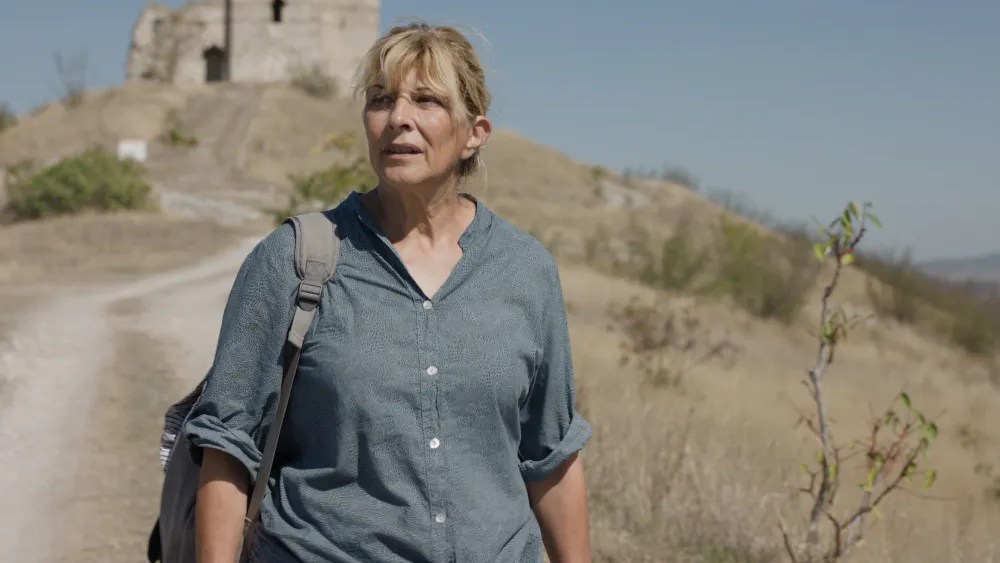
Having ridden into town with a lone tough guy with a mysterious past, whose name is Said, something curious happens — he goes missing, and instead we follow a friend from his youth, Veska. She’s an archaeologist, who has returned to her home town to excavate some ruins from an ancient civilization.
It is through Veska’s eyes that we see the town and its array of battered characters eking out an existence on the margins of a transnational economy that has passed them by, just as the town has been sidelined by a new highway connecting Europe with Turkey.
Maria, played by Denislava Yordanova, and Veska, played by Yana Radeva, in “The Dreamed Adventure”
Courtesy of Komplizen Film, Bernhard Keller
In the film, there are two worlds: the world of the night, which is full of dangers and threats, but also the promise of a good time; and the world of the daytime, which is relatively dull and uneventful. In the present-day as in the 90s, men rule the night, but women like Veska — in the 90s — and Maria (a teenage girl she has taken under her wing) — in the present day — find themselves drawn to the allure of the demimonde of the nighttime.
“In the 90s, the night was owned by men, and was dangerous, but I could understand why the women would want to take part in that as well, to party and have fun in a world of power relations, money and sexuality. To say, ‘I also can go there,’” Grisebach says.
We follow Veska as she digs into the past at the archaeological site by day and by night as she delves into the town’s underworld, much of which is controlled by the local Mafia boss, Iliya.
She had known Iliya during the 1990s, which Iliya refers to as the “Golden Age of Men,” when rival gangs fought for control of the town, and the country at large. But now, she’s no longer scared of him.
Valeska Grisebach
Courtesy of Iris Janke
Although the Western genre is an ever-present influence, Grisebach subverts some of its tropes. The expectation, for example, is that there will be a duel, she says. Everything leads us to believe that Veska and Iliya will duke it out or that Said will ride in to save the day, like a latter-day Shane. But no, in this film, words are the ammunition, not bullets, and truth is what is at stake, not the ranch.
“The genre is asking for conflict, but for me it was more interesting to address ideas about who is strong and who’s weak. Who is on top and who is on the bottom? Who is, to speak frankly, fucking, and who is being fucked?” Grisebach says.
There is an ambivalence toward the wild period of the 1990s in the film. “It was full of these expectations for democracy and capitalism,” Grisebach says. A lot of people dreamt of setting up their own business. “People told me, ‘We were all dreaming of being a millionaire.’ They thought, ‘I can be somebody,’ but a lot of people didn’t succeed in becoming somebody,” she says.
Nostalgia for this troublesome decade was more common among the men. “These moments of remembering [the 90s] were like getting drunk,” she says.
“The Dreamed Adventure” is produced by Komplizen Film in co-production with Grisebach, Kazak Productions (France), Miramar Film (Bulgaria), Panama Film (Austria), New Matter Films (Germany), ARTE France Cinéma and ZDF/ARTE, and in collaboration with ARTE France. The producers are Jonas Dornbach, Janine Jackowski and Maren Ade for Komplizen Film. The Match Factory is handling world sales.

Leave a Reply