

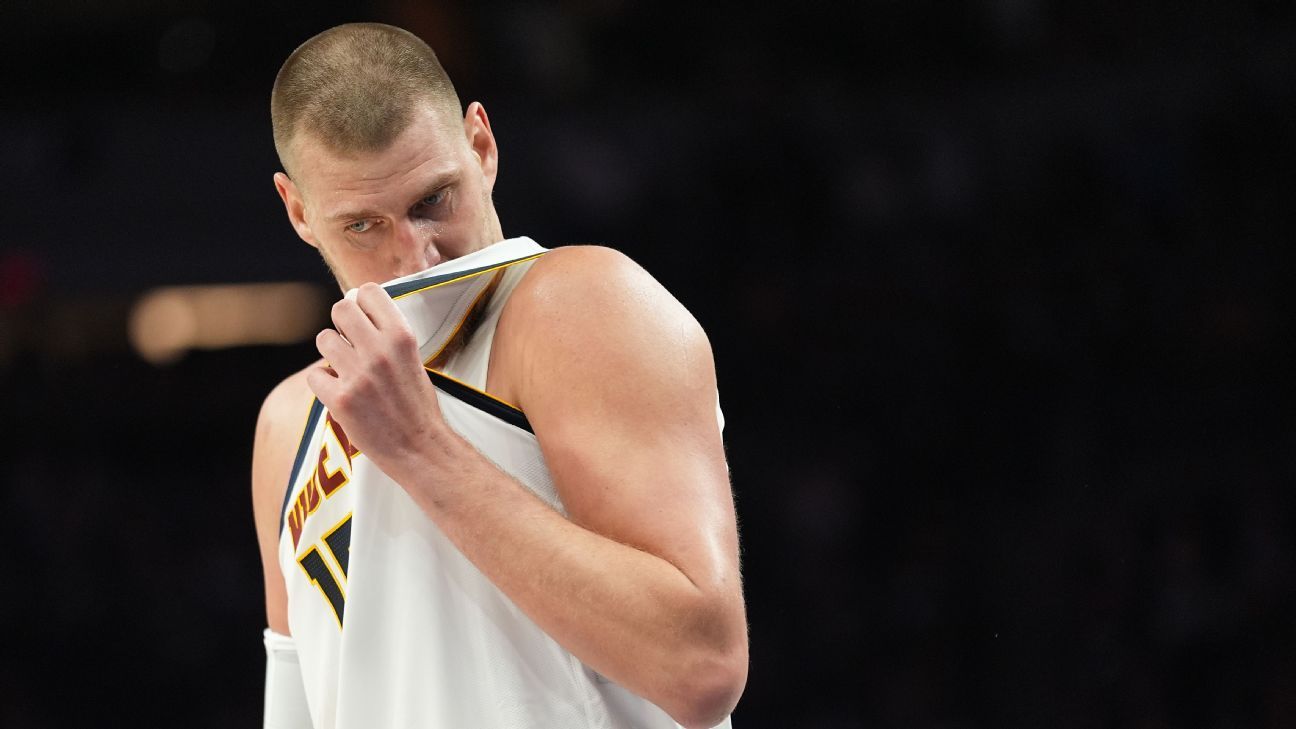
MINNEAPOLIS — In what was statistically the worst shooting night of his playoff career, Nikola Jokic missed 19 of his 26 shots in Thursday night’s Game 3 and the Denver Nuggets, whom he led to an historic offensive season, failed to reach 100 points for the first time since January.
“I’ve never seen him shoot what he shot today,” guard Jamal Murray said. “That’s an outlier type of game.”
It resulted in the Minnesota Timberwolves running away with a 113-96 win, stomping the Nuggets into a 2-1 series deficit as pressure mounts on Jokic to solve Rudy Gobert and the Minnesota defense before Denver’s season expires.
“They’re big, tall, long,” Jokic said. “They’re really good defensive players.”
The Nuggets had control of this series through five quarters. They won Game 1 and sprinted out to a 19-point first half lead in Game 2. But the Timberwolves responded with an 11-0 second-quarter run when Jokic first hit the bench and have completely flipped momentum since.
Jokic had a chance to close out the Timberwolves in Game 2, but the Nuggets were outscored by 10 points in the final seven minutes and Jokic missed six of his seven shots, leading to a Timberwolves escape. In total, he went 1-of-8 against Gobert in Game 2, and that ineffectiveness followed him to Minnesota.
Jokic and the Nuggets went 3-of-21 shooting in an 11-point first quarter, their lowest-scoring quarter of the season. Minnesota built a near immediate double-digit cushion, upped their lead to 27 points and never let it slip below 10 in the final three quarters.
“When you open the game like that, the easy ones don’t go,” Jokic said. “Really good defensive [first] quarter by them, really bad offensive quarter by us.”
The Nuggets finished the regular season with an NBA-best 121.2 offensive rating, the second-highest in NBA history. They failed to score 100 points in only two of 82 games, and Jokic was sidelined in both of them.
This was the first time in Jokic’s career that he attempted at least 26 shots in a game and made only seven or fewer of them. He also had four turnovers and three assists, the first time all season he had more turnovers than assists in a game.
“He had a tough night,” Nuggets coach David Adelman said. “It happens to players. This guy’s played a million playoff games. There’s nights that are poor. He’ll bounce back. Everyone needs a day to understand we didn’t play well offensively.”
Jokic is 5-of-24 on 3s in this series and his offensive co-star didn’t provide much reprieve. Murray made only five of his 17 shots and missed all five of his 3s. He’s 15-of-42 in the two Nuggets losses.
In the aftermath, Adelman and Murray pointed to the team’s weak screen-setting as a factor in this abnormally bad offensive night.
“I think to get [the role players] going, they have to screen better,” Adelman said. “If you can free up your best players, that’s gonna bring rotations. That’s gonna bring a low man. That leads to ball movement 3s.”
Gobert was Jokic’s primary defender for a majority of the night with Minnesota coach Chris Finch mirroring their minutes. Jokic went 7-of-21 against Gobert and is now a combined 8-of-29 against him in the two Nuggets losses.
Jokic played a career-low 65 games this season, missing a chunk of time because of a hyperextended knee while also battling a wrist issue. After the game, he was asked how he felt physically.
“Feeling good,” Jokic said. “Feeling good.”
But the Nuggets have other injury troubles. They’ve been without fourth-year wing Peyton Watson since April 1 because of a hamstring strain and ruled out starting wing Aaron Gordon two hours before tip-off because of a sudden calf issue.
Jokic said he knew “two days ago” that Gordon wouldn’t be able to play in Game 3, but the Nuggets initially listed Gordon as probable and Adelman said they installed two separate gameplans on Thursday because they didn’t know if Gordon would or wouldn’t get the green light.
Watson is trending in a positive direction. He had court workouts after Thursday morning’s shootaround and pregame. Watson and Gordon will get treatment on Friday before the team determines their status for a pivotal Game 4.
“I do think out of fairness to the team we do want to know who is going to play that next game,” Adelman said. “It just helps you because guys know the expectation of what’s going to be that night, as opposed to today when we were scrambling a bit.”




Leave a Reply