

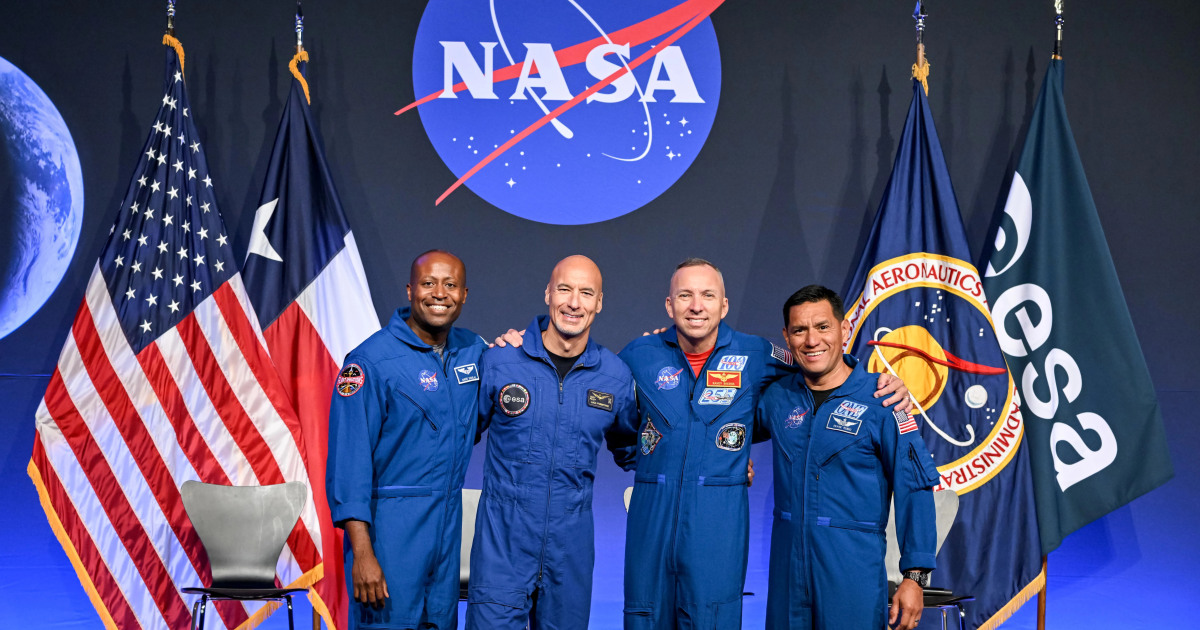
When NASA’s Artemis III mission launches next year, the crew won’t include any women — a revelation that sparked controversy after the agency on Tuesday announced the four astronauts selected for the flight.
Subscribe to read this story ad-free
Get unlimited access to ad-free articles and exclusive content.

“Not a single woman flying on Artemis III is an insane choice,” Alexandra Doten, a space influencer who goes by Astro Alexandra, posted on X on Tuesday.
NASA Administrator Jared Isaacman attempted to address these criticisms head-on Wednesday.
“I have seen reactions ranging from disappointment to outrage,” he said in a statement.
Isaacman said that some astronauts may not have been selected for the Artemis III flight because they are already on tap for expeditions to the International Space Station or because their training and skill sets make them more suitable for future Artemis missions, during which astronauts are expected to land on the moon.
“The Astronaut Office assigns the crew that gives the mission the best chance of meeting its objectives, taking into account many factors, including the background and expertise of the astronauts, such as test pilot experience, development work on specific programs, and availability,” he said.

The crew members unveiled Tuesday are NASA astronauts Randy Bresnik, Frank Rubio and Andre Douglas and European Space Agency astronaut Luca Parmitano. Their mission, slated to launch no earlier than summer 2027, aims to test two commercially built moon landers that could transport astronauts to the lunar surface on the Artemis IV mission in 2028. The tests are set to take place in Earth orbit, where the Artemis III crew will spend about two weeks.
SpaceX and Blue Origin are each building one of those landers, and the Artemis III mission is designed to demonstrate rendezvous and docking operations between NASA’s own Orion capsule and the new vehicles.
For Artemis IV the following year, NASA plans for one of the landers to meet up with the Orion spacecraft (which carried the Artemis II astronauts on a 10-day flight around Earth and the moon in April) in orbit around the moon. The lander would then transport astronauts to the lunar surface. To conclude the mission, the lander would launch back off the moon and dock again with Orion, which would fly the crew back home to Earth.
NASA has promised since 2023 that it will land the first woman and the first person of color on the moon during the Artemis program. However, the agency removed that language from some of its websites last year, a move that appeared tied to President Donald Trump’s push against diversity, equity and inclusion.
Isaacman said NASA’s crew selection process “does not involve any political appointees,” an explanation likely intended to assuage questions about whether the Trump administration had any influence over the decision.

It is possible that NASA is saving its most experienced female astronauts for the Artemis IV mission to the moon, but that crew has not yet been announced.
The agency has no shortage of female astronauts. Out of NASA’s 37 active astronauts eligible for flight assignments, 15 are women. Last year, when NASA announced its newest class of 10 astronaut candidates, the majority were women for the first time in history.
Jasmine Singh, an astronomy doctoral student who goes by @astro_jaz on X and has nearly 105,000 followers, wrote that the all-male Artemis III crew was a “huge blow” to anyone who was inspired by NASA astronaut Christina Koch during Artemis II.
“The people who aren’t upset about there being no women on artemis iii don’t understand what it means to see someone who looks like you accomplishing something so special especially after being put down for centuries,” Singh wrote.
In his statement, Isaacman wrote: “The Artemis III astronauts are experienced, qualified, and deserve to be celebrated for the mission they have been assigned, just as the crews that follow will be celebrated when their time comes. We have an extraordinary astronaut corps, and every mission and every crew is part of a larger campaign to get America back to the Moon and to build the future we all dreamed about as children.”
For the Artemis III flight, Bresnik will be the mission’s commander, with Parmitano serving as the pilot and Douglas and Rubio acting as mission specialists. NASA astronaut Bob Hines will train with the crew as a backup member.













Leave a Reply