

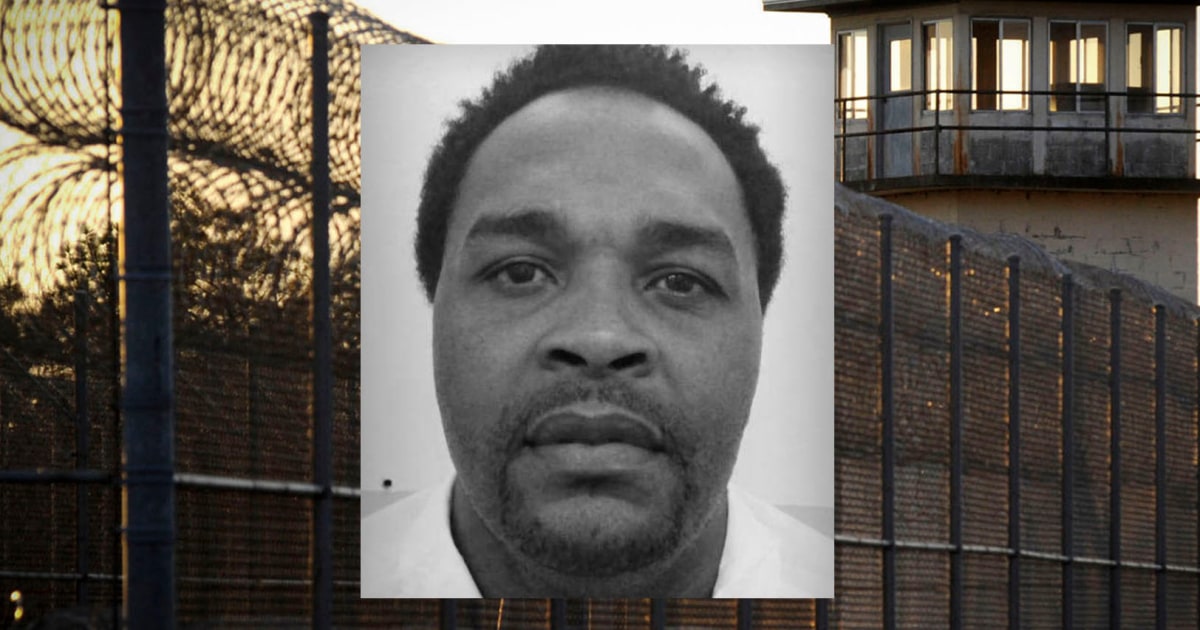
A death row prisoner whose planned execution on Thursday was suddenly halted became emotional when he learned that a federal court had ruled Alabama’s use of nitrogen gas violates the constitutional ban on cruel and unusual punishment.
Subscribe to read this story ad-free
Get unlimited access to ad-free articles and exclusive content.

“It’s like an expected sigh of relief in one aspect, and then you still got to stay and maintain your focus and continue to fight,” Jeffery Lee, who has been on death row for nearly three decades, told NBC News by phone Tuesday. He spoke from the William C. Holman Correctional Facility in Atmore, Alabama, moments after a district court judge agreed to stop his execution.
“Fear not, I am not finished, and just, you know, to me, my faith is everything,” Lee, 49, said.

Despite the ruling, his fate remains uncertain: State Attorney General Steve Marshall has filed an appeal, likely sending the case up to the Supreme Court, which has previously sided with Alabama by allowing nitrogen executions to proceed after last-minute appeals. Marshall’s office declined to comment Wednesday.
Lee was scheduled to become the ninth person in the country put to death via nitrogen hypoxia, which was pioneered by Alabama in 2024 and entails breathing pure nitrogen through a mask while being denied oxygen. Seven of those executions took place in Alabama; one was carried out in Louisiana. Alabama’s primary method of execution remains lethal injection, which it last carried out in April 2025, but sourcing the drugs has been difficult in the last several years.
Lee filed a lawsuit challenging nitrogen use last August.
During a three-day bench trial in February, U.S. District Judge Emily Marks heard testimony that nitrogen executions cause “severe air hunger” for the condemned, leading to “extreme emotional distress, panic, anxiety, and fear.”
“Indeed, many people find air hunger ‘worse than pain’ because it is associated with the fear of dying,” she wrote in an opinion in May.
Even so, Marks initially upheld the method as constitutional.
But the 11th Circuit Court of Appeals overturned her decision Monday and ordered the district court to review Lee’s request to be executed by firing squad instead. In response, Marks permanently blocked the state on Tuesday from executing Lee by nitrogen.
In his appeal, Marshall pointed to challenges the state would face by implementing the firing squad — including finding five willing shooters and the possibility that any shots fired could miss a target placed over the heart, resulting in more pain for the condemned.
“An inmate facing the firing squad might be quickly dispatched or, like Mikal Mahdi in South Carolina last year, he might suffer the pain of being shot multiple times in the chest due to poor aim,” the appeal said.
Witnesses to previous nitrogen executions in Alabama have described the condemned in apparent agony during the executions. They watched as prisoners struggled against the restraints that held them to the gurney while gasping for air.
A media witness to the last nitrogen execution in October described a prolonged process; the prisoner, Anthony Boyd, was not declared dead until 30 minutes after the air started flowing.
Lee expressed grief over the experience of those who were executed before him through a method that has now been found unconstitutionally cruel.
“I was raised up around those guys, because when I first got to the row, I was 23 years old, just turning 24,” he said. “What we heard they went through, man, it’s like losing a family member.”

Lee was found guilty in 2000 of the murders of Jimmy Ellis and Elaine Thompson, and the attempted murder of Helen King, during a robbery west of Montgomery.
On Dec. 12, 1998, Lee visited Jimmy’s Pawn Shop with his brother and cousin, saying he was looking at wedding rings for his girlfriend. After browsing, he said he didn’t have money on him and left. Minutes later, he re-entered the store with a sawed-off shotgun, shooting and killing Ellis and Thompson and wounding King, authorities said.
A jury sentenced Lee to life without parole, but a judge set aside that decision and sentenced him to death, a practice known as “judicial override” that was outlawed in Alabama in 2017.

Lee has expressed remorse for the slayings and said he believes he has found redemption in the years since, through his devotion to Christianity.
“I don’t fear dying, and nothing like that, because I know where I would be,” he said, referencing heaven.
He said he hopes his legal win will prevent others from being executed with nitrogen.
“God — he’s not finished,” he said. “He’s still working, not only on my behalf, but on the other brothers’ behalf that are still facing this situation.”
While nitrogen gas executions in Alabama have been blocked by this ruling, the future of the method will remain unclear until the Supreme Court settles the issue, said Robert Dunham, director of the Death Penalty Policy Project, an independent research program and a special counsel at the nonprofit law firm Phillips Black, which provides post-conviction legal representation. The Supreme Court last denied an Alabama prisoner’s request to halt his nitrogen execution in October.
Dunham said that if Lee’s case ends up before the Supreme Court and the state attorney general gets his way, the lower court’s ruling could be upended. That would mean Lee’s execution could still move forward.
Alternatively, he said, the high court could allow it to remain on hold while justices review the lower court’s decision during their next session.
Another long-shot possibility, Dunham said, is that Alabama Gov. Kay Ivey commutes Lee’s sentence to life in prison. While she has overseen 25 executions over her nine years as governor, Ivey has twice commuted death row inmates’ sentences, most recently in March.
But a spokesperson for Ivey said Wednesday that the state’s intentions with Lee have not changed.
“As Alabama continues to defend its execution protocol in the courts, the governor remains prepared to move forward with the planned execution,” the spokesperson said in a statement.
No matter what happens, Dunham said, the federal court’s ruling that nitrogen gas executions are unconstitutional remains significant.
“They looked at the evidence to determine a judicial finding of fact that validates what critics of the death penalty have been saying about how torturous gas executions are,” he said. “Whether or not it’s upheld on the law won’t affect that fact.”
Alabama lists two other methods in its execution protocol: lethal injection and electrocution. In her opinion Tuesday, Marks said her ruling may not spare Lee from either of those methods, or the firing squad should Alabama decide to legalize it.
“The Constitution does not guarantee a painless death, and human life cannot be purposefully extinguished without some risk of pain,” Marks wrote. “The Court, the condemned, and the State must all confront that sobering reality.”
But attorney MiAngel Cody, a member of Lee’s legal team, said she believes Lee’s execution, at least via nitrogen gas, “is too flawed to move forward.”
“We remain hopeful that Governor Ivey will grant clemency,” Cody said in a statement Wednesday.










Leave a Reply