

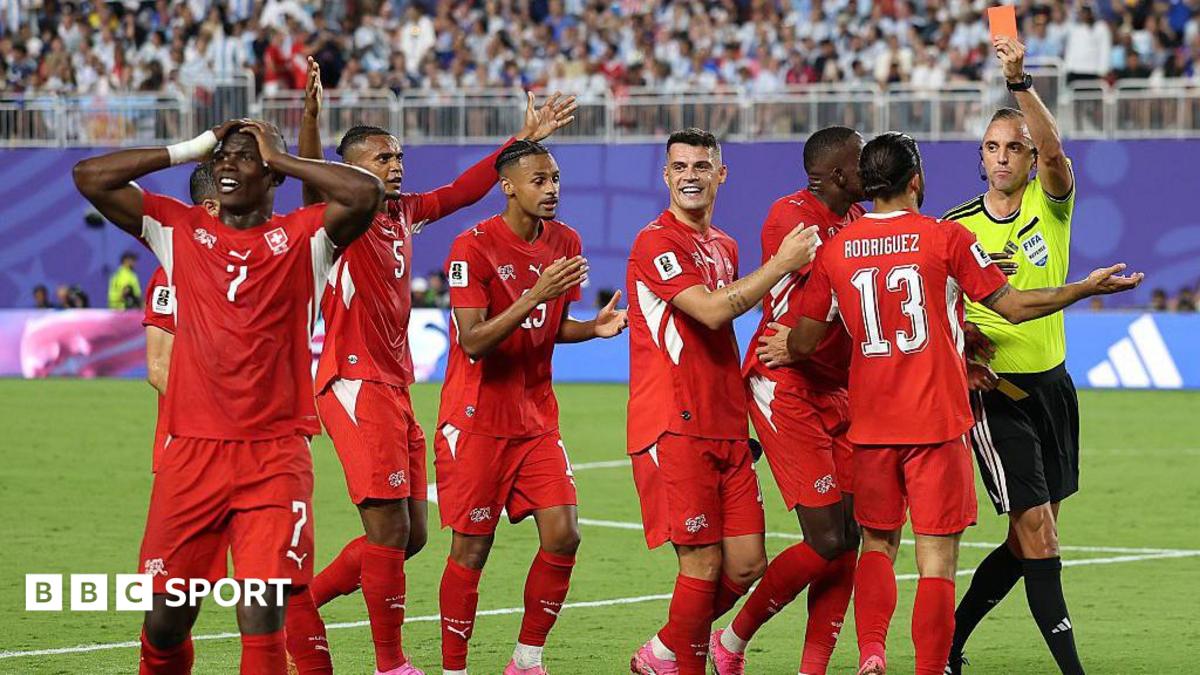
The VAR decisions against Almiron and Embolo proved popular among many supporters, who felt it showed a willingness to try to eradicate diving.
Yet BBC Sport has spoken to a number of domestic leagues who said the use of mistaken identity for simulation had not previously been mentioned, and it came as a complete surprise.
There was a great deal of concern about the potential impact at club level.
One league in particular spoke about how it could cause “chaos”, with every yellow card reviewable for potential simulation.
There were other concerns, too, about the additional pressure it would place on officials for their initial decisions.
It would create a two-tier system, whereby simulation could only be reviewed if a yellow card had been shown.
If a team were to concede a goal from a free-kick, where the opponent embellished contact but there was no booking, there would undoubtedly be more controversy about the role of the VAR.
As officials gathered at matches for the opening qualifying rounds of European competition this week, Uefa told its VARs they should only use the new law in true cases of mistaken identity.
In briefings before the World Cup, Pierluigi Collina – Fifa’s head of referees – had used an example from the Euro 2016 final.
Referee Mark Clattenburg gave a free-kick to Portugal on the edge of the area, with France defender Laurent Koscielny booked for handball, although Portugal striker Eder had used his arm.
In this case, Fifa said the VAR could intervene and give the free-kick to France.
At no stage in the briefings or news conferences over several months had simulation been referenced – even though it would be the most obvious intended use.
Uefa believes mistaken identity is a purely factual decision which does not require the referee to go to the monitor.
Changing from a foul to simulation is subjective and, in the cases of Almiron and Embolo the referee did have to visit the screen.
Therefore, Uefa believes simulation is not mistaken identity.
As the VAR can now intervene on incorrect second yellow cards, it would be possible to punish diving if the player who committed the foul is sent off for two bookings.
Simulation can also be penalised if it results in an incorrect straight red card or a penalty.
Uefa will check incorrect corners but, unlike at the World Cup, this will not include a potential offside in the build-up and will only apply to the last touch.
European football’s governing body has already rejected the option to intervene to issue red cards if a player covers their mouth in a confrontation, with Almiron and Ecuador’s Piero Hincapie sent off for doing so at the World Cup.
The head referees from Uefa’s 54 member nations are due to hold a summit next week to discuss all aspects of VAR use.
Mistaken identity will be among the topics, and BBC Sport understands the domestic leagues are likely to follow Uefa and only use it as a factual review.
The Ifab was not willing to discuss the interpretation of the law when contacted.
Leave a Reply