

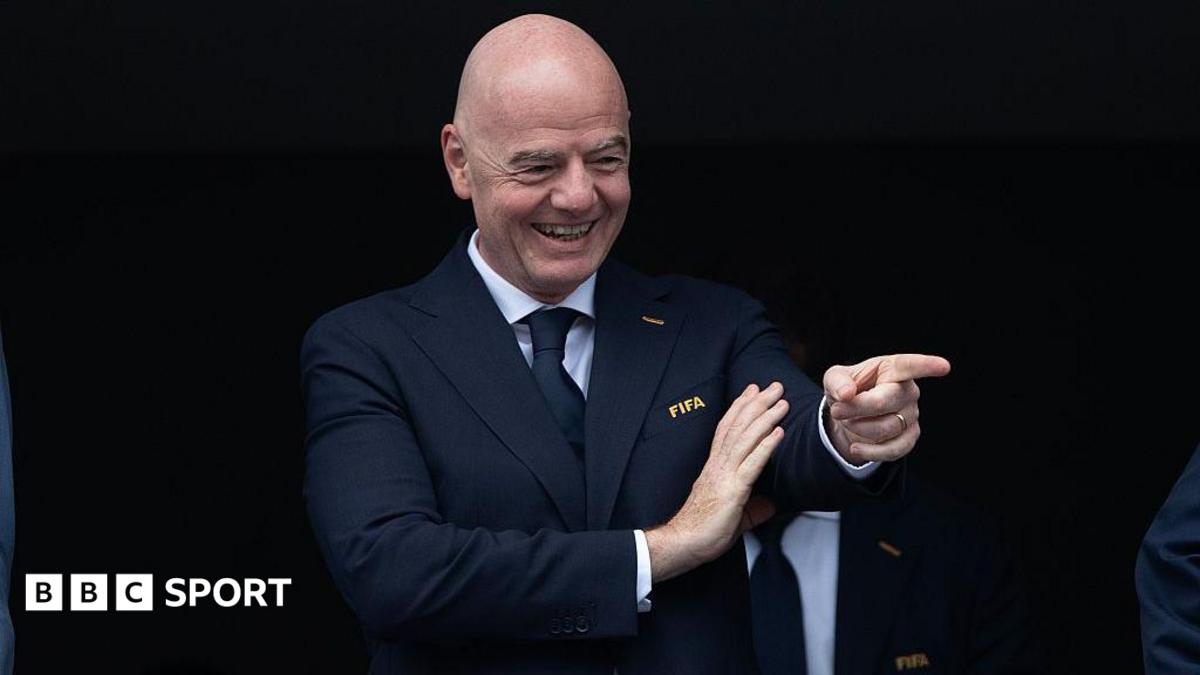
Uefa laid down new battles lines on Tuesday, when voicing strong opposition to the Balogun decision.
European football’s governing body said Fifa had “crossed a red line” and described it as an “unprecedented, incomprehensible and unjustifiable decision”.
But this was not the first time Uefa has crossed swords with Fifa.
In May 2025, Uefa president Aleksander Ceferin led a group of European delegates in staging a walk-out during a break at the Fifa Congress.
Infantino had been on a diplomatic tour of the Middle East alongside Trump and arrived two hours 17 minutes late.
Uefa has looked to score political points during the World Cup, too.
No sooner had Artan landed at home in Somalia last month than Uefa announced he had been invited to referee the Uefa Super Cup between Paris St-Germain and Aston Villa on 12 August.
And throughout this year, Uefa has been eager to point out how cheap Euro 2028 tickets are compared to the World Cup. It will not introduce hydration breaks, or red cards for players who cover their mouth.
Infantino, remember, came from Uefa. For many years he was the man who presented the Champions League draws.
He may not quite be persona non grata there these days – he gave a speech at the Uefa Congress in February – but there is clear friction.
Taking all this into account, Infantino’s position must surely be in doubt?
On the contrary. Infantino is popular with many federations around the world – and a lot of that is down to Fifa’s development of the game.
Infantino’s Fifa Forward programme has funded football projects across the globe, and he has created opportunities through the expanded World Cup.
Sixteen extra nations now qualify – the vast majority from the confederations with less depth. Europe only got three of the additional spots.
This World Cup has shown that, below the top level, Asia and Concacaf have a lot of work to do to be competitive.
But Infantino has provided the dream, the hope that nations who never before could play at the World Cup might just get there. Like Cape Verde, Curacao, Jordan and Uzbekistan.
Despite all the criticism over the 48-team format, it gave Cape Verde the chance to live their dream.
And it will allow less traditional football nations to grow their game and get stronger – and surely that is a positive for football around the world?
The catch?
Tournaments like the World Cup, and the huge ticket prices, pay for these projects.
This year, Fifa is expected to bring in $9bn (£7.9bn)
Uefa may oppose much of what Fifa and Infantino stand for, but European football is the rich man of the game. Largely, it can fund itself.
The rest of the game depends on Infantino and the money Fifa generates.
There are 211 countries within Fifa. Each gets a vote on the presidency, with 106 needed to win an election.
Let’s look at the maths.
In April, Conmebol – the South American confederation – said its 10 countries would back Infantino.
Three weeks later, the Confederation of African Football (Caf) confirmed unanimous backing from its 54 member associations.
Shortly afterwards, the Asian Football Confederation’s 47 nations followed suit.
Infantino already has 111 votes. He cannot be beaten.
Even if Uefa thought it could muster a candidate capable of mounting a challenge, the race is already run.
Infantino was re-elected unopposed in 2019 and 2023. It would take something truly remarkable for anyone to stand against him, let alone beat him in 2027.
Leave a Reply