

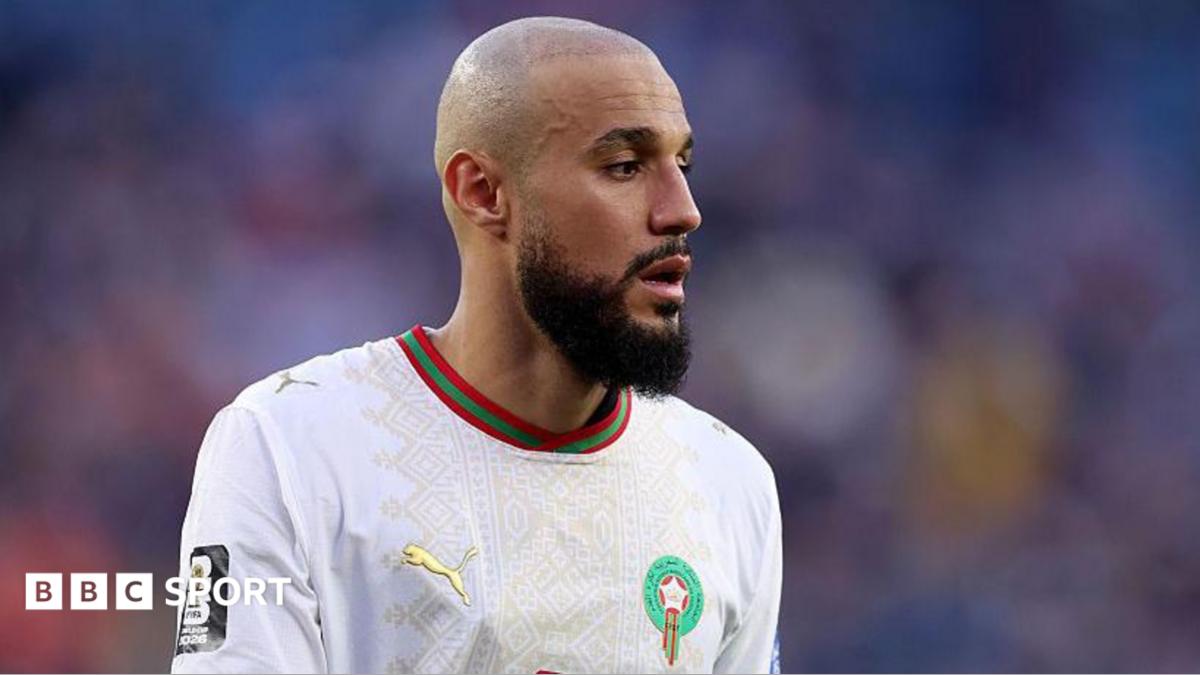
Reducing the modern shift to politics alone would miss the point.
For many dual-national footballers, the decision has always been deeply personal – shaped by family, culture and opportunity as much as passports or public debate.
But the relationship between the Dutch and Moroccan football federations has fundamentally changed.
The scale of that change is remarkable.
Almost one in every four players at World Cup 2026 was born outside the country they represent. Eight of the tournament’s 48 squads have at least as many players born abroad as in the country, illustrating how modern international football increasingly mirrors patterns of migration.
Few nations embody that evolution more than Morocco.
Nineteen of Mohamed Ouahbi’s 26-man squad were born outside the country. During the group-stage draw against Brazil, Morocco became the first team in World Cup history to field an entire starting XI born abroad.
It is no accident of demographics.
More than a decade ago, the Royal Moroccan Football Federation began investing heavily in identifying dual-national talent across Europe. Scouts were deployed throughout France, Belgium, Spain and the Netherlands – not merely to monitor promising youngsters but to strengthen links with them and their families long before senior international football entered the equation.
Former Morocco technical director Pim Verbeek later explained that recruitment extended far beyond the player. Family, he argued, often played as important a role as football in shaping a player’s decision.
The policy reshaped Morocco’s international fortunes. By the 2018 World Cup, five members of their squad had been born in the Netherlands. Four years later, when Morocco became the first African nation to reach a World Cup semi-final, they had 14 foreign-born players in their 26-man squad.
Change rarely happens all at once. In the years after Boussatta, players such as Khalid Boulahrouz and Ibrahim Afellay still chose the Netherlands – attracted by the prospect of competing for one of international football’s traditional powers.
At the same time, Morocco was steadily reshaping its approach – forging close ties with dual-national players long before senior call-ups became a reality.

Leave a Reply