

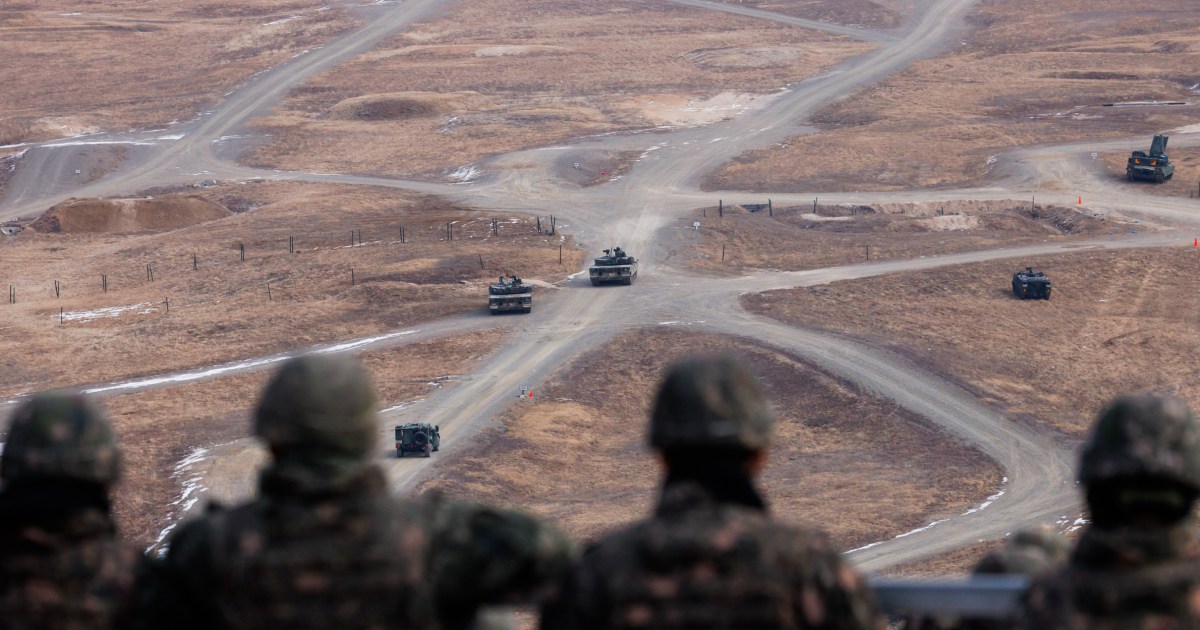
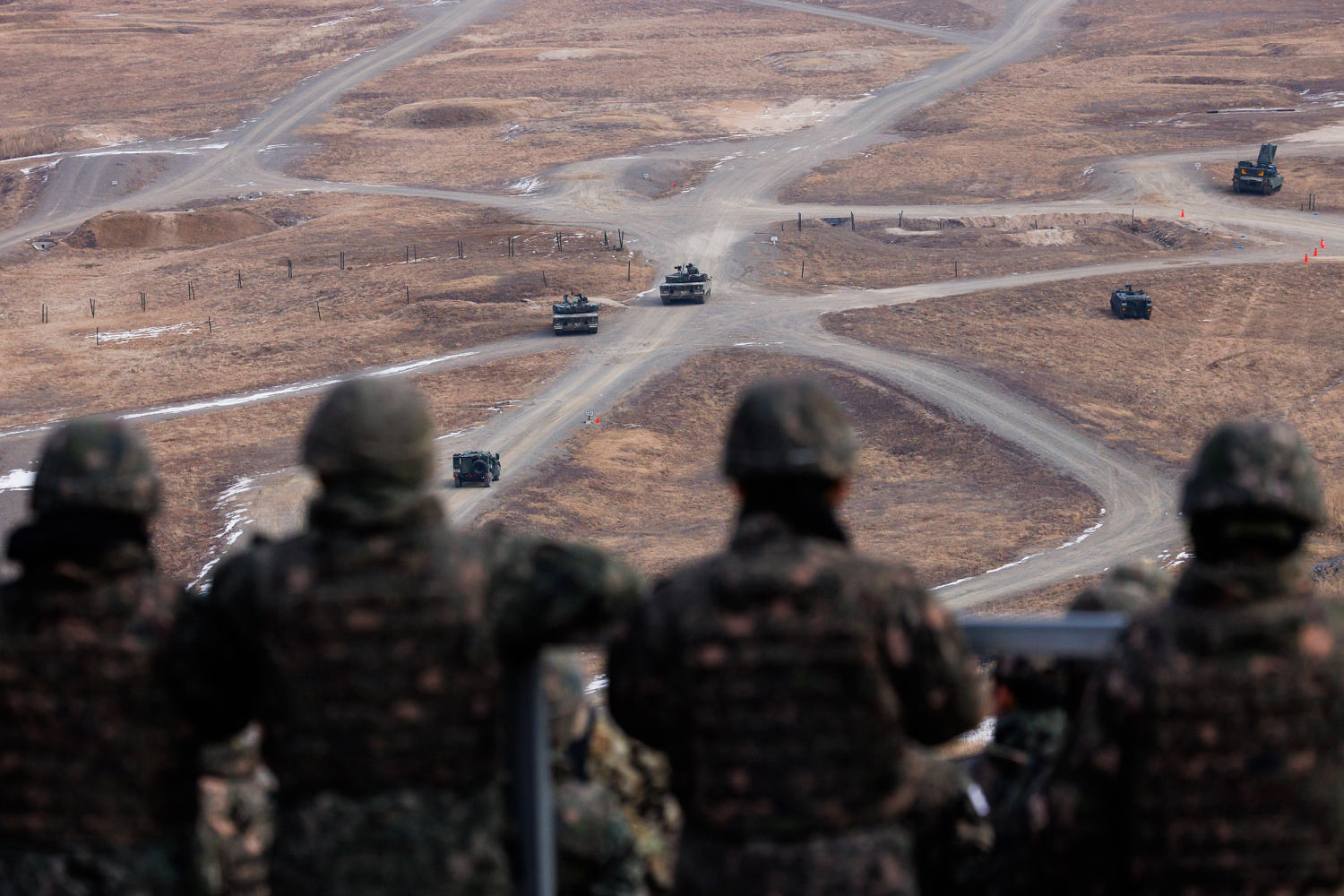
South Korea said Wednesday that joint military exercises currently underway with the United States were being scaled back after President Donald Trump, citing his “very good” relationship with North Korean leader Kim Jong Un, ordered that they be reduced.
The surprise comments by Trump, which came hours before the exercises began Monday, have unsettled South Korea, which relies heavily on the U.S. for its security, as well as other U.S. allies in the region facing a growing threat from nuclear-armed North Korea.
The annual U.S.-South Korea drills, known as Ulchi Freedom Shield, will now end on Aug. 21 rather than Aug. 27 as originally scheduled, the South Korean Ministry of Defense said.
00:41
Trump orders reduction of joint exercises with South Korea
00:0000:00
The two allies “have agreed, at the request of the U.S. side, to make some adjustments to the duration and scale of the exercise,” the ministry said in a statement.
Some of the combined field training exercises will also be conducted on a reduced scale, the ministry said, adding that the U.S. and South Korea “are currently consulting on the specific details.”
The ministry also said the ROK-U.S. Combined Forces Command, a joint war headquarters made up of the South Korean military and U.S. Forces Korea, was conducting the exercise with its wartime command posts divided between Command Post Tango, the two militaries’ main wartime command center, and Camp Humphreys, a U.S. military base south of the South Korean capital, Seoul.
“Going forward, the ROK and the United States will discuss and implement various measures to achieve the objectives of the UFS exercise and maintain a robust combined defense posture,” the ministry said, using an abbreviation for South Korea’s formal name, the Republic of Korea.
The ministry declined to comment on a reported meeting Tuesday between Gen. Xavier Brunson, the commander of U.S. Forces Korea, and South Korean Defense Minister Ahn Gyu-back.
The White House did not immediately respond to a request for comment.
According to U.S. Forces Korea, the annual Ulchi Freedom Shield exercise with South Korea, which hosts 28,000 American troops, aims to build understanding between the two militaries to ensure their “ability to fortify the combined defense posture” and enhance their response to “a spectrum of security threats.”
Foremost among those threats is North Korea, a nuclear-armed state that in recent years has advanced its missile and nuclear capabilities and developed a close security relationship with Russia.
Though the U.S. and South Korea say their drills are defensive in nature, North Korea routinely criticizes them as a rehearsal for invasion and often test-fires weapons in protest.
In a social media post on Sunday, Trump said the exercises sent a “totally inappropriate and hostile” message to North Korea, which he said had been “unthreatening and respectful” during his time in office.
He also expressed anger over South Korea’s level of involvement in the U.S.-Israeli war with Iran, and said he had ordered Defense Secretary Pete Hegseth to “substantially reduce” the exercises.
Trump, who met with Kim three times during his first term as president, has repeatedly expressed interest in resuming talks after their earlier round of diplomacy collapsed in 2019. But Kim, whose position has strengthened considerably since then, has rebuffed overtures from Trump as well as South Korean President Lee Jae Myung.
Trump told reporters on Monday that he was not sacrificing the security of U.S. allies to curry favor with North Korea, and that he was “actually making it much safer.”
He said Kim had responded to his outreach, without providing details. “I understand him; he understands me,” Trump said.
North Korea has not publicly responded to Trump’s comments, but a commentary published Wednesday by state-run news agency KCNA reiterated the regime’s criticism of the exercises, saying Pyongyang’s “exercise of its right to self-defense will continue to completely neutralize the enemies’ military threat.”

Leave a Reply