

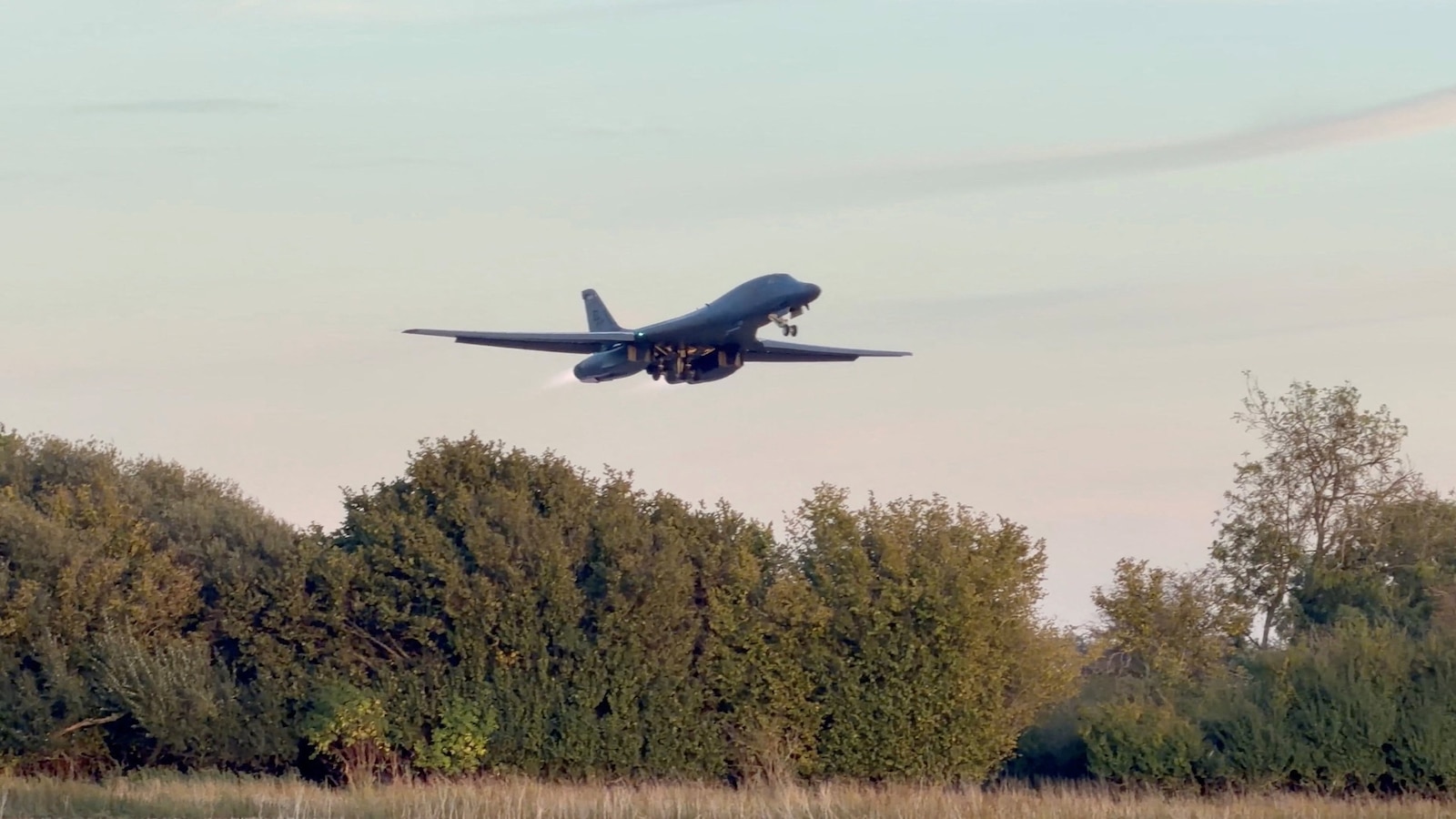
The U.S. has pulled its heavy bombers from a British air base used to launch strikes against Iran, a move President Donald Trump said Monday was prompted by a direct threat to the installation as authorities investigate a suspected plot to attack it.
At least a dozen B-1 bombers were flown from RAF Fairford back to their home bases in the U.S. in recent days, according to the Pentagon, which did not specify what prompted their departure.
A source familiar with the situation said “vigilance is high” at other U.S. bases in Europe following the suspected terror plot uncovered last week and that security could be increased at some military installations.

A U.S. B-1 bomber taxis to the runway to depart for home at RAF Fairford on Oct. 4, 2026, in Fairford, United Kingdom.
David Brown/Getty Images
Trump told reporters as he was leaving the White House there was a threat to the aircraft in the United Kingdom, so he made the decision to swiftly remove them.
“We know who made the threat,” the president said. Asked about the nature of the threat, or whether the U.S. assessed Iran posed a potential drone threat to U.S. assets in Europe, Trump said he was unable to answer the question.
Vice President JD Vance pointed to Iran while explaining the administration’s rationale for moving the bombers back to their home bases in the U.S., framing the move as “out of an abundance of caution.”
“We do feel with some confidence that the Iranians are, you know, they’re trying to do what the Iranian state has done for 49 years, which is engage in acts of terrorism against the United States and against a lot of other people as well,” Vance told reporters Monday. “So we are being extremely cautious, and that’s all I’d say about that.
Secretary of State Marco Rubio, however, characterized the aircraft movement as a “regular rotation” and said he “wouldn’t directly tie” it to the suspected plot involving RAF Fairford.
“[I]t’s not unusual to see rotations happen and movement of assets to different parts of the world based on exercises, redeployments, people changing out and new people coming in, new planes coming in, old planes going out,” Rubio said.
But another source familiar with the situation said that the B-1s’ departure was not a scheduled rotation.

Police officers guard an area as roadblocks remain in place near RAF Fairford airbase in Fairford, Gloucestershire, U.K., on Sept. 29, 2026.
Toby Shepheard/Reuters
The U.S. still retains significant ability to strike Iran, with warships, aircraft and some 50,000 troops positioned across the Middle East. American attacks on Iran have relied heavily on precision-guided weapons, while heavy bombers bring the ability to carry large payloads over long distances and strike multiple or heavily fortified targets.
The move does not prevent the U.S. from using heavy bombers against Iran. The aircraft are built for long-range missions and can reach the Middle East from bases in the U.S. with aerial refueling, but basing them in the United Kingdom shortened the distance to potential targets and could make it easier to launch strikes on shorter notice.

A B-1 bomber takes off from RAF Fairford airbase, as the US removes its B-1 bombers one week after several men were arrested on suspicion of offences under the Explosives Act, in this screengrab obtained from a social media video in Fairford, Gloucestershire, Britain October 4, 2026.
@craigyoungmedia/via Reuters
Returning the bombers from Europe comes after five men were arrested last month on terror charges near RAF Fairford. They were arrested in possession of three vans in the village of Whelford, which is about two miles from the base, which hosts the U.S. Air Force and has since February been serving as a key hub for American operations against Iran.
The five were later released on bail after “extensive interviews,” authorities said.
The suspects, who have not been charged, “remain under investigation as we explore multiple lines of enquiry,” Laurence Taylor, head of U.K. National Counter Terrorism Policing, said on Sept. 28.
Prime Minister Andy Burnham told the BBC News in late September that there were “strong indications” that Iran “played a part in what happened.”






Leave a Reply