

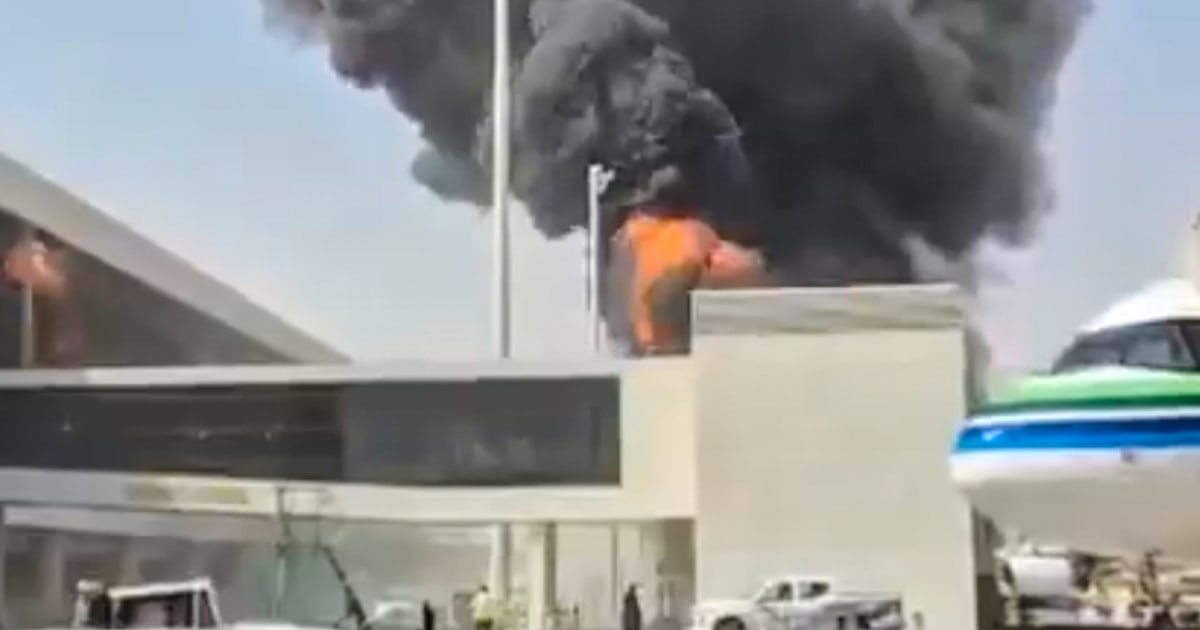
The deadliest attack on a Gulf Arab state since the start of the Iran war raised new questions Sunday about whether the United States might be about to join another conflict in the region.
The missile strike on Saudi Arabia’s main international airport drew widespread condemnation and intensified pressure on the kingdom and its allies to respond to the Iran-backed Houthi rebels. The attack was the deadliest to hit the kingdom in a decade, and marked a sharp escalation in the Yemen-based Houthis’ campaign against the leading oil exporter that has already rattled the global economy.
President Donald Trump indicated it could now prompt America to join the fight, weeks after the conflict between the Houthis and a Saudi-led coalition reignited alongside the unresolved clash between Washington and Tehran.
At least 12 people were killed and 309 injured when the missile attack hit King Khalid International Airport in the capital Riyadh on Saturday, according to Saudi civil aviation authorities. The victims included one American as well as four citizens of Saudi Arabia, two Bangladeshi nationals, an Egyptian, a Jordanian, a Palestinian, a Syrian and one Sudanese.
Some of the wounded were in critical condition, authorities said, while airport operations remained suspended Sunday.
Saudi Arabia’s government and its allies blamed the Houthis for Saturday’s strike. The group did not immediately claim responsibility for the latest attack, although it renewed a warning to stay away from Saudi airports.
Washington also blamed the Houthis for Saturday’s assault, the latest of several in the past week on the busy facility. Three people were killed there in an attack on Thursday.

The attack has placed fresh scrutiny on Washington’s response to the widening conflict, which has seen the Houthis hit Saudi energy infrastructure and seize territory that gives them leverage over shipping in the Red Sea.
Trump said Saturday that the U.S. was considering joining Saudi military operations against the Houthis, leaving open the possibility of direct American involvement.
“We may. We’re gonna look at it,” Trump told reporters. “We just found out about the recent attack. So we’ll make a decision. We move very quickly.”
00:16
Trump responds to potential U.S. involvement after Saudi attack
00:0000:00
The U.S. launched a three-month bombing campaign against the Houthis last year to stop them from targeting shipping through the critical waterway, an alternative to the Strait of Hormuz.
The Saudis will be looking to allies like Pakistan, Turkey, Syria, Egypt and the U.S. for help, said Fawaz Gerges, a professor of International Relations at the London School of Economics.
“But I doubt very much whether there is an answer or even a military solution to the Yemeni conflict,” he told NBC News.
“The Houthis are determined to fight to the end,” Gerges said. “I suspect that the reason why the U.S. has been reluctant is not only because of the Iran war, but also because the U.S tried for several months to force the Houthis to stand down, and they did not succeed.”
At the same time, the Houthis are becoming “more nimble, more resourceful, more deadly by the day, and I think what we have seen in the past few weeks is that the targeting system of the Houthis has become much more effective,” he said.
Egypt said Sunday that it “stands firmly” with Saudi Arabia, expressing “strong condemnation” for the attacks. ” Qatar called the missile strike “a grave violation of Saudi Arabia’s sovereignty and a direct threat to regional security.”
Germany and Canada also condemned the attacks, with Prime Minister Mark Carney describing them as “abhorrent.”
Secretary-General of the United Nations António Guterres blamed the Houthis, calling the attack “a violation of international law.” The Saudi-led coalition fighting the Houthis called the attack a “fully-fledged war crime” and vowed a strong response.
00:13
Houthi strikes on Riyadh airport kill 3 Saudi nationals
00:0000:00
The renewed fighting has developed alongside the broader war involving Iran, with the Houthis stepping up attacks on Saudi territory as Saudi-backed forces battle the group inside Yemen. The latest violence follows the collapse of a truce in July and a renewed Saudi-backed offensive against Houthi positions.
The Houthis have expanded their operations along Yemen’s Red Sea coast and around the Bab el-Mandeb Strait, a critical shipping route connecting the Red Sea to the Gulf of Aden. Disruption there threatens international trade and energy shipments, raising fuel prices and adding another source of instability to global markets.
Trump has focused intensely on energy prices ahead of the Midterm elections, including a diesel deal with the Kremlin that stunned Ukraine. But he has so far resisted deeper involvement in the Middle East.
After sweeping gains by Houthi forces last month, Trump said the group had contacted the U.S. to stress that they “don’t want to fight with us” and would “much prefer not having us involved.”
Saudi Crown Prince Mohammad bin Salman urged Trump in September to take military action against the Houthis, a person familiar with the matter told NBC News.
“There is a whole lot that America can deliver,” said Abdulkhaleq Abdulla, a retired professor of political science from the United Arab Emirates.
“It doesn’t have to be in the form of going all out against the Houthis, but American sharing of intelligence, America providing the best of defense systems against Houthi’s drones and missiles is needed, and I think if that is delivered, Saudi Arabia and the rest can defend themselves,” he said.
Abdulla also called on Turkey and Pakistan to come to Saudi Arabia’s defense. The three nations signed a joint defense agreement in Mecca in August, a pact of Sunni Muslim U.S. allies alarmed at growing regional conflict.
“Now it’s the time to activate what this alliance treaty involves,” added Abdulla. “That an attack on one is an attack against all.”



Leave a Reply