

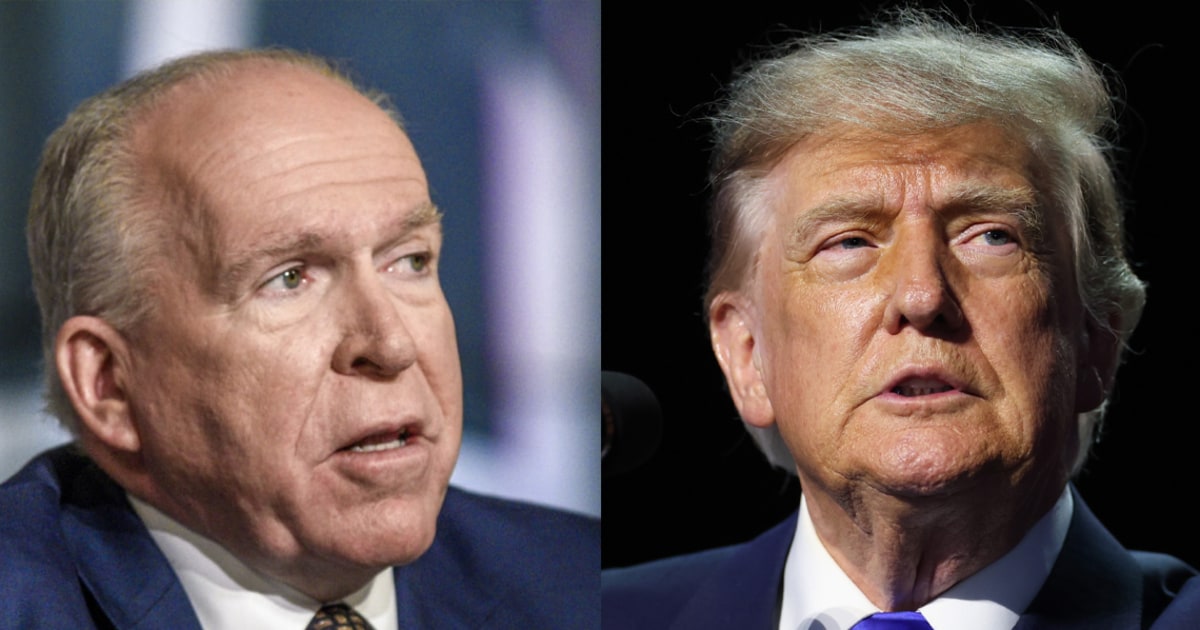
A Trump loyalist heading a “grand conspiracy” investigation into some of Trump’s grievances signed a subpoena seeking testimony from former CIA director John Brennan just before his resignation from the Justice Department last week, his lawyer told a court Monday.
On Sept. 9, Joe diGenova signed the document aimed at Brennan for testimony before a federal grand jury sitting in Fort Pierce, Fla., Brennan attorney Ken Wainstein wrote in a declaration. After Wainstein reached out to diGenova after he accepted the subpoena on Sept. 10, diGenova wrote that he would “arrange counsel” to speak with them. Brennan’s testimony was preliminarily set for Oct. 15.
diGenova resigned later in the day on Thursday. On Friday, Wainstein said, 2020 election denier Kurt Olsen — now part of the prosecutorial team in the Southern District of Florida — told Brennan’s team that there were multiple “viable” grand jury investigations into his client “including a ‘far-reaching’ investigation in Fort Pierce that includes ‘issues at Mar-a-Lago and beyond’ into whether President Donald Trump had his civil rights violated.” Another investigation is running out of District of Columbia, looking into Brennan’s statements before Congress, Olsen confirmed.
“Mr. Olsen explained that Director Brennan was a ‘target’ of the narrower investigation, and the investigation for which he was now being subpoenaed was the ‘more wide-ranging conspiracy,’ as to which our client was a ‘subject.’ However, he explained that the narrower investigation was ‘still viable,’ and that the issues in the narrower investigation might also be part of the larger investigation, such as being overt acts,” Wainstein wrote.
The filing came shortly before Wainstein and co-counsel Daniel Gelber appeared in court on Monday before U.S. District Judge Jia M. Cobb in Washington to argue the judge order the Justice Department to preserve communications about the Brennan case.
Brennan’s team, citing reports of the Trump administration’s widespread use of Signal to conduct official government business, is seeking an injunction to force the government to preserve communications for a potential future argument that the case is a vindictive prosecution driven by Trump. “Director Brennan seeks nothing more than to ensure that the government does what it is already obliged to do — preserve all records and communications relevant to the government’s preordained decision to investigate and prosecute him,” his team wrote in a filing last month.

“The government is not going to disclose what it’s destroying,” Wainstein said in court on Monday. “There’s a lot of really underhanded stuff going on in this investigation.”
Wainstein also said the Justice Department had been playing “games” with the case, and said they were “pretty unprecedented example of judge shopping” by running the federal grand jury probe from the courthouse in Fort Pierce in the Southern District of Florida, where Trump-friendly U.S. District Judge Aileen Cannon is the sole jurist on the bench.
Public officials are operating lawfully and honestly in discharging their official duties and they’re not entitled to regular rules, Wainstein argued.
“If anything, it’s a presumption of irregularity,” Wainstein said.
Wainstein argued that diGenova’s was the “strongest champion” of a case against Brennan — noting diGenova called Brennan a “traitor” a few years ago — and that his departure sent “a very clear message” about the case. diGenova did not answer a phone call on Monday.
Jeremy Newman, an attorney with the Justice Department, argued that the Justice Department conceded that it had a legal obligation to maintain some communications under the Federal Records Act, but that Brennan was making an argument that his constitutional rights were violated, and that he lacked standing to bring the suit given that he had not been charged. If he were charged, Newman said, then he could take those issued up with a judge and seek remedies.
Brennan’s team argued that will be too late, because any Signal messages exchanged about the case will have long disappeared by that juncture. Wainstein suggested Justice Department leaders were using disappearing messages because they don’t want “history to know about what they were saying to one another” about what he called a politically-driven investigation.
NBC News reported in May that the FBI was conducting interviews with current and former CIA officers as part of the investigation.
diGenova told NBC News on Friday that there was a specific event which sparked his departure, but wouldn’t go into details about the matter. “Everybody was in their lane, and then some lanes got crossed, and then I decided to leave,” diGenova told NBC News.
After diGenova’s departure, the investigation is being run by U.S. Attorney for the Southern District of Florida Jason Reding Quiñones with support from Main Justice, according to a person familiar with the matter.



Leave a Reply