

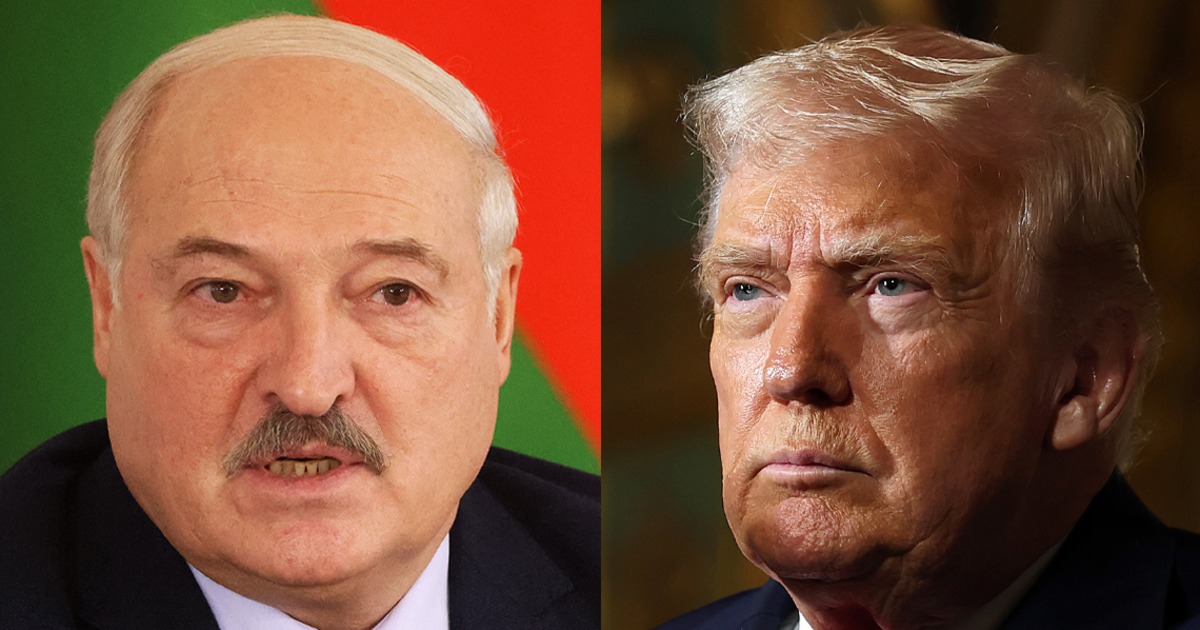
The man known as Europe’s last dictator may soon be coming in from the cold, as President Donald Trump helps him emerge from years of isolation.
Subscribe to read this story ad-free
Get unlimited access to ad-free articles and exclusive content.

Trump thanked Belarus’ President Alexander Lukashenko for his “cooperation and friendship” in a post on Truth Social earlier this month after a deal to release some political prisoners held by his regime, adding: “So nice!”
The U.S. president has also steadily eased sanctions on Belarus’ state institutions and companies, intended to punish Vladimir Putin’s closest geopolitical ally for allowing Russia to use Belarus as a staging ground for his invasion of Ukraine in 2022.
Lukashenko, for his part, has expressed hopes of sealing a “big deal” with the U.S., and could attend a meeting of Trump’s Board of Peace later this year.
For many living under his regime in Belarus, Lukashenko, 71, is anything but “nice.” In power since 1994, he has been accused of flagrant human rights violations against his critics, wiping out opposition and independent media.

The leader, who like Trump is known for his frank style of communication, often refers to himself as “Batka” — or “Father” in Belarusian. He plays ice hockey and has a keen interest in tractors, stemming from his agrarian past.
Lukashenko ruthlessly cracked down on protests in the aftermath of the 2020 presidential election, a vote widely seen as rigged in his favor, in which officials declared Lukashenko received more than 80% of the vote. Ordinary Belarusians who took part in protests were rounded up and prosecuted, landing hundreds in the country’s notoriously brutal jails, while key opposition figures were imprisoned or forced into exile. Some 250 prisoners were released in March in exchange for the easing of U.S. sanctions.
“The regime in Belarus has never been as repressive as it is now, maybe only during the Stalin times,” said Pavel Slunkin, a former Belarusian diplomat who resigned over Lukashenko’s handling of the protests.

Trump’s praise for Lukashenko is “unpleasant to hear,” added Franak Viacorka, chief of staff to exiled Belarusian opposition leader Sviatlana Tsikhanouskaya, Lukashenko’s opponent in 2020.
“We understand that it’s the price for freeing our people,” Viacorka told NBC News on the phone from Poland in late March, when Trump lauded Lukashenko over a deal to release political prisoners. “I think Americans are not naive. They understand well who Lukashenko is,” Viacorka added.
He noted that Europe has not yet lifted its much more economically significant sanctions on Belarus, though Lithuania’s foreign minister told reporters earlier this month that there had been pressure from the U.S. to permit exports of sanctioned Belarusian fertilizer products. Exports of potash are critical to Belarus’ economy, and prices have soared as the Iran war has limited supplies of other fertilizer products.
Lukashenko has few geopolitical friends left in Europe aside from Putin, largely shunned by his neighbors over his rights record and actions on Ukraine. European nations bordering Belarus have previously accused Lukashenko of weaponizing migrants trying to cross into the E.U. from his country in revenge for sanctions and support for Belarus’ democratic movement abroad.
The leader had a rare phone call with French President Emmanuel Macron earlier this month to discuss relations between Minsk and the European Union, though it yielded no warm words or diplomatic breakthrough.
Ukraine’s President Volodymyr Zelenskyy, meanwhile, met with Tsikhanouskaya in Kyiv this week. He quipped that Lukashenko had recently said it was time for leaders of Ukraine and Belarus to meet, but it was Tsikhanouskaya, the exiled opposition leader, who showed up.
Even as relations with Trump have warmed, state news agency BelTA reported earlier this month that Lukashenko had ordered the selective mobilization of the armed forces “in order to prepare them for war.” Zelenskyy warned that unusual activity has been detected at his country’s northern border with Belarus, but Lukashenko has denied any intentions to be drawn more directly into the war unless his country is attacked.
Lukashenko has repeatedly proclaimed his respect for Putin, saying last month that they communicate “like brothers,” but it is far from an even relationship. Belarus is heavily economically reliant on Moscow, with Lukashenko last year giving Russia permission to keep tactical nuclear missiles in Belarus. The two countries conducted joint nuclear forces drills earlier this month.

When it comes to Trump and Lukashenko, there are undeniable similarities between them, Slunkin, the former diplomat, said. Both are skeptical about human rights and the European Union. Both are also sympathetic toward Russia and love being praised. “When Donald Trump tweets that he likes Lukashenko, I think it’s pretty much sincere,” Slunkin said. “This is maybe the first time in his over 30-year rule when a U.S. president unequivocally accepts him as he is,” he added.
It’s hard to gauge what Trump really stands to gain from embracing Lukashenko, said Nigel Gould-Davies, a former U.K. ambassador to Belarus who is now a senior fellow at the International Institute for Strategic Studies think tank.
For Lukashenko, he said, the quid pro quo over sanctions and political prisoners is in effect a return to a “discredited game” that he has played with the West from the early 2000s onward — achieving concessions in return for a few token gestures while retaining complete control.

“The West at that time hoped that this series of rapprochements would ultimately help wean Belarus away from Russia and ease the degree of domestic repression at home,” he added. “It achieved none of those things beyond the very short term.”
The problem with tying diplomacy to the release of political prisoners is that for Lukashenko, detainees are not a finite resource, Gould-Davies added. “Even as Lukashenko is releasing a proportion of the political prisoners that he has treated absolutely appallingly in recent years, he is continuing to detain new prisoners all the time.” At least 1,131 people remain behind bars on politically motivated charges, according to a recent U.N. report.
Some observers have suggested that with Lukashenko on his side, Trump could have more sway over Putin in Ukraine peace talks. But a State Department spokesperson told NBC News last month that “ongoing U.S.-Belarus engagement is not connected to any other efforts currently underway, including Russia-Ukraine peace negotiations.”
Asked if the U.S. was pressing Lukashenko to make further human rights reforms, the spokesperson said: “Much more remains to be done, and we hope to see continued progress.”

For Lukashenko, an invitation to meet Trump at the White House or his home estate of Mar-a-Lago would be the ultimate symbol of his re-emergence on the world stage.
Trump’s special envoy to Belarus, John Coale, presented Lukashenko with cuff links featuring an image of the White House on a visit to Minsk in September.
“There is nothing greater he can achieve in his life,” Viacorka said. “He has never been to the White House. He was never invited to Washington. So for him it would be the greatest personal recognition.”

Leave a Reply