

The Republican Party is facing serious headwinds going into November. The party that controls the White House typically loses seats in Congress in the midterms. On top of that, President Donald Trump’s approval rating has hit a new low, and voters continue to express dissatisfaction with the economy and the war with Iran.
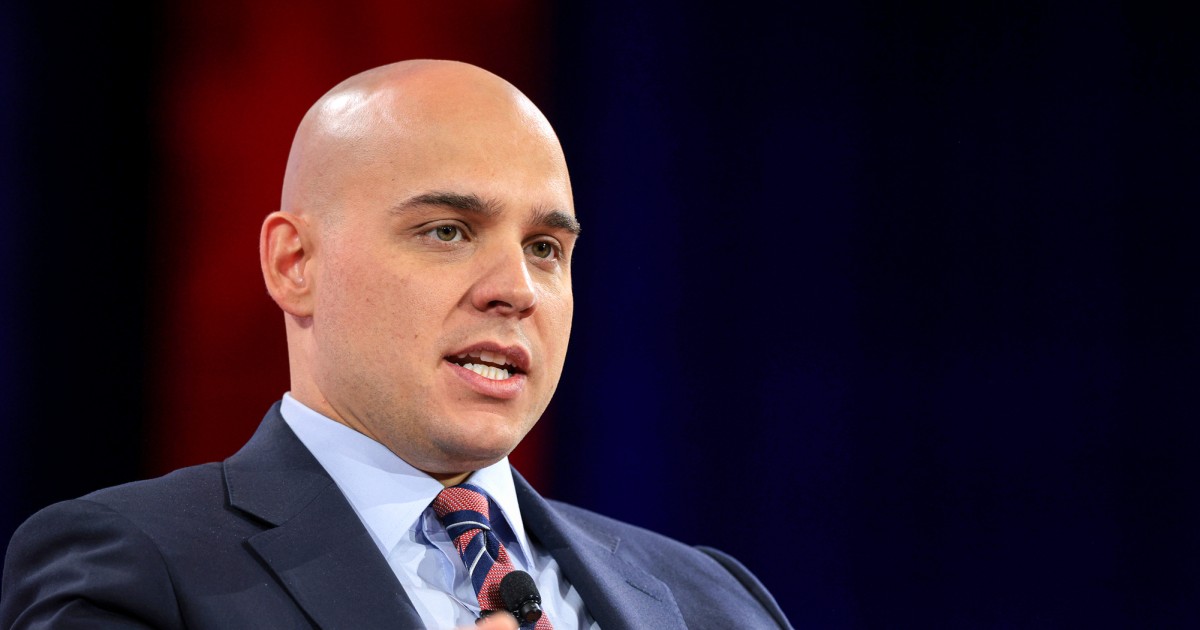
Yet James Blair, a top Trump political adviser, said he still believes Republicans can hang on to their majorities in Congress — although he knows it won’t be easy.
“‘I’m cautiously optimistic,” Blair said. “I won’t predict, you know, how many seats are going to be in either chamber come November. But, I do think there is a path for us to retain both majorities and defy history, for sure.”
Blair made his remarks in an interview with “Here’s the Scoop: Election Edition,” NBC News’ new Saturday podcast series hosted by chief White House correspondent Garrett Haake.
Listen and follow “Here’s the Scoop: Election Edition” here.
Blair served as deputy White House chief of staff until April and has been at the center of Trump’s political operations, now serving as the chief of the president’s MAGA Inc. super PAC. During the campaign, Blair was Trump’s political director and is known for his close relationship with White House chief of staff Susie Wiles, who served as a campaign manager in 2024.
Blair acknowledged that Democrats have some advantages this cycle. But he said he believes this post-Labor Day period is where the “heavy lifting” begins and that Democrats may see their polling advantages slip.
Comparing Democratic candidates to unpopular members of their party, like Senate Minority Leader Chuck Schumer, Blair added, is a strategy he hopes GOP candidates will use. He said he views this year’s midterms as being driven by both national and local concerns.
01:38
Rep. Aguilar and James Blair weigh Iran war’s midterms impact
00:0000:00
“There is a national backdrop against which things are being fought, and there are local considerations and sort of very specific considerations that a good campaign will be able to utilize both of,” he said.
“What they [Democrats] want a Republican to be measured against is, ‘Do you think everything is going perfectly?’” Blair said. “Our candidates, the challenge for them is to not be measured against the measuring stick the Democrats lay out for them, but to be measured against their opposition.”
On Thursday, Vice President JD Vance echoed Blair’s message at a private breakfast in Dallas for Republicans from battleground states.
“We’ve got to nationalize this election,” he said. “We’ve got to talk about all the crazy things the Democrats are doing.”
Addressing dissatisfaction on Iran and the economy
Blair’s comments come as voters’ views of Trump have sunk this year.
An NBC News Decision Desk Poll this month found that just 36% of U.S. adults approve of the way Trump is handling his job as president. On Trump’s handling of the Iran war, those polled scored the president even lower, with just 31% expressing approval.
Blair downplayed concerns about the war, saying that polling he’s seen has shown voters have begun to care less about the issue.
“As things have settled down and people see that we’re in control and are coming in for a landing, you’re seeing numbers with the voters that are sensitive to that moving back in the Republicans’ direction,” he said. “We saw that over the summer around the MOU [memorandum of understanding signed between the U.S. and Iran], and again, settling again as there’s not been, sort of, daily action.”
Earlier this week, the U.S. and Iran traded strikes, with the U.S. military hitting five Iranian oil tankers after Iran struck two U.S. warships. On Wednesday, the president told Republicans gathered in Dallas for a GOP midterm convention that the war with Iran would not end until after Election Day.
Trump has repeatedly said that the ongoing conflict has achieved its goal of preventing Iran from building a nuclear weapon, something that Blair cited as a political success, despite the president’s low marks from voters on his handling of the war.
“The president made a correct decision in the scope of history to solve a problem that has been bipartisan-agreed as a problem for 47 years in this country,” he said. “I think we can manage our way through, in September and October, to still be successful, and I think we will be.”
Another area where voters give the president low marks is on the economy and inflation.
An August Reuters/Ipsos poll found that just 32% of registered voters approved of the president’s handling of the economy. In that same poll, a slightly higher share of voters — 37% — said they believed the Democratic Party had a better plan, policy or approach to the economy than the share who said so about Republicans, 36%.
Blair downplayed concerns that views of the economy could cost the GOP its control of Congress, arguing that the president and Republican leaders were still dealing with inflation left over from President Joe Biden, who left the White House in January 2025.
“We’re still cleaning up that mess, and we need more time to finish the job,” Blair said. “That’s what we’re asking for in November.”
That message of asking for patience was reflected at the Republican midterm convention in Dallas this week.
“All of the price hikes that happened under Biden that were caused by their policies don’t just immediately drop,” Blair added.
In February 2025, the first full month of Trump’s second term, inflation was 2.8% year over year. It dipped as low as 2.4% in April 2025, the month Trump announced his “Liberation Day” tariff regime — but before those tariffs had taken effect. Fast-forward 18 months, and both tariffs and the Iran war energy crisis have helped push inflation back up to 3.4% as of August.
Trump ‘on the ballot’
In recent weeks, the president has increasingly focused on the midterms, telling reporters that he plans to travel and campaign in 35 races. He has also asked supporters to “pretend, please, that I’m on the ballot,” an idea that Blair embraced.
“Democrats are already using him as a turnout tool for their voters, whether Republicans do that or not. So that’s sort of baked into the cake,” Blair said. “The other side’s already going to, you know, attack however they’re going to attack, do whatever they think they can do to motivate their voters to win. We want to use all of the tools at our disposal to help our voters.”

Specifically, Blair pointed to low-propensity male voters, or those who don’t vote in every election, as ones whom Trump may be uniquely able to encourage to go to the polls.
He used an example of a voter who “works 40 to 60 hours a week, is not super engaged in politics. … He’s not watching this podcast. He’s not watching the news. He’s not trying to be engaged in politics on a regular basis.”
“That’s a guy who voted in the presidential race, but, historically he’s not voted in the midterms because that’s just the nature of those voters,” Blair added. “So for the president to lay out the stakes to that individual to give him a reason to come out and vote that transcends, you know, not just what he’s hearing from his local candidates, but sort of broadens out the picture nationally and what the stakes are, I think that’s very useful.”
Still, Blair said he doesn’t expect the same coalition that sent Trump back to the White House in 2024 to align with the president again this year.
“Coalitions are never exactly the same,” he said, adding: “Maybe a coalition’s core sticks, and then every election is a little different.”
He pointed specifically to Latino voters, who voted for the Republican nominee in 2024 in record numbers.
“Do I think that Republicans generically will get the same percentage with Hispanics in ‘26 as they did in ‘24? You know, probably not,” Blair said. “But will Hispanics still overperform for Republicans, you know, in broad, relative to where they did in 2018 and 2022? Yes, I think that’s likely.”
How Latinos vote this fall could be a significant factor in how many seats Texas Republicans and California Democrats win after redrawing their congressional maps. For example, Republicans’ three top targets in Texas — the 28th, 34th and 35th districts — are all overwhelmingly Latino districts. If the president’s standing with Latino voters wanes, that could jeopardize Republicans’ ability to win these seats.

MAGA Inc. begins to unload its coffers
Blair also spoke about the role that MAGA Inc. will have in the midterms. At the end of July, when its most recent campaign finance disclosure was filed, the group had a war chest of more than $400 million.
Asked about some Republicans’ concerns that Trump may not choose to spend the bulk of the MAGA Inc. cash before Election Day, Blair said simply, “I can assure that the president will leave it all on the field to keep his majorities.”
Over the summer, some members of the GOP were particularly concerned about Texas, where state Attorney General Ken Paxton ousted Sen. John Cornyn in a bruising Republican primary. Paxton had Trump’s endorsement, but much of the Republican Party backed Cornyn, known as a strong fundraiser with a record of winning in the state. Public polling has indicated a close, competitive race between Paxton and Democratic state Rep. James Talarico, who has led the state attorney general in fundraising.
On Saturday, MAGA Inc. booked $10 million worth of TV ad time in the state. Blair dismissed concerns about Paxton’s strength in the race, saying, “The fact is Ken Paxton had $100 million spent against him in the primary. Talarico had $0 spent against him in the primary, and that has an impact on candidate images that takes time to rectify. But the resources … have begun to be deployed now in earnest [and] will take care of that problem.”
On Wednesday, The New York Times reported that MAGA Inc. was funneling $49 million through a new group — No Going Back PAC — that would run TV ads in Senate races across the country.
Blair didn’t detail the group’s spending plans, but acknowledged a widening battlefield of competitive statewide races, including in Alaska’s Senate race, where former Rep. Mary Peltola is the Democratic nominee running against Republican Sen. Dan Sullivan.
The race is complicated by the presence of a third candidate, also a Republican named Dan Sullivan. (In Alaska, the top four candidates in the primary, regardless of party, advance to the ranked-choice general election.) Republicans have accused Democrats of sowing confusion among voters by recruiting Dan J. Sullivan to run as a spoiler in the race against the senator, Dan S. Sullivan.
“We know that national Democrats did that,” Blair said, without pointing to specific evidence. “We know that the press release for that candidate was written by a consultant to Mary Peltola. No one even disputes this fact. That is rigging a process using ranked-choice voting against the people of Alaska.”
Democrats have not taken credit for recruiting Dan J. Sullivan, a teacher, into the race. Blair acknowledged that his presence and Peltola’s past electoral success in the state are making the race close.
“I don’t dispute that’s a competitive race,” he said. “Mary Peltola’s been elected statewide before. We know this. So I mean, I think for us, like, we’re smart enough to read numbers. We know where things are. We’re going to fish where the fish are, and we’re gonna go try to win the majority, you know, protect the majority in all these places.”








Leave a Reply