

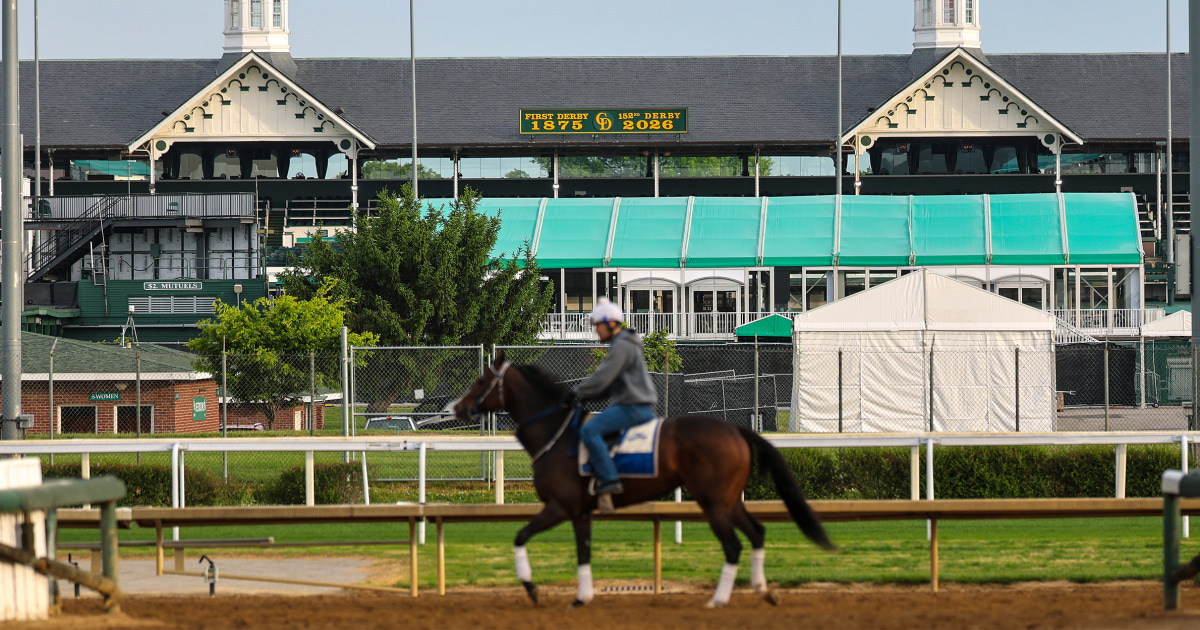
The first Kentucky Derby I covered was in 2002 for Sports Illustrated, replacing the great Bill Nack, the type of writer you never want to follow onto a beat. However, there was no line outside the editor’s office, and I had been writing about racing on and off since the late 1970s because my early jobs were near Saratoga and my intermediate stop was in New York, where newspapers also cared about racing until the last decade or so.
Subscribe to read this story ad-free
Get unlimited access to ad-free articles and exclusive content.

That Derby was won by War Emblem, a small-boned speedball who stole the race on the front end after having been sold by his geriatric owner to Saudi Arabian Prince Ahmed bin Salman for $900,000 three weeks before. Asked in the post-race press conference if he had “bought the Derby,” the Prince said, “Everybody buys the Derby.”
A year later, Funny Cide’s owners bought the Derby for $75,000, including $5,000 each from high school buddies from a small town in the upstate New York hinterlands. Two years, two wildly different tales. And ever since, the Kentucky Derby is the most static and reliable piece of the American sports calendar. It has been contested almost annually without interruption since 10 years after the end of the Civil War, and on the first Saturday in May for almost a century. It will be attended by roughly 150,000 fans, kings and commoners, wearing hats and drinking mint juleps.
So you can count on Saturday’s 152nd Kentucky Derby. But only to a point.
Because for all its familiarity — you can add the ancient twin spires and the singing of “My Old Kentucky Home” (controversial lyrics and all) to the mix — the Derby is also one of most unpredictable sporting events of the year. Hunter S. Thompson famously called it “Decadent and Depraved,” for reasons very unrelated to horse racing. It could just as well be called “Chaotic and Capricious.”
Among my 22 Derbies covered, I’ve seen dominant performances by deserving winners like Smarty Jones (2004), Barbaro (2006), Big Brown (2008), California Chrome (2014), American Pharoah (2015), and Justify (2018). But I’ve also seen favorites get beaten, like Fierceness two years ago, because a very good colt was not good at all on Derby Saturday and finished 15th; and Journalism last year, because a very good colt was actually quite good on Derby Saturday, but another horse — Sovereignty — was strikingly better and would prove in subsequent months to be the best of his class by a wide margin.
More astonishingly, in 2005, I watched Giacomo storm down the homestretch in the middle of the track, picking off exhausted stragglers worn out by a speed duel, to win at 50-1 odds. Four years later, I saw Mine That Bird and fearless jockey Calvin Borel fly down the rail to also win at 50-1. Then in 2022, Rich Strike got into the field only because another horse withdrew the day before and snaked through the home stretch to win at odds longer than 80-1.
This volatility is a product of the race’s parameters themselves: The Derby is for three-year-olds. (Horses can only run it once; never dismiss the need to say that out loud). Three-year-old horses in the spring of the year are fast-developing athletes, often likened by racing insiders to human teenagers. The winner of the Derby can be a horse that came into maturity only in the weeks leading up to the race. The event is also run at a distance of 1 1/4 miles and with a 20-horse field; none of the horses in the field has seen those conditions, nor will they ever see them again. It is both an enduring athletic test and a crapshoot.

But one aesthetic prevails: The Derby will give. Perhaps this year it will give to Santa Anita Derby winner So Happy’s trainer Mark Glatt, who lost his wife, Dena, in February. Perhaps it will give to controversial billionaire owner Mike Repole, who in addition to endlessly making his own voice heard in the sport’s hallways, has never won its biggest race and once again has the favorite, Renegade (although he is stuck in the No. 1 post position, which hasn’t produced a winner in 40 years). Perhaps it will give it to Riley Mott, who has two horses entered, trying to win the roses one year after his father, Bill Mott, won with Sovereignty. A generational win like that hasn’t happened in 78 years. Better still, Bill also has a horse entered. Perhaps it gives them the first ever father-son exacta.
Regardless, there will be tears. That is a certainty. You win the Derby, you cry.
Leave a Reply