

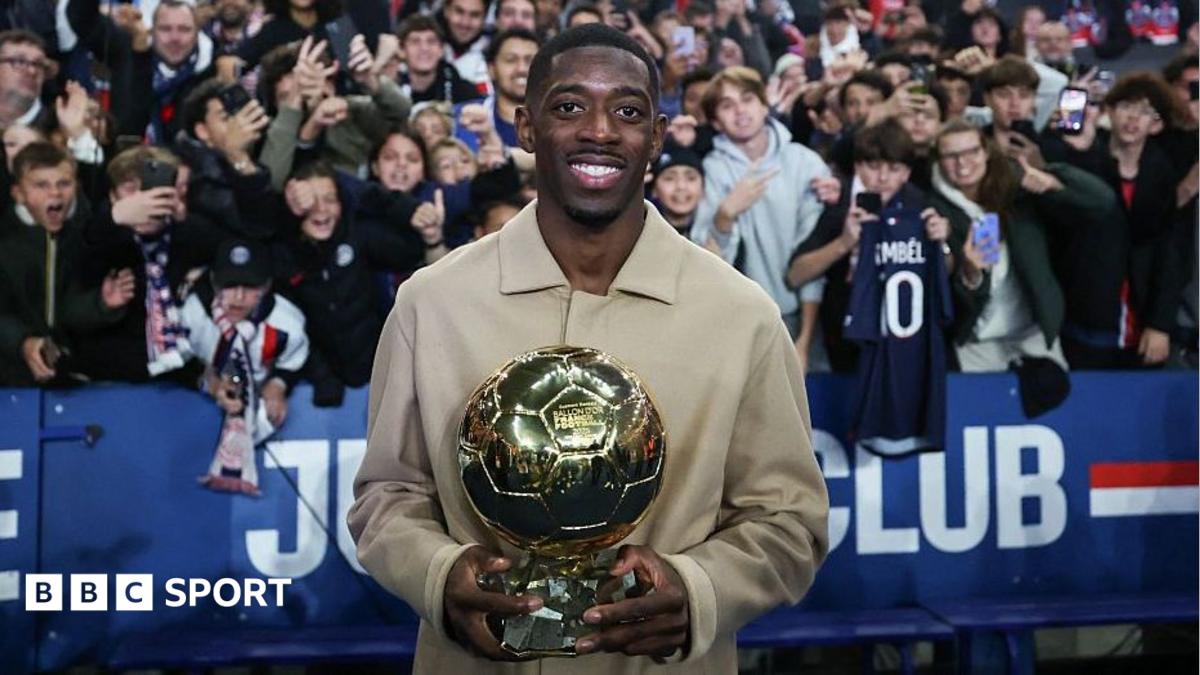
Michael Owen tells a story about how when Liverpool boss Gerard Houllier rang to break the news he had won the award in 2001, the 22-year-old did not even know what the Ballon d’Or was.
Owen engaged in a photoshoot at Liverpool’s Melwood training ground a fortnight before the images were distributed to the media, with the striker officially presented the trophy on the Anfield pitch before a game against Derby County.
He was the first winner playing for an English club since Manchester United’s George Best in 1968, the period in between dominated by Italian, Spanish and German teams.
From its launch in 1956 until 1995, when Weah became the first and so-far only African player to win it, only European players were eligible.
Only in 2007 did the award became truly global, open to players from any club – not just those representing European teams. Not until 2011 was it awarded at a glamorous ceremony. And only in 2018 was the women’s prize launched.
“Winning the Ballon d’Or has an extremely positive impact,” adds Braida. “We at AC Milan bought Kaka for around 7.5m euros and sold him for 67m euros [to Real Madrid].
“I must tell you, however, that in 2008, following his Ballon d’Or win in 2007, Manchester City made us a written offer of 105m euros. We’re talking about a written offer, not a sounding-out or mere words.
“We were probably still in the early stages of certain commercial developments at that time, but now it clearly has a massive impact. Even back then, his value increased fivefold and winning the Ballon d’Or brought him global exposure and fame.”
For someone like Three Lions captain Kane, hoping to become the first English winner in 25 years and only the fifth of all time, the prestige is huge – especially with the ceremony held in London to mark the 70th anniversary of Stanley Matthews winning the inaugural prize.
“It would be a massive achievement if it did happen,” Kane said on Wednesday, having remained coy on his own chances.
Kane has done his share of recent interviews but others, such as Rio Ferdinand on Bayern’s official social accounts, have made his case for him. “Ballon d’Or!”
He is, after all, vying to become Bayern’s first winner since Karl-Heinz Rummenigge’s second successive triumph in 1981. Not since Borussia Dortmund’s Matthias Sammer 30 years ago has it returned to the Bundesliga.
Bayern will also remember the case of Robert Lewandowski, who was widely tipped as favourite in 2020, scoring at an astonishing rate as the Bavarians won all six trophies available, including the Champions League, before the ceremony was cancelled because of the Covid-19 pandemic.
The Poland striker, who finished runner-up to Messi the following season, told BBC Sport last year the prize has become “part football, partly politics” and was “more commercial” than its counterpart, The Best Fifa Men’s Player award.
Ballon d’Or snubs can cut deep. Franck Ribery said it felt “like a robbery” when he missed out to Ronaldo in 2013. Real Madrid boycotted the 2024 ceremony when they learned Manchester City midfielder Rodri would scoop the gong instead of Vinicius Junior.
“In Brazil, the hype is also giant,” explains Caique Andrade, international football reporter at Globo. “When Vini didn’t win the 2024 Ballon d’Or, there was a lot of commotion about it.”
It may be an individual award, but winning is huge for clubs, too.
“This means an incredible impact in terms of popularity, visibility and also financial returns for the club,” explains Braida. “Today, with the rise of social media and followers – factors that shape commercial aspects – this is even more true.”
Kirkham concludes: “It is a global point – that means more audience and more eyeballs, and that means more money around the world.”
Leave a Reply