

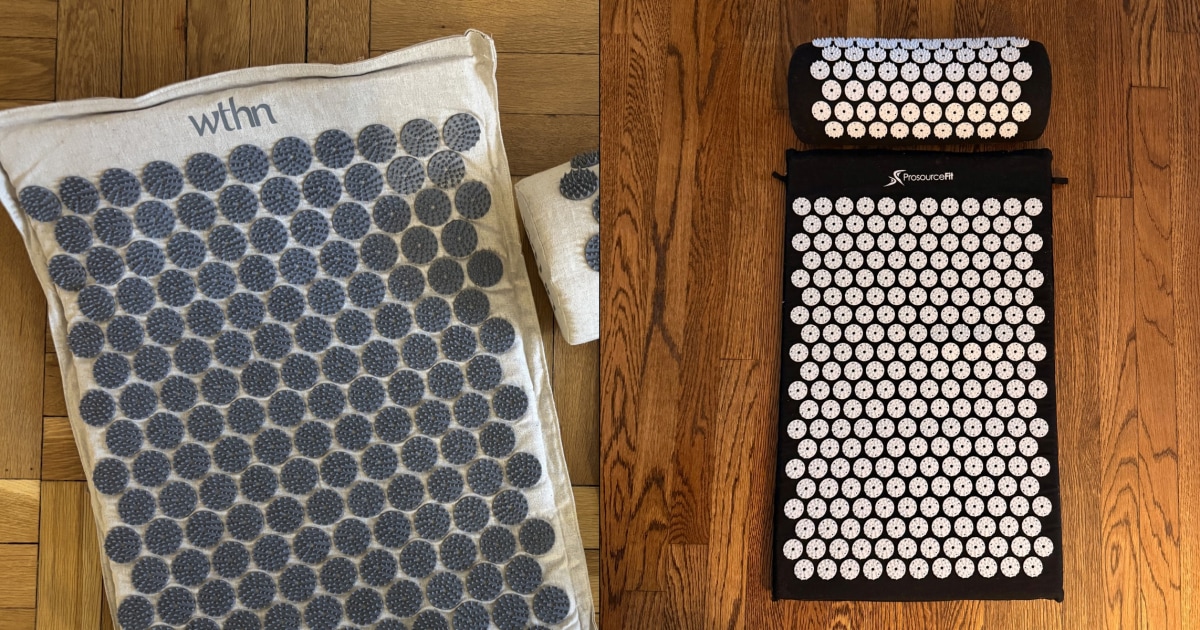
At first glance, an acupressure mat doesn’t necessarily look like something that helps you relax — it’s a pad covered in spikes whose nickname is “a bed of nails,” which is understandably intimidating if you’re unfamiliar with it. But as someone who’s used one for years, I promise: an acupressure mat is the recovery tool you didn’t know you needed. Within minutes of laying on mine after hunching over my computer all day or doing a tough workout, I feel my body melt into it as my muscles relax, and a 30-minute session forces my mind to slow down, too. Don’t just take it from me — all the experts I interviewed agree that an acupressure mat can help relieve tightness and soreness, reduce stress and improve sleep quality.
Below, I break down everything you need to know about acupressure mats, including what to consider while picking one, how to use one correctly and why calling it an “acupuncture mat” is totally inaccurate.
Want more from NBC Selected? Sign up for our newsletter, The Selection, and shop smarter.
What are acupressure mats?
Acupressure mats are padded mats covered in small plastic spikes that help stimulate pressure points across the body, says Dr. Sarah Cash Crawford, a physical therapist and the founder of Anchor Wellness and WAVE Physical Therapy and Pilates. When you lie or stand on them, the gentle, consistent pressure the spikes create against your skin can increase circulation, encourage muscle relaxtion and activate the parasympathetic nervous system, a.k.a. our “rest and recover” state. “I often explain it to patients as a way of creating controlled sensory input that helps the body shift out of stress mode and into a calmer, more regulated state,” says Crawford.
What are the best acupressure mats?
Best for beginners

ProsourceFit’s Acupressure Mat is a great option for beginners due to its moderate amount of spikes and lower price point compared to similar ones on the market. It’s the first mat I bought over three years ago, and NBC Selected senior editor Nikki Brown has a comparable model that she uses regularly. “I’m prone to muscle spasticity, especially in my right hip and middle back, and laying on this mat makes it easier to stretch,” she says. “I usually lay on it for 20 to 30 minutes with my legs elevated so I can really feel the pressure along my back and butt. It’s made me more aware of how much I arch my back and my sometimes poor posture. The spikes take some getting used to, but after a few weeks of consistent use, they feel amazing.” ProsourceFit’s acupressure mat comes with a foam bolster pillow, and you can also buy an extra-large version that’s double the size.

Best for full-body relief

This acupressure mat is over 4 feet long, so it covers most people’s whole body rather than just the upper or lower region for comprehensive relief. It has the most spikes out of all the options I recommend, which means it has the most gentle intensity. The mat comes with a foam pillow, and you can buy a shorter size if you’re looking for something smaller.
Best set

You get two acupressure mats in Balance Mate’s set, a small one and a large one, as well as a neck pillow and a thin cloth to put over the spikes as you’re getting used to them. You can line the two mats up to cover your entire body while you’re laying down, or use them separately — the large one covers most people’s back from their shoulders to their hips, while the smaller one is ideal for standing on or putting on a chair seat.
Best for experienced users

If you have lots of experience using an acupressure mat, you might want to try one that offers a more intense feel, like this option from ShaktiMat. It has the least amount of spikes out of all the options I recommend, and while it doesn’t come with a pillow, you can buy neck and back pillows separately. ShaktiMat also makes low and moderate intensity acupressure mats.
Editor’s pick

After using ProsourceFit’s acupressure mat for a while, I wanted something that felt more intense, so I ordered Wthn’s Acupressure Mat Set — I go to the brand’s New York City studios for acupuncture and was able to test it out before buying it. I’ve religiously used my Wthn mat since 2024 to release tension from my back, neck and shoulders after hunching over my computer all day, and I put it under my legs after applying muscle cream as part of my running recovery routine. I love positioning the included bolster pillow under my neck or lower back while I’m laying on the mat. I also often use the pillow by itself under my neck when I’m lying in bed or on the couch to really target that area. Wthn sells an acupressure neck wedge you can buy separately, too.

How I picked the best acupressure mats
Experts suggest thinking about the following factors while shopping for acupressure mats, all of which I took into consideration while curating my recommendations.
- Size: There’s no standard-size acupressure mat, so to find the right one for you, think about how you plan to use it. Longer and wider options are best for addressing the back and legs, while shorter and narrower ones work well for under your feet, shoulders and neck, as well as sitting on. I specified the dimensions of each acupressure mat I recommend above.
- Material: Choose an acupressure mat whose spikes and base are made from durable, high-quality materials so it can withstand consistent use over time. If you plan on using the acupuncture mat on the floor, look for one with some padding to protect your body. I included material type for each mat I recommend above.
- Spike density: This refers to the number of spikes an acupressure mat has, which tells you how intense the pressure feels when you use it. More spikes means a mat has a less intense sensation, so it’s best for beginner to intermediate users — since there’s more spikes to distribute your weight over, there’s less pressure in each spot, leading to a gentler overall feel. On the other hand, less spikes means a mat has a more intense sensation, making it best for experienced users — since there’s less spikes to distribute your weight over, there’s more pressure in each spot, leading to a “spicier” overall feel. The acupressure mats I recommend above range in spike density from 4,000 (most intense) to 10,000 (least intense). I included the exact number for each one so long as the brand provided it.
- Included accessories: Some acupressure mats come with accessories like neck pillows or back/knee bolsters, which can help target specific areas or position your body correctly to get the most relief. I detailed which, if any, accessories, each of the acupressure mats I recommend come with.
How to use an acupressure mat correctly
There isn’t necessarily a “wrong” way to use an acupressure mat — if you simply lay on top of it, you’re doing it right. But to help make your sessions as impactful as possible, experts share their tips below. An important one to know right off the bat: The spikes on your acupressure mat should make contact with your skin for maximum efficacy, says Kirstin Bunton, a licensed acupuncturist and the head of healer development at WTHN, an acupuncture and Traditional Chinese Medicine wellness studio. (Ed’s note: The inclusion of products sold by Wthn in this article was made independently of Bunton.) If you find that uncomfortable, especially if you’re a beginner, she recommends using the mat while wearing thin clothing rather than thick, bulky garments.
What are the best acupressure mat positions?
The best acupressure mat position for you depends on the area you’re targeting, says Bunton.
You can turn it horizontally and vertically depending on the part of your body you want it to cover. Some positions to consider include:
- Laying on it supine to cover your back from the shoulders to the hips, or moving it down to cover the backs of your legs from the hips to the ankles
- Laying on it prone to cover the front of the legs from the hips to the ankles
- Sitting in a chair and putting it on the seat to cover your bottom and the back of your thighs; putting behind your on your back to cover from your shoulders to your hips; or putting it on the floor under your bare feet.
- Standing on it, which causes an intense sensation that only experienced users should try
How long should you use an acupressure mat for?
Beginners should aim to use an acupressure mat for about 10 to 20 minutes at a time, says Dr. Scott Kaylor, a physical therapist and clinic owner at Zone Physical Therapy who’s affiliated with Stride, a custom orthotics and insoles brand. As your body gets used to it, you can increase the duration, but remember that longer sessions aren’t always better. In fact, consistency matters more than duration. “Using the mat briefly and comfortably tends to be more beneficial than pushing through excessive discomfort for long periods of time,” he says.
Signs that you’re using an acupressure mat for too long include general discomfort and overstimulation, numbness, dizziness and skin irritation during and after a session, says Crawford. You should only feel calmer, looser and more grounded once your body settles in — anything else is a red flag.
How often should you use an acupressure mat?
You can use an acupressure mat daily, but as your body is getting used to it, start with a few times a week, says Crawford.
Frequently asked questions
There’s limited studies available around the efficacy of acupressure mats, but generally, experts say they work to temporarily reduce discomfort, pain and tension when you use them as a tool within a broader recovery routine. They’re not a standalone solution, so if you’re dealing with consistent issues, it’s important to see a professional, says Kaylor.
The main benefit of acupressure mats is increased circulation in targeted areas, which helps your muscles relax to temporarily relieve discomfort, pain and tension, says Bunton. They’re especially useful tools for people who are stiff after sitting or standing for prolonged periods of time, do repetitive movements that can create tightness, or experience exercise-related soreness, says Kaylor.
Crawford says acupressure mats can also help with decreasing stress levels. “One of the biggest benefits is simply creating intentional time for stillness, rest and recovery, which many people are missing in their day-to-day lives,” she says. That relates to sleep quality and quantity, too. Bunton says some of her clients who deal with sleeping issues like insomnia tend to overthink when they get in bed, preventing them from being able to drift into a slumber. She recommends laying on an acupressure mat right before bed because it signals to your body that it’s time to slow down and decompress, and relaxes the muscles in the head and neck area.
Because acupressure mats are covered in spikes that apply pressure to your skin, they can feel quite intense at first, but they shouldn’t ever be painful, says Kaylor. Using them should lead to a tolerable, manageable amount of stimulation that’s eventually relaxing and has a somewhat warm sensation. Try pairing an acupressure mat session with deep breathing, meditation or mindfulness to encourage your nervous system to settle down, says Crawford.
Acupressure mats are generally safe for most people to use, says Bunton. But experts say you should speak with your doctor before trying one if you have certain medical conditions, including the following: bleeding, circulation and clotting disorders; neuropathy; skin conditions like infections and open wounds; uncontrolled diabetes and/or diabetes-related sensation issues; chronic pain; significant sensory impairments or sensitivity. Also consult your doctor if you’re pregnant or recovering from an injury or surgery.
Acupuncture and acupressure are both practices rooted in Traditional Chinese Medicine that center around stimulating specific points across the body, says Kaylor. They differ in terms of how you or a licensed practitioner apply that stimulation.
- During acupuncture, a licensed practitioner applies stimulation with very fine needles placed in targeted points across your body, says Crawford.
- During acupressure, you, a practitioner or a tool with a textured surface applies stimulation through physical pressure to targeted areas, says Kaylor. Unlike acupuncture, you can do acupressure at home, so it’s a more accessible option for most people and you can do it between professional acupuncture treatments.
Yes, acupressure mats are the same as acupuncture mats. “Acupressure mat” is the correct term for the tool. There’s technically no such thing as an acupuncture mat — acupuncture involves stimulating specific points by inserting thin needles into the skin, while acupressure involves stimulation through physical pressure.
Meet our experts
At NBC Selected, we work with experts who have specialized knowledge and authority based on relevant training and/or experience. We also ensure that all expert advice and recommendations are made independently and with no undisclosed financial conflicts of interest.
- Dr. Sarah Cash Crawford is a physical therapist and the founder of Anchor Wellness and WAVE Physical Therapy and Pilates.
- Dr. Scott Kaylor is a physical therapist and clinic owner at Zone Physical Therapy who’s affiliated with Stride, a custom orthotics and insoles brand.
- Kirstin Bunton is a licensed acupuncturist and the head of healer development at Wthn, an acupuncture and Traditional Chinese Medicine wellness studio. (Ed’s note: The inclusion of products sold by Wthn in this article was made independently of Bunton.)
Why trust NBC Selected?
I’m a reporter at NBC Selected who has covered wellness and fitness for over five years, including topics like posture correctors, running shoes and dumbbell workouts. To write this article, I interviewed two physical therapists and one acupuncturist about acupressure mats, how to use them and what to look for while shopping for them. I’ve also used an acupressure mat for over three years as a runner who logs over 30 miles a week, and to relieve back and shoulder tension after sitting at my desk all day.
Catch up on NBC Selected’s in-depth coverage of tech and tools, wellness and more, and follow us on Facebook, Instagram, Twitter and TikTok to stay up to date.










Leave a Reply