

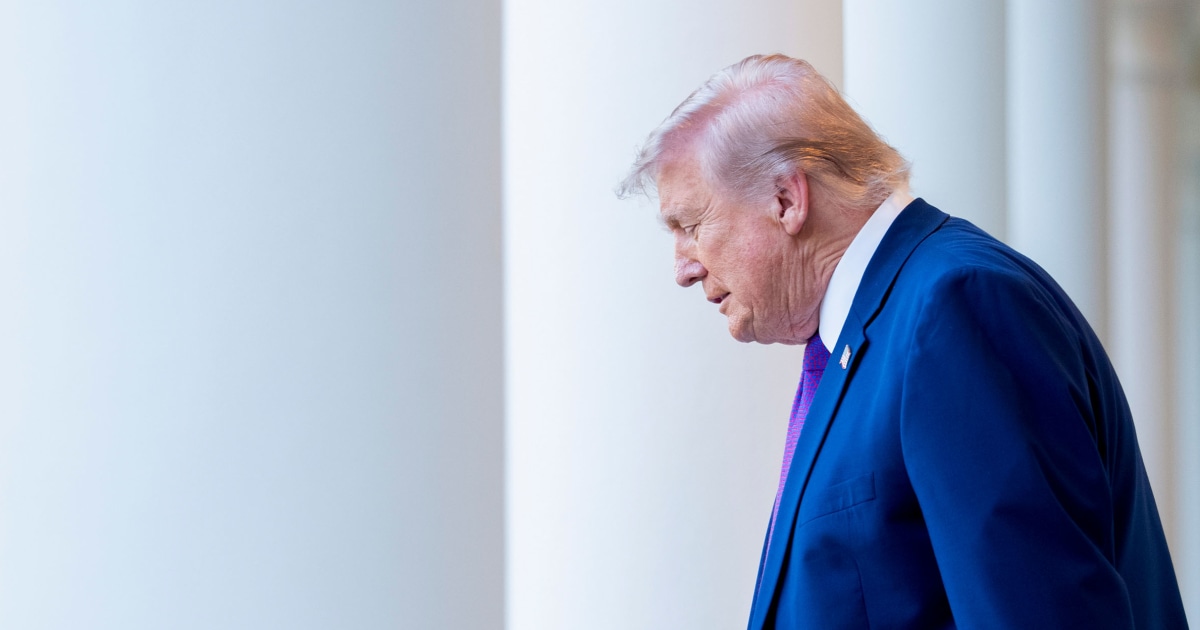
WASHINGTON — He is the biggest draw in American politics, a sitting president who created a movement that has been steadfastly loyal to him for more than a decade.
Subscribe to read this story ad-free
Get unlimited access to ad-free articles and exclusive content.

He may also be the most polarizing figure in American politics, now presiding over rising inflation and a Middle East war with no clear end in sight.
Donald Trump’s capacity to both attract and repel American voters creates a dilemma that Republicans are grappling with ahead of the midterm elections in November: Should he campaign aggressively to hold the party’s slim congressional majority, or hang back lest his presence on the trail boomerang on the people he’s trying to elect?
There’s no easy answer, interviews with 19 current and former Republican lawmakers and political operatives suggest. Midterm elections are often referendums on the president. That being the reality, it makes no sense to try to hide Trump away until the votes are cast, some Republicans argue.
“They need him badly,” former House Speaker Kevin McCarthy, R-Calif., said in a reference to congressional Republicans. “They need his money. They need him to drive turnout.”
“This is about getting our base out; that’s what huge,” said Jeff Kaufmann, chairman of the Iowa Republican Party. “And there is no one better” than Trump at galvanizing Republican voters.
A complication is that Trump’s winning 2024 electoral coalition has frayed. That year, he won 46% of independent voters, compared with 49% who supported Democratic nominee Kamala Harris, exit surveys showed. In an Economist/YouGov poll this week, only 25% of independents said they had favorable views of Trump, compared with 66% who held unfavorable views.
One House Republican locked in a competitive race said they have no plans to campaign with Trump or feature him prominently in ads. The lawmaker also said some fellow Republicans are dubious about the National Republican Congressional Committee’s decision to christen its midterm campaign program the “MAGA Majority,” putting Trump front and center.
“I got a few text messages from people, a few vulnerable members, who were like, ‘Eh, I don’t know if this is the best strategy,’’’ the member said, speaking on condition of anonymity to talk freely. “You can tell some of these folks, on some of the comments they’re making, they’re nervous.”
A state Republican chairperson conceded that Trump’s presence “can be tough.”
“I think he can help with things like turnout, but there is some room for backfire on something like that,” the person said. “It would have to be the right audience, and I think folks here would be OK if that did not happen.”

At minimum, voters are likely to see Trump in full campaign mode in September as he headlines an unusual Republican convention aimed at boosting the party’s midterm election prospects. The Republican National Committee changed its rules this year to stage a convention, separate from the multiday pageant it holds every four years to nominate its presidential candidate.
“Republicans nationwide are united behind President Trump and his winning agenda,” RNC chairman Joe Gruters said in a statement. “While Democrats remain trapped defending a failed record, voters know which party delivers results. Republicans have the energy, the message, and the strongest turnout force in politics with President Trump leading the charge.”
Still, uncertainty lingers in Republican circles over whether Trump will indeed plunge in and work to keep Congress in GOP hands.
He has myriad interests that have little to do with his party’s electoral prospects, including his White House ballroom project and an Ultimate Fighting Championship contest next month on the South Lawn.
One Republican consultant told NBC News that the White House has not shared a larger plan for the midterms and what candidates should expect from Trump.
“It would be nice if they had a plan,” the consultant, who has clients in House races, said of the White House political shop. “They’ve given very little guidance to members of Congress or senators as to what to expect. If they do have a plan, they’re just not telling anyone.”
Another Republican strategist said the White House must do more to sell its accomplishments. A photo-op last month with a DoorDash deliverywoman who turned up at the Oval Office with fast food helped call attention to Trump’s “no tax on tips” policy, but that won’t suffice, the person said.
“It seems as though Trump’s strategy thus far has been, ‘The Democrats are crazy,’” the strategist said. “He might very well be right, but that’s not something that’s necessarily going to sell, especially when gas prices are $4.50. The message has to be how we’re going to capitalize on the things that we already did.”
Asked for comment, a White House aide sent a list showing trips that Trump, Vice President JD Vance and Cabinet members have made to various states, demonstrating “how the administration is traveling strategically across the country ahead of the midterms.”
The White House tally shows that Trump this year has visited Arizona, Georgia, Iowa, Michigan, Nevada, North Carolina, Ohio, Pennsylvania and Texas.
Trump doesn’t much like to travel, but he signaled he’s ready to do it to stop Democrats from retaking Congress.
In a recent phone interview with NBC News, he tied his party’s fate to the SAVE America Act, a bill languishing in the Senate that would require proof of citizenship to register to vote.
“I am on the ballot, and my voters love me,” Trump said. “In many cases, they won’t love the Republican Party if they don’t pass the SAVE America Act. I can only do so much.”
So far this year, Trump has made 12 stops around the country promoting his policies — the same number at a similar point in his first term ahead of the 2018 midterm elections, an NBC News analysis shows.
That year, he dramatically ramped up his travel one month out from Election Day. He spent 21 out of 31 days on the road in October 2018, headlining 16 political rallies, three policy events and at least four fundraisers. In the five days leading up to the election, he took part in 10 more rallies.
When it was all over, Democrats had regained the majority in the House, while Republicans had kept the Senate. Democrats impeached Trump twice over the next three years; he was acquitted in the Senate both times.
An incentive for Trump to match that frenetic schedule is what might happen if Democrats capture the House. With the power to issue subpoenas and investigate Trump and his Cabinet officials, Democrats would be well positioned to throttle Trump’s agenda.
“You got to win the midterms, because if we don’t win the midterms, they’ll find a reason to impeach me,” Trump told congressional Republicans in January. “I’ll get impeached.”
Vance can fill gaps on the campaign trail, though he’s not as popular a draw as his boss. On Thursday, Vance is scheduled to visit Maine and speak about his efforts to combat fraud, the latest in a series of trips he is making to competitive House districts to boost Republican candidates.
Vance will be in Maine’s 2nd Congressional District, where former Gov. Paul LePage, who is unopposed for the GOP nomination, will face the winner of next month’s Democratic primary. The state also is home to a Senate race that could help determine control of the Senate. The Republican incumbent, Susan Collins, faces a serious challenge from the expected Democratic challenger, Graham Platner.
Vance events have typically been, by design, smaller than Trump’s large-scale rallies — a recognition that no one upstages Trump. The vice president’s visit last week to Des Moines, Iowa, for example, attracted several hundred people to a manufacturer’s warehouse. And a Turning Point USA event last month that featured Vance as a headliner caught attention for the number of empty seats inside a University of Georgia arena.
In an interview with NewsNation, a Turning Point spokesperson blamed the lower-than-expected turnout on “shenanigans” by “left-wing” groups that claimed free tickets to make sure seats went unfilled.

Republicans’ grip on the congressional majority is tenuous. Democrats can wrest control of the House if they net just three seats. In the Senate, they need to net four seats to overcome Vance’s tiebreaking vote.
If history is a guide, Republicans may be in for a rough night Nov. 3, whether Trump campaigns actively or not. The sitting president’s party typically loses seats in the midterms; the only question is how many. Republican President George W. Bush described GOP losses in the 2006 midterms as “a thumping.” Democrat Barack Obama called his party’s setback in 2010 “a shellacking.”
Making matters tougher for the GOP, 14 House Republicans are on the ballot in races considered toss-ups, compared with just four Democrats, according to the nonpartisan Cook Political Report.
A wild card is the redistricting wars that have taken place. Trump has called upon Republican state legislatures to draw new maps that would create more congressional seats for his party, prompting countermoves in blue states like California.
Recent court victories, however, have given given Republicans an edge.
Before he left for his trip to China on Tuesday, Trump told reporters that Democrats have “redistricted for years, and now we took our shot and it looks like we’re going to pick up a lot of seats, and that’s a good thing.”
Steve Bannon, who was a senior White House aide in Trump’s first term, expects Republicans to keep control of the House but believes they will lose the Senate. Trump’s political base is prepared to punish Senate Republican leader John Thune of South Dakota for failing to pass the SAVE America Act, Bannon said.
Yet Bannon also described the Iran war as a costly distraction from pocketbook issues.
“I’m worried about ending this war and getting the focus on the economy,” Bannon said in an interview. “The great economic turnaround is clearly being hindered by this war, and it’s got to be brought to a close. It’s time to wrap this thing up, get everyone home and focus on domestic issues.”
A question that has long bedeviled sitting presidents is where, exactly, they should travel to maximize their parties’ chances in midterm campaign seasons. At a similar point in 2006, Bush’s approval rating had fallen to the mid-30s, about the same as Trump’s. Like Trump, he was mired in a Middle East war of his own making.
Ahead of the midterms that year, “Bush campaigned, but it was in places like Utah,” a reliably Republican state, said Alex Conant, a Republican strategist who served in Bush’s White House. “You’re not going to go someplace where all you’re going to do is help turn out Democrats and independent voters that don’t like you.”
“At the end of the day, the Republican challenge is that Democrats are very motivated and Republicans aren’t,” he added. “Trump helps with the latter but also hurts with the former.”



Leave a Reply