

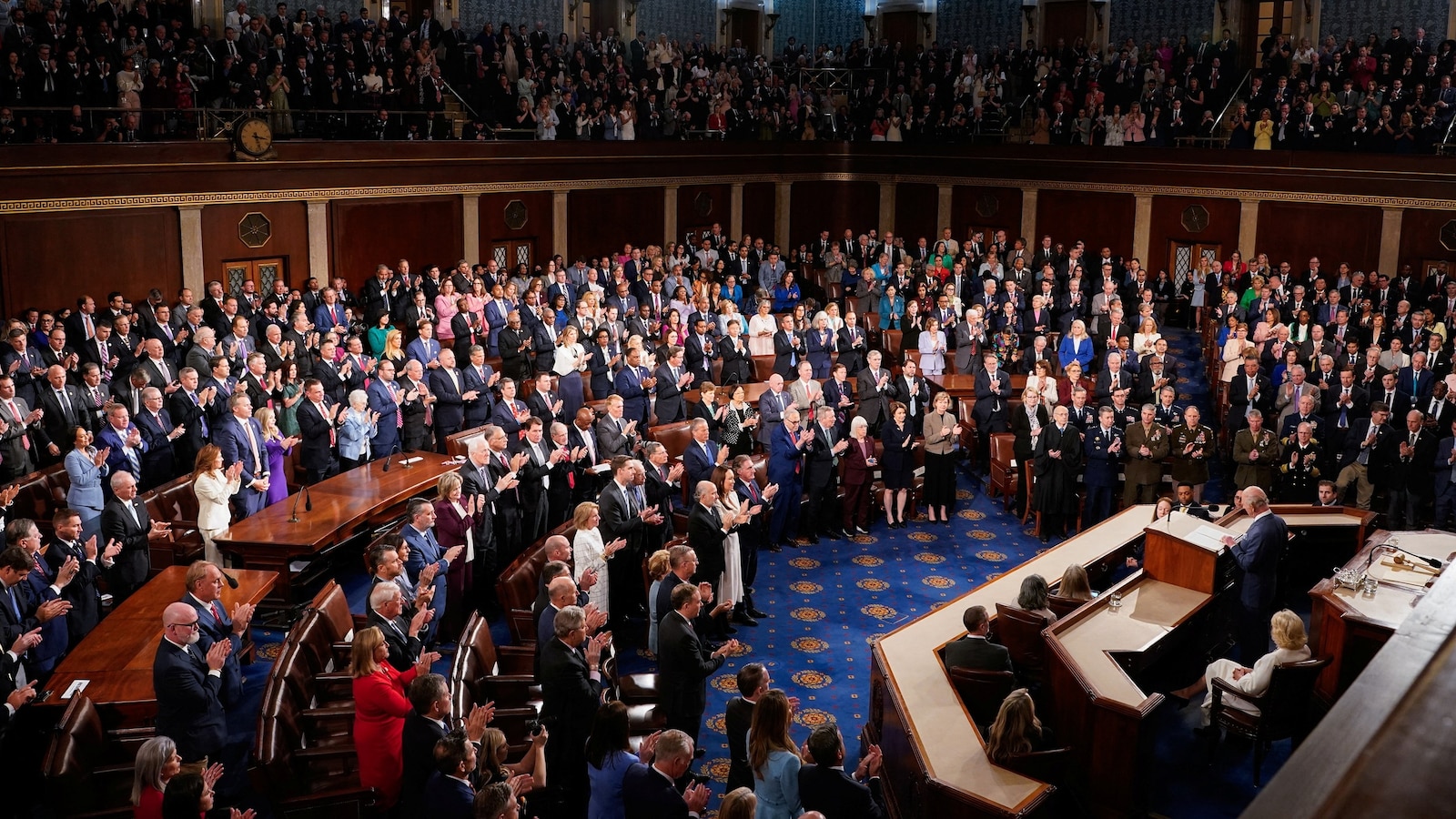
King Charles III delivered a dynamic address to a joint meeting of Congress on Tuesday, galvanizing lawmakers who appeared rapt by his message of unity and shared history between the United States and United Kingdom.
Here are four key takeaways from the royal address:

Britain’s King Charles III receives a standing ovation as he speaks to a joint meeting of Congress in the House Chamber at the U.S. Capitol, April 28, 2026, in Washington.
Elizabeth Frantz/Reuters
Mending fences between the U.S. and the U.K.
It’s something that we don’t see often in a bitterly divided Congress: A packed chamber, full of laughter, unity, and bipartisan standing ovations, in stark contrast to the last State of the Union address, where there were empty seats, several disruptions and members walking out in protest — characteristics of the annual address that have recently become the norm.
But Tuesday, throughout the king’s address, laughter echoed off the walls of the House chamber — Charles even halting his remarks at times to allow for more laughter and applause.
Democrats and Republicans listened attentively — arguably more alert than they are when being address by a U.S. president, even from their own party. Nobody appeared to fall asleep. Nobody walked out.
The tone of the king’s remarks was light and hopeful — even with so much uncertainty at home and abroad — delivering a message of unity and appreciation of the shared alliance that many in Congress say is welcomed and needed to meet the challenges of our time.

King Charles III addresses a joint meeting of Congress as U.S. Vice President JD Vance and Speaker of the House Mike Johnson listen at the U.S. Capitol, April 28, 2026 in Washington.
Chip Somodevilla/Getty Images
Defending the NATO alliance
Despite President Donald Trump’s public critiques of NATO, the king held steadfast in highlighting the importance and history of the alliance, calling on Congress to rededicate itself to collective defense while stressing that its mutual defense, intelligence and security ties “are hardwired together through relationships, measured not in years, but in decades.”
“We do not embark on these remarkable endeavors together out of sentiment. We do so because they build greater shared resilience for the future. So making our citizens safer for generations to come,” the king said. “Our common ideals were not only crucial for liberty and equality, they are also the foundation of our shared prosperity.”
Trump previously told reporters that the U.S. does not “need any help” from the alliance and bashed NATO’s lack of response to his request for assistance in reopening the Strait of Hormuz.
“NATO WASN’T THERE WHEN WE NEEDED THEM, AND THEY WON’T BE THERE IF WE NEED THEM AGAIN,” Trump wrote on his Truth Social platform.

Britain’s King Charles shakes hands with Sen. Patty Murray as he leaves after his address to a joint meeting of Congress in the House Chamber of the U.S. Capitol in Washington, April 28, 2026.
Kylie Cooper/Reuters
In his speech, the king recalled the only use of Article 5 in the alliance’s history: when America called on allies to help fight against terrorism after 9/11.
“We stood with you then, and we stand with you now in solemn remembrance of a day that shall never be forgotten,” he said.
The king argued the same unity is needed today across several active battlegrounds throughout the globe. When the king called for peace in Ukraine, the chamber again broke out in bipartisan applause — despite fractures within the legislative branch over continued assistance there.
“We answered the call together, as our people have done so for more than a century, shoulder to shoulder through two world wars, the Cold War, Afghanistan, and moments that have defined our shared security,” the king said. “Today, Mr. Speaker, that same unyielding resolve is needed for the defense of Ukraine and her most courageous people.”

King Charles III meets with Speaker of the House Mike Johnson, Senate Majority Leader John Thune, Senate Minority Leader Chuck Schumer and House Minority Leader Hakeem Jeffries during a bicameral, bipartisan leadership meeting at the U.S. Capitol, April 28, 2026 in Washington.
Heather Diehl/Getty Images
The king called the world “more volatile and more dangerous” than the one his mother spoke to at a joint meeting 35 years ago from the same chamber — arguing the U.S. needs an ally like the United Kingdom to maintain security for both their peoples.
“The challenges we face are too great for any one nation to bear alone,” the king said. “But in this unpredictable environment, our alliance cannot rest on past achievements or assume that foundational principles simply endure.”
“As my prime minister said last month, ours is an indispensable partnership. We must not disregard everything that has sustained us for the last 80 years. Instead, we must build on it,” he added.
Celebrating checks and balances
The king’s call for checks and balances on executive power received bipartisan applause — with lawmakers on both sides of the aisle cheering the pillar of American democracy. The king honored the two nation’s relationships, born from conflict but grown holding the same core values.
“They united 13 disparate colonies to forge a nation on the revolutionary idea of life, liberty, and the pursuit of happiness. They carried with them and carried forward the great inheritance of the British Enlightenment, as well as the ideals which had an even deeper history in English common law and Magna Carta.”
The king highlighted the rights granted to citizens in both countries, finding their roots from a shared history of democracy.
“These roots run deep, and they are still vital. Our Declaration of Rights of 1689 was not only the foundation of our constitutional Monarchy, but also provided the source of so many of the principles reiterated – often verbatim – in the American Bill of Rights of 1791,” the king said.
Charles also credited shared values that create “vibrant, diverse and free societies” that give the United States and United Kingdom “our collective strength.”
“It is here in these very halls that this spirit of liberty and the promise of America’s founders is present in every session and every vote cast not by the will of one, but by the deliberation of many, representing the living mosaic of the United States in both of our countries,” he said.
King Charles III meets with Speaker of the House Mike Johnson, Senate Majority Leader John Thune, Senate Minority Leader Chuck Schumer and House Minority Leader Hakeem Jeffries during a bicameral, bipartisan leadership meeting at the U.S. Capitol, April 28, 2026 in Washington.
Heather Diehl/Getty Images
A return to decorum and dignity
The chamber remained at capacity throughout the king’s remarks. It was not apparent that any lawmakers walked out of the address in protest and there were no protests or outbursts.
Despite the bipartisan vibe throughout the address, Republicans were not as eager to stand for the king’s call to protect nature — with only about half of that side of the chamber rising to applaud his calling to protect and nurture “the glorious heritage” of the United States.
But unlike disagreements with the president at the State of the Union, lawmakers did not direct any jeers towards the king or outwardly express their disagreement with anything he said.









Leave a Reply