


Adam Rittenberg

Multiple Authors
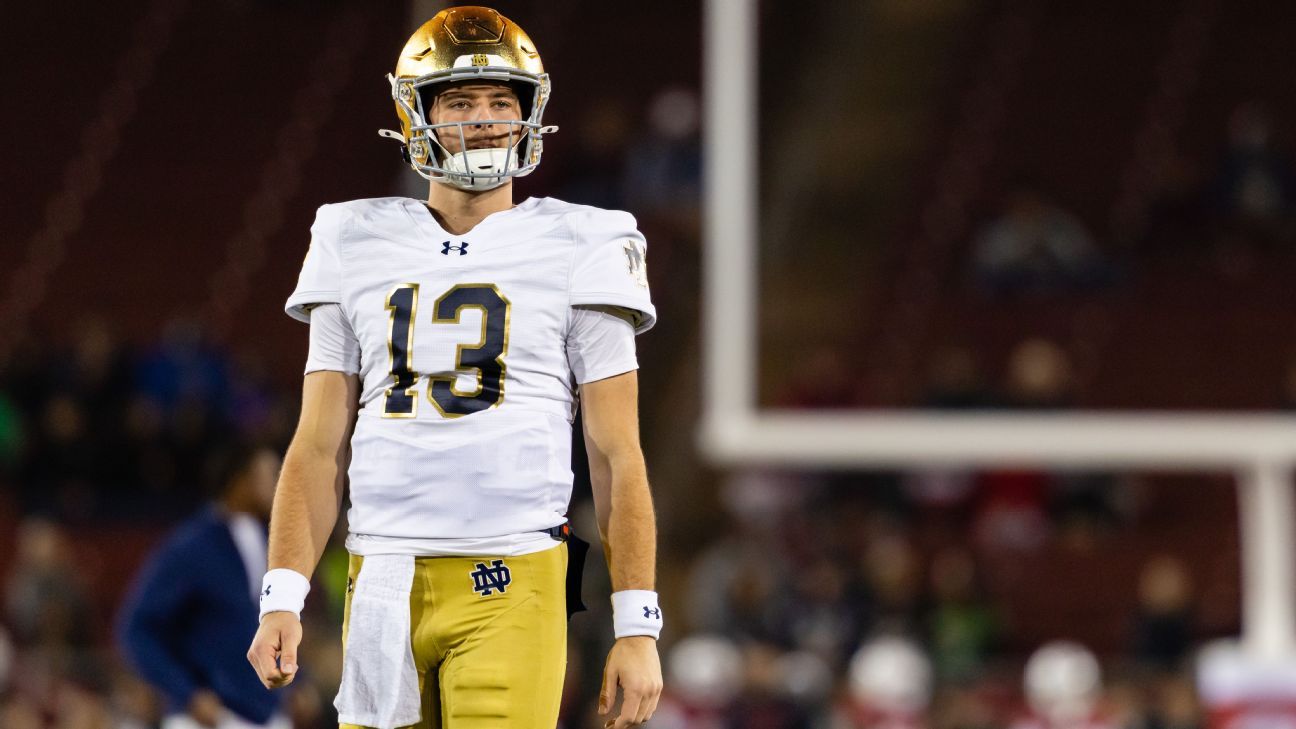
SOUTH BEND, Ind. — Chad Carr would have loved to have seen his big brother CJ wearing the golden helmet of Notre Dame.
Chad zigged when others zagged. Even though he hailed from one of Michigan football’s most famous families, with a grandfather, Lloyd Carr, who coached the Wolverines to 122 wins and a national title in 1997, Chad didn’t always fall in line with the maize and blue.
“He would be happy that I didn’t go with the grain,” CJ Carr told ESPN about his brother who died of brain cancer in 2015 at just 5 years old. “He really liked to kind of push people’s buttons by cheering for other teams. So he would have thought it’s funny.”
CJ’s decision to become an “Irishman,” as he calls himself, and immerse himself in all that Notre Dame offers, has illuminated how he views his life and career, and potentially his college football legacy. The program that cherishes its independence above all else, even amid criticism, is now being led by a quarterback with a true independent streak.
“He’s his own man, and he’s trying to build his own path,” Notre Dame cornerback Leonard Moore said.
Carr’s path has only one acceptable endpoint, which has eluded Notre Dame for the past 38 years — a national championship. Other Fighting Irish quarterbacks have targeted titles, but, for different reasons, haven’t achieved them. While Notre Dame’s title drought is pegged to several causes, a frequently cited one has been its lack of a truly elite quarterback.
The Irish have not produced an NFL first-round draft pick at QB since Brady Quinn in 2007, and have had just four quarterbacks selected in the first three rounds since Joe Montana was a third-round pick in 1979. They haven’t had a top-25 passer in the FBS since 2012 (Everett Golson) and no top-10 passers since Jimmy Clausen in 2009.
Notre Dame has been waiting for a quarterback such as Carr, whose natural ability is supported by a meticulous approach toward the position he plays, and a competitive fire that burns even hotter since the team’s College Football Playoff snub in December. He has drawn praise throughout spring practice, which wrapped up Saturday with the Blue-Gold Game, and will enter the season as a national awards candidate and a quarterback to watch for the 2027 NFL draft.
“He’s a competitor, he’s a leader, he doesn’t follow the trends of others,” Notre Dame coach Marcus Freeman said. “Man, he’s a trendsetter.”
Before Carr could be any of those things, though, he had to win the starting job.
SPEND TIME AROUND Carr these days and he presents fully as QB1. But rewind to August and his status was cloudy, as the competition with Kenny Minchey had spilled into training camp.
Even though Carr came to Notre Dame as the more decorated prospect — ESPN’s No. 36 overall recruit in the 2024 class — he was limited by a throwing elbow injury as a true freshman and didn’t separate from Minchey, a dual threat who had played sparingly in two years at Notre Dame.
“Every day was a very stressful and high-pressure situation, every rep mattered,” Carr said. “You’re always evaluating your performance and the other guy’s performance. As much as you’d like to say you’re just worried about yourself, the comparison comes in.”
Quarterbacks coach Gino Guidugli said both Carr and Minchey “saw the world through a realistic lens,” and didn’t need to be told who had the better practice. Guidugli stressed to both that they were competing to maximize reps, whether with the starters or backups.
The job wouldn’t be won with one good or bad day.
“It was so close,” Guidugli said.
Freeman had not faced a quarterback decision since 2022, his first full year as head coach, when Notre Dame went with Tyler Buchner over Drew Pyne. The team then turned to experienced transfers in 2023 (Wake Forest’s Sam Hartman) and 2024 (Duke’s Riley Leonard).
As the 2025 season opener at Miami loomed, Freeman would be picking between two players who had never started a game.
“What made it difficult is you couldn’t really look at the stats from practice,” Freeman said. “They both had good days, they both had days they didn’t perform as well. You just had to spend some time in solitude and make the decision. And I didn’t know if that decision was going to carry through the entirety of the season.”
Freeman went with his gut and picked Carr, whose starting debut came against a Miami defense that would finish fourth nationally in sacks and propel the Hurricanes to their first College Football Playoff. There would be no easing in for Carr, and the results were predictably choppy but mostly positive: 221 passing yards on 63.3% completions, two touchdowns, one interception, one rushing touchdown.
Carr’s most encouraging moment came after his worst, an interception in Irish territory. He then led consecutive scoring drives to give Notre Dame a chance in the final minutes.
“It’s like, ‘Hey, dude, we ain’t got time to bang our helmet and throw s— around,'” Guidugli said. “The way he responded in that game and those moments, took us down, scored a touchdown late, you knew you had a good one.”
Despite Notre Dame’s 0-2 start, Carr showed increased promise as the games went along. Following a Week 4 blowout of Arkansas, when Carr passed for 354 yards and four touchdowns with no interceptions, completing 22 of 30 attempts, Freeman called his skill set “rare.”
After being intercepted in each of his first two starts, Carr threw only four picks in his final 249 pass attempts, finishing with 2,741 yards and 24 touchdowns.
“His arm talent is as good as I’ve been around,” said offensive coordinator Mike Denbrock, who coached Heisman Trophy winner Jayden Daniels at LSU in 2021. “On top of that, his ability to process information and looks to recall situational things based on coverage, those things are, for his age, at another level.”
Carr eclipsed 200 passing yards in nine games, but he also steered an offense propelled by running back Jeremiyah Love, the Doak Walker Award winner.
Denbrock describes Carr as “an aggressive thinker,” which in quarterback parlance often translates to gunslinger. He trusts his ability and isn’t afraid to take a chance.
But his first season as the starter, especially playing alongside players such as Love, helped Carr understand something else.
“I learned my job is not to be a superstar,” he said. “My job is to execute the offense. I don’t need to do it all.”
His job description might change in 2026.
JUST SOUTH OF the University of Michigan in Ann Arbor, on the other side of I-94, is the town of Saline. Hornet Stadium at Saline High School sits just 5.4 miles away from the Big House.
Many affiliated with Michigan football also have ties to Saline or the high school.
“A ton of Michigan coaches send their [kids] there, they live in Saline, so there’s a lot of carryover,” said Joe Palka, who coached Saline High’s football team from 2012 to 2023. “Lloyd [Carr] himself lives in Saline. Everybody’s right there.”
As a freshman at Saline High, CJ played in spurts. Then the state paused its high school playoffs because of COVID-19. When play resumed in January, starting quarterback Larry Robinson, who went on to play at Army and Western Michigan, fell ill and Carr had to start the regional championship against Rockford.
Although Saline didn’t win, Carr’s performance against Rockford’s pressuring defense solidified his status and accelerated recruiting interest. Palka received calls from Michigan and Michigan State about a week later.
“At that point in time, we knew he was going to be the guy moving forward,” Palka said.
Carr had 8,135 passing yards and 78 touchdowns during his final three seasons as Saline’s starter. At the time, Guidugli and Denbrock were coaching at Cincinnati and LSU, respectively. They stopped by Saline to see Carr, but without much optimism.
“You’re recruiting CJ Carr, Lloyd Carr’s grandson, to try to come to Cincinnati, but this kid’s going to Michigan, right?” Guidugli said. “That was the assumption by everybody around the country.”
Those in Saline thought the same. But Carr’s parents, Tammi and Jason, Lloyd’s son and a former Michigan quarterback, made it clear from the start of the recruiting process that CJ would make his own decision.
Michigan had been the first school to offer CJ and remained in the mix until the end of his recruitment. But he wasn’t totally sold.
“Growing up, you’re told Michigan is the best place and you should go to Michigan,” he said. “For me at least, it was similar to some of the other schools I’d heard about, where kids are like, ‘Yeah, this is good, there’s some pros, there’s some cons.’
“You had grown up thinking: This is the best university on Earth.”
Ironically, CJ heard that same description about Notre Dame from everyone he met on campus there. At first, he wondered why: There’s nothing to do, you’ve got to go to class, it’s cold. But the more time he spent at Notre Dame, he began to understand why students felt that way.
As he became a bona fide national recruit, interest spiked, including from SEC schools. Even Ohio State stopped by Saline High to watch Carr throw (Palka remembers then-Notre Dame offensive coordinator Tommy Rees, Carr’s primary recruiter, staying at the school until the Buckeyes coaches left).
Jason Carr didn’t want CJ to rush his college decision. After one of many Notre Dame visits in 2022, the Carrs were still set to see several SEC schools.
“Cancel the visits,” CJ told his dad. “I’m not going anywhere else. I’m going to Notre Dame.”
WHEN CJ CARR makes up his mind, as he showed with his college choice, there’s no hesitation. But he doesn’t skip steps, either, especially with football.
As a freshman at Saline High, he began exploring arm care and worked with the school’s pitching coach to outline a program, which included resistance bands and exercises before football practice and during individual periods. His in-season preparation at Notre Dame is extensive and includes meeting with Guidugli to review play calls by formation, third-down looks and in-game hypotheticals.
They review each practice script and game-call sheet. On Friday nights, they watch a game, with Guidugli making “random calls, based on the formation” and Carr asking questions or explaining what he would do.
“His routine is the separation and his ability to process,” Guidugli said.
In Carr’s first year at Notre Dame, he rarely left the football complex, as doubts swirled in his mind: I’m not good enough. This is not what it should look like. We’re going to just stay in here until we figure it out. He has since streamlined his approach.
“You can get burned out,” he said. “So I’ve had to focus more on efficiency and getting work that I need to get in, in a timely manner, and then going home and resting and sleeping and eating and recovering.”
Carr’s detailed approach toward football is an inherited trait. Jason texts CJ after every game, asking what he saw in several situations. Then Jason rewatches the game and sends a separate set of notes.
They conducted similar reviews when CJ and his younger brother, Tommy, were growing up.
“Some of my best memories are sitting in my dad’s office with my brother, watching high school tape and yelling at each other, getting in screaming matches about where the ball should go, and how my feet are off, and I’m like, ‘They’re not off!'” CJ recalled.
CJ and Tommy reacted differently. CJ welcomed the verbal sparring, while Tommy, a quarterback at Saline High who signed with Michigan in December, would leave the room.
“It pisses him off in a different way than it pisses me off,” CJ said, while adding, “Football has been a way for our family to connect and bond throughout my whole life.”
There was a third Carr brother, of course. Chad’s diagnosis and battle with diffuse intrinsic pontine glioma (DIPG), an inoperable brain tumor, put a spotlight on the Carr family between Lloyd’s retirement and CJ’s recruiting rise. CJ was 10 when Chad died.
Along with another family impacted by DIPG, Tammi and Jason formed the ChadTough Defeat DIPG Foundation, which has committed more than $40 million to researchers focused on fighting the disease.
“It’s just amazing to get to know that family, to get to know why CJ is the way he is and to get to know them outside of football,” said Freeman, who has attended ChadTough events.
In November, CJ wrote about Chad in The Players Tribune, in an essay headlined, “100 Years of Love in 5 years of Life.” He did so in part to get ahead of the inevitable questions about a difficult topic as his own national profile increased.
But he also wanted people to know Chad — not just the disease that claimed his life.
CJ wrote: “One big thing Chad taught us all was about doing the unexpected, and not being predictable, and trying new things. He always had the courage to not just go along with the plan. … Chad would crack up about me going to Notre Dame, for sure. Like: Don’t let anyone tell you what to do. Do what you want! I can almost hear him laughing about it in my mind. And that makes me smile.”
THE IRONY OF Freeman and Carr being the faces of Notre Dame football isn’t lost on either man. Freeman was an All-Big Ten linebacker for Ohio State who had a team-high nine tackles when the Buckeyes beat Michigan in Lloyd Carr’s final regular-season game in 2007. CJ was just 2 then but part of a family of Wolverines.
Now they’re both at Notre Dame.
“We’ve spent many hours talking about how both of us were raised and how unique it is that our paths have led us to Notre Dame,” Freeman said. “Life is unpredictable, and it’s crazy how your journeys lead you to different places. And listen, my decision to come to Notre Dame was probably a lot different, and I would even venture to say easier, than CJ’s.”
Denbrock thinks Carr ultimately saw Notre Dame as “a greater challenge” and wanted to “chase something down or make his own way while he’s doing it.” Like everyone else at Notre Dame, he’s chasing a national championship.
As a high school senior, he saw Michigan win its first title of his lifetime. The next year at Notre Dame, Carr watched from the sideline as Leonard led the Irish to the championship game, only to fall against Ohio State.
“All I could think about was, ‘Man, he’s lucky, I’m jealous,'” Carr said. “I want to be the guy who’s in this position, who’s leading the guys. I was hoping he would do it, but also, selfishly, I want to do it, too.”
In nine months, he could get the chance.
“It would mean everything to me, it would mean everything to the program, just to be there and win one and take it home,” Carr said. “We’re gonna push every day, and we’re gonna get there. We’re gonna do it.”
Leave a Reply