

Attorneys for the New York Times will be in court on Thursday to fight a series of grand jury subpoenas they allege were to attempt to retaliate against and intimidate reporters whose work angered President Donald Trump.
Lawyers for the newspaper are asking a federal judge to quash those subpoenas, which seek to compel the journalists to testify about their sources, as well as access the phone records of the reporters and some of their family members.
“The Government’s actions violate the most basic First Amendment protections for newsgathering activity. They represent the latest salvo in an escalating series of attacks on journalists to intimidate them from engaging in reporting that the Trump Administration openly detests,” lawyers for the New York Times wrote in a court filing last week.
The legal fight over the subpoenas stems from the New York Times’ reporting about reported security concerns related to the new Air Force One airplane donated to the United States by the Qatari government. Citing unnamed sources, the paper reported the newly commissioned plane “lacks the same defensive countermeasures that were security features of the old model, including its advanced antimissile capabilities.”
Shortly after the reporting was published, the Department of Justice served subpoenas compelling the reporters to testify before a grand jury, as well as a series of subpoenas to phone companies for the records of the reporters and some of their relatives, according to court filings.
The Department of Justice has defended the subpoenas in court filings, arguing they are trying to identify if government employees are leaking classified information that impacts national security.
“The above-referenced articles presented a substantial national security concern, including because they indicated potential leaks of classified or national defense information that appeared to have been provided to the Times when the President of the United States, senior officials, and reporters were flying in foreign airspace during a time of hostilities with a foreign adversary that has made clear its intent to harm the President and U.S. interests,” wrote Sean Buckley, the Deputy United States Attorney for the Southern District of New York.

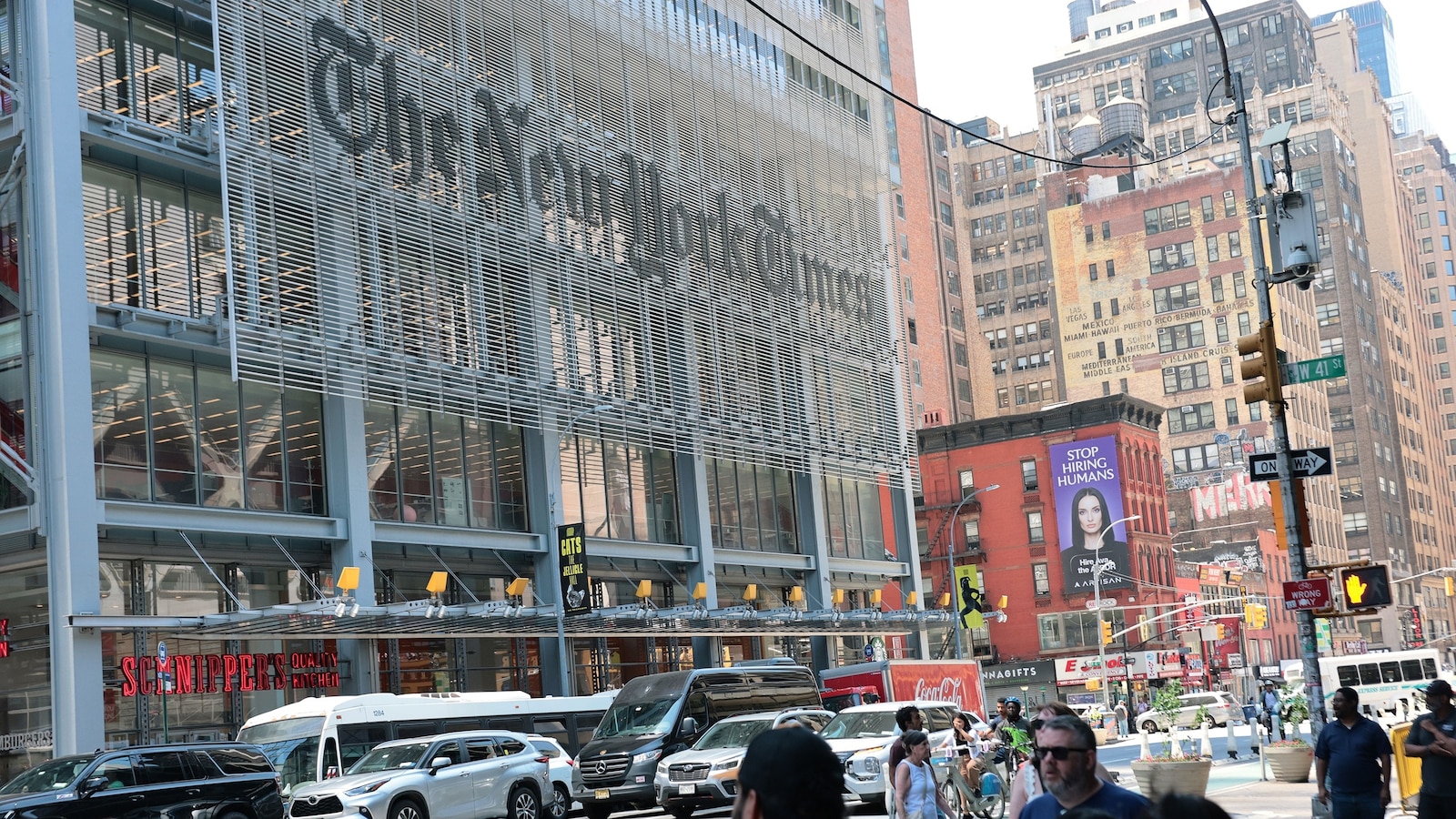
In this May 20, 2026, file photo, The New York Times building is shown in New York.
Michael M. Santiago/Getty Images, FILE
However, lawyers for the New York Times argue that the subpoenas are unlawful and unconstitutional because they “were issued in a bad faith effort to harass,” intimidate and retaliate against the newspaper, which they said, “has been a particular lightning rod for the President’s ire.”
“Every indication supports the conclusion that the Administration issued the Subpoenas because the reporting enraged the President and embarrassed him by resurfacing and reinforcing criticism about his acceptance of a jet from a foreign government and his insistence on quickly retrofitting it for use as Air Force One,” the Times attorneys wrote.
The Qatari royal family donated the $400 million Boeing 747-8 to the United States last year, and the Air Force had estimated it would cost less than $400 million to retrofit the plane. It’s unclear how much money has been spent on the plane so far, and the plane is expected to undergo further upgrades.
Shortly before Trump leaves office, the ownership of the plane is expected to be transferred to the Donald J. Trump Presidential Library Foundation, so Trump can continue using the luxury aircraft.
Lawyers for the New York Times also argue that the subpoenas violate the basic journalistic protections affirmed by the 2nd U.S. Circuit Court of Appeals, which established a three-part test to evaluate if a journalist must disclose their sources. Under that test, prosecutors would need to demonstrate that they have exhausted all other options to get the information.
“The timing compels the conclusion that the Government did not even try to comply with its own regulations governing media subpoenas,” lawyers for the New York Times wrote in a court filing, highlighting that the subpoenas were served within a day of the investigation beginning. “In that brief period, the Government plainly did not have time to commence, much less conduct, an investigation of any suspected leak of classified or National Defense Information.”
The Times has also accused the Department of Justice of violating their own guidelines for notifying reporters about the subpoenas, as well as issuing another subpoena after the outlet filed its motion to quash the initial subpoenas. According to a court filing last week, the Department of Justice served at least two subpoenas to phone providers after the New York Times raised concerns about the lawfulness of the first subpoenas.
Federal prosecutors deny that they violated DOJ policies, failed to carry out initial investigative steps, or lack a legal basis for the probe.
“We value and appreciate the important role that the press plays in this country, but DOJ also plays an important role to make sure that the people entrusted with our nation’s secrets do what they’re supposed to do with that information, which means not sharing classified information,” a Department of Justice spokesperson said earlier this month.





Leave a Reply