

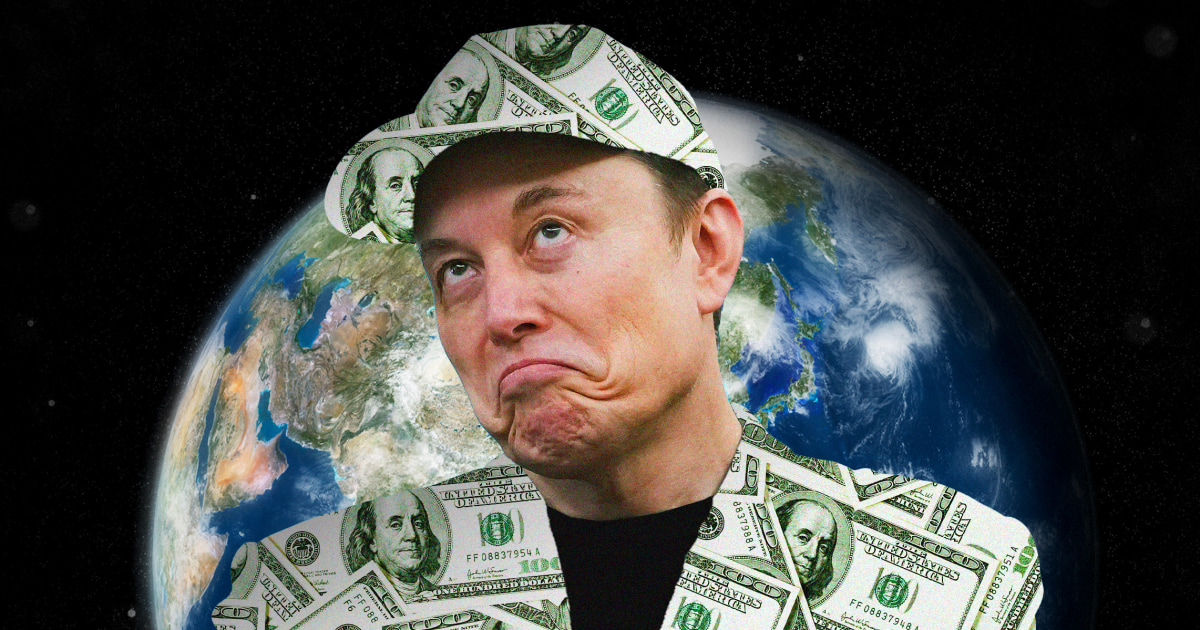
Progressive politicians are sharpening their attacks against tech tycoon Elon Musk, zeroing in on his soon-to-be-trillionaire status days before his company SpaceX’s record-setting initial public offering.
Subscribe to read this story ad-free
Get unlimited access to ad-free articles and exclusive content.

Musk, the wealthiest person in the world, is expected to become its first trillionaire when his rocket company begins selling shares to the public as soon as next Friday, June 12.
While Musk has already faced intense criticism from Democrats after his chain saw-wielding tenure in the Trump administration, his rise to trillionaire status is making him an even bigger target among politicians who want to highlight the nation’s wealth gap ahead of the midterm elections.
“Income inequality is a huge problem in America and having our first trillionaire vividly illustrates the problem,” Darrell West, a senior fellow at the Brookings Institution who researches the subject, said in an email. “This will be an issue in 2026 and 2028.”
A trillionaire is someone who has $1,000,000,000,000 or more — or 1,000 times the threshold for a billionaire. Scientific research says it’s a figure so large and surreal that it’s difficult for humans to put into context.
For anyone concerned about rising inequality, it’s no longer just about “millionaires and billionaires” — a catchphrase for progressives for many years. And the latest entry into the political lexicon is spreading quickly online and on the campaign trail.
“Nobody should be a trillionaire. Tax the damn rich,” Rep. Pramila Jayapal, D-Wash., said recently on X.
Sen. Bernie Sanders, I-Vt., said at a rally in Maine last month that Musk is “going to get even richer, I think, in the next couple of weeks” and that it was “insanity” for him to have so much wealth.
Mallory McMorrow, a state lawmaker in Michigan who’s running in the Democratic primary for the U.S. Senate, called out Musk at a candidate forum this year, saying: “The rich are getting richer. We have Elon Musk, who wants to be a trillionaire.”
In a phone interview Tuesday, McMorrow said she has continued to raise the subject of Musk’s net worth with audiences. She said it’s an effective jumping-off point for other subjects, including gas prices, cuts to healthcare spending and the government contracts that have helped make SpaceX successful.
“Elon Musk is somebody who would not be as successful as he is without billions of dollars of government contracts and subsidies,” she said.
“One trillion dollars is enough money to run the entire state of Michigan, a state of 10 million people, and all of the healthcare and all of the infrastructure and all of the schools and everything that goes into a state budget for more than 12 years,” she said. (The state budget is $81 billion.)
Online outrage about Musk’s projected trillionaire designation has been building for months. Last year, after he got a massive new compensation deal from Tesla that could one day be worth $1 trillion, a Europe-based abortion-rights group got 354,000 likes on Instagram with a post declaring (wrongly) that Musk had already become a trillionaire and suggesting humanitarian uses for the money. The post was shared by others, including singer-songwriter Billie Eilish, who called Musk a “coward,” among other insults. Musk responded that Eilish was “not the sharpest tool in the shed.”
Now, Musk’s pursuit of a $1 trillion net worth is becoming a reliable way to evoke a response at campaign stops and progressive events. People booed the idea of Musk as a trillionaire at a labor rally in New York in April and at a “No Kings” rally in Washington, D.C., last year when Sanders brought it up.
Musk, the CEO of SpaceX and Tesla, didn’t respond to a request for comment. He has defended his wealth, saying he plans to use his personal net worth for a human settlement on Mars rather than for himself. The idea is built into the SpaceX investor prospectus, with Musk not getting his stock bonus until the company has a city on Mars with 1 million people.
“I really don’t have any other motivation for personally accumulating assets except to be able to make the biggest contribution I can to making life multi-planetary,” Musk told the International Astronautical Congress in Guadalajara, Mexico, in a speech in 2016, when he was worth about $12 billion. The audience applauded the pledge.
Musk has also defended how much he pays in taxes. In 2021, he said he was paying more than $11 billion in taxes that year. He hasn’t released his tax bills for other years, and in 2018, he paid no federal income taxes, according to ProPublica, which said it had obtained IRS data on wealthy Americans. Musk doesn’t appear to have commented on the 2018 figure. Federal taxes apply to income, not to a person’s net worth.
But it’s not just Musk critics who are talking about his next big wealth milestone. Anticipation is also rising among Musk fans. On X, which Musk owns, some of his admirers are counting down the days until they think it will happen or interpreting it as validation of his approach to business.
“The man is absolutely unstoppable,” a MAGA influencer account that uses the name Gunther Eagleman and has 1.7 million followers on X posted last month. “Tesla, SpaceX, xAI, Starlink, and everything else he touches turns to gold.”
The shift to talking about trillionaires has come about suddenly. A decade ago, there was no one in the world worth even $100 billion. Amazon founder Jeff Bezos was the first to cross that threshold, in November 2017.
Though the world has never seen someone with a $1 trillion net worth, oil baron John D. Rockefeller was maybe the closest when the context of the times is taken into account, according to Bloomberg: His wealth in 1915 was equal to about one-thirtieth of the U.S. gross domestic product, similar to the position of a trillionaire now.
It’s not clear how many Americans are aware that Musk is approaching trillionaire status or how they’ll react if and when he crosses it, but public polling shows skepticism toward extreme wealth. An Economist/YouGov poll of American adults in January found that 80% of respondents say the gap between the rich and the poor is a very big or somewhat big problem, while 59% say the federal government should try to reduce the gap.
“There is a growing public backlash against large-scale wealth because too many of those individuals pay very low income tax rates for the kind of money they have,” said West, of the Brookings Institution.
Some progressive strategists said they see Musk’s becoming a trillionaire as a potential political gift because it highlights a contrast with the strained finances of the middle class.
“There are plenty of ads out there taking on the billionaire class already, and I think his trillionaire status will bring that to the fore,” said Mark Longabaugh, a progressive media consultant and a veteran of Sanders’ 2016 presidential campaign.
He said Musk has become a symbol in some voters’ minds of how the wealthy live different lives, supplanting past villains, such as the Koch brothers, who were a favorite target of Sanders in 2016.
Randi Weingarten, president of the American Federation of Teachers, denounced “billionaires or trillionaires” at a rally in April. She told NBC News in a statement that Musk’s net worth is a politically potent subject to talk about because “most people can’t afford to buy a home and are one illness away from bankruptcy.”
The number itself can be difficult for humans to grasp. A study published in 2013 and based on experiments at the University of Richmond found that many people had difficulty understanding how numbers like 1 million, 1 billion and 1 trillion relate to one another. Asked to place the numbers on a line, about 35% of people spaced them “roughly equally” apart, which is incorrect. The authors concluded that it may be clearer to express a number like $1 trillion as $1,000 billion, instead.
“These numbers are beyond human experiences, so humans have no reference point for it. My guess is that Elon Musk has no idea what it means, because it is outside human experience,” said Nora Newcombe, a psychology professor at Temple University who has studied the topic and ways to improve understanding.
A personal net worth of $1 trillion would make Musk wealthier than all but a handful of corporations — Walmart’s market capitalization is about $910 billion — and is roughly equal to the gross domestic product of Pennsylvania. It’s also equal to the wealth of a million millionaires.
Musk is approaching $1 trillion at a key time for the wealth debate. In California, voters may see a ballot referendum this fall on whether to impose a new 5% tax on people with net worths of more than $1 billion, echoing similar proposals that have been introduced in Congress. Some billionaires have pushed back, threatening to leave California and pouring money into alternative ballot questions that could conflict with the wealth tax.
Musk, who lives in Texas, wouldn’t be subject to the proposed California billionaire tax, but his likely trillionaire status could still be galvanizing to the debate over the ballot measure.
“That is mind-blowing to me, as someone who is not a billion-, million- or trillionaire,” said Quiana Hall, a steward with SEIU-UHW, the union that’s backing the California billionaire tax. She said revenue from the tax could help health clinics stay afloat in the face of other government cutbacks.
“There’s a lot to give in that trillion,” she said.
Musk remains mostly unpopular. About 46% of respondents said they had unfavorable views of him in a March YouGov poll, while 30% said they had favorable views.
“I do think he’s a pretty perfect villain. He’s super rich, but he’s also super influential,” said Rebecca Pearcey, a Democratic strategist who worked on Sen. Elizabeth Warren’s 2020 presidential campaign.
But she said there’s a risk in a political message that’s purely about taxing the rich.
“It’s not, ‘Elon Musk has all this money. How do we take it from him?’ It’s ‘How do you make sure everyone is playing by the same rules?’” she said.





Leave a Reply