

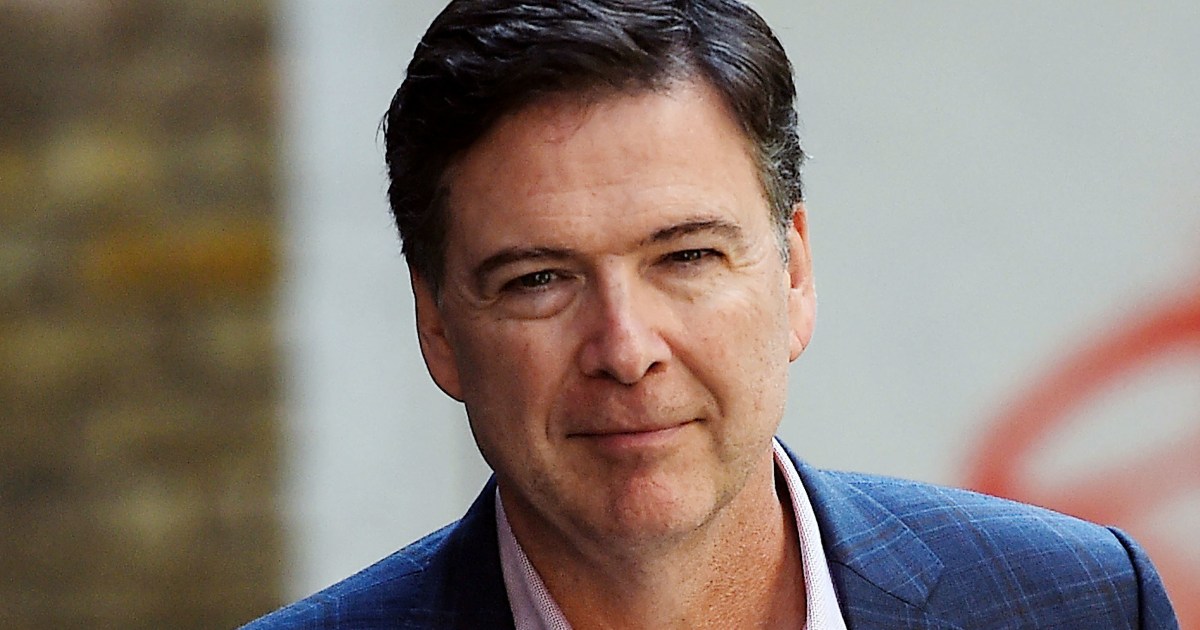
Former FBI Director James Comey said Monday that the Trump administration’s pursuit of another indictment against him — this time over an Instagram photo of seashells — reflects the president’s fixation on going after his critics.
Subscribe to read this story ad-free
Get unlimited access to ad-free articles and exclusive content.

“Donald Trump has a bottomless desire to gain revenge against those who criticized him,” Comey said in his first post-indictment interview with Nicolle Wallace on MS NOW.
He said his family had gotten use to the consequences of his Trump criticism, with his daughter being fired as a prosecutor in the Southern District of New York and his son-in-law resigning as a prosecutor in the Eastern District of Virginia.
“There’s a cost to speaking up in this strange era, awful era we’re in now,” Comey said. “I’m not gonna to be quiet, I’m going to continue to speak about what I believe.”
Comey said he was innocent of the allegation that he threatened the president via a seashells photo, adding that Trump seemed to be obsessed with him.
“I am going to continue to speak up because I have grandchildren, and someday they’ll be old enough to understand his time, and I want them to know what Pop did during this period of time,” Comey said.
The Trump administration secured the indictment late last month from a federal grand jury sitting in the Eastern District of North Carolina, where Comey has a beach house. The case centers upon a May 2025 Instagram photo of seashells that were arranged to form the numbers “8647,” which the indictment asserts is “a serious expression of an intent to do harm to the President of the United States.”
Trump administration officials have said that the case goes beyond just the photo and that investigators collected other pieces of evidence over the course of the 11 months that passed between Comey’s Instagram post and when they sought the indictment last month.
Comey said there is a risk that the country becomes “numb” to what critics have called the weaponization of the Justice Department. He said even he was susceptible. “Even I can feel it, ‘Oh, the second time, whatever,’” Comey said about the latest indictment. “This is not normal, this is not who we are.”
The White House did not immediately respond to a request for comment Monday.
Trump has called for Comey’s prosecution, and his former aide Lindsey Halligan secured an indictment in September on charges of lying to Congress. The case was invalidated after a judge ruled that Halligan was improperly appointed to her position as a top prosecutor.
Comey’s legal team said they plan to motion for the dismissal of the seashell case, calling it a product of selective and vindictive prosecution like they did after last year’s indictment.

Legal experts across the political spectrum say the new Comey case is built on sand and doubt it can survive legal challenges, especially given the wide variety of ways that “86” — which is “everyday lingo” in the restaurant industry — can be interpreted.
Comey had previously said that he and his wife came across the seashell arrangement while on a beach walk, and that their initial thought was that someone had spelled out an address. His wife, who had worked in a restaurant, recognized the term “87,” and they soon realized it was a political message and his wife suggested Comey post it, he told Stephen Colbert last year. “Cool shell formation on my beach walk,” he wrote in a caption with the post, which he soon deleted amid backlash.
The seashells case was brought forth by U.S. Attorney for the Eastern District of North Carolina, W. Ellis Boyle, who was appointed to the post by former Attorney General Pam Bondi, and Assistant U.S. Attorney Matthew Petracca, a former Republican county committeeman in New Jersey who was hired by Boyle months ago, as NBC News previously reported.
The indictment asserts that “a reasonable recipient who is familiar with the circumstances” would interpret the photo as a threat. But legal experts said that language is outdated, given that current Supreme Court precedent requires prosecutors to show the defendant intended to communicate a threat and had an understanding of the threatening nature of a statement.
Sarah Krissoff, a former federal prosecutor in the Southern District of New York who’s now at the law firm Cozen O’Connor, told NBC News that it’s difficult to get a case dismissed by arguing that the underlying indictment is fundamentally flawed, while adding that the “absurdity” of the charges against Comey may encourage a judge to find a way to do so.
“Comey’s legal team will certainly try to make arguments that the indictment is flawed on its face, and generally, those are challenging arguments to win. The law only requires that an indictment sets out the basic elements of a crime. But given the history here, and the absurdity of criminal charges in these circumstances, the judge may work hard to find a way to dismiss the indictment early on,” Krissoff said.
Comey’s case was assigned to U.S. District Judge Louise Wood Flanagan, an appointee of former President George W. Bush.
Krissoff said under 2024 Supreme Court precedent, prosecutors must “show both that there was a true threat, and that the defendant intended to make a threat.” Federal prosecutors, she said, may try to argue that the “knowingly and willfully” language in the indictment is enough for it to stand.
Acting Attorney General Todd Blanche has said there’s a “body of evidence” collected by the Justice Department in the seashells case, but has not detailed the evidence, citing grand jury secrecy rules.






Leave a Reply