

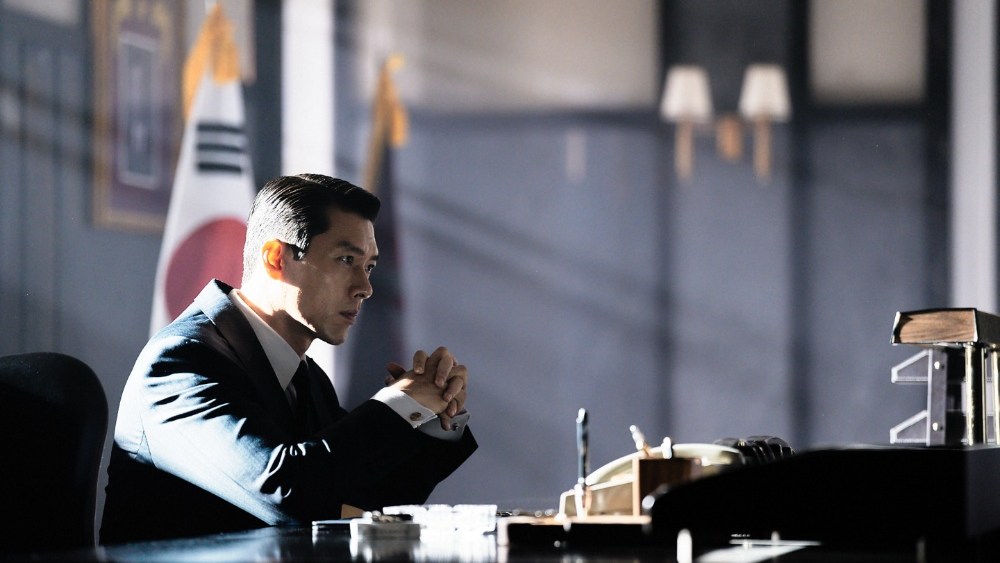
At a some KRW70 billion ($51 million) across two seasons, “Made in Korea” ranks among the most expensive K-dramas ever made.
Season 2 premieres six episodes on Hulu and Disney+ Sept. 9, closing the story in 1979, the year Korean politics came apart in 10 weeks.
Season 1 left viewers in the 1970s, inside the Korean Central Intelligence Agency’s anti-communist propaganda machine and alongside Baek Ki-tae’s expanding drug operation. Season 2 jumps forward nine years, to a presidential assassination, military coups and an unstable state that changes hands many times in the months that follow.
“It was one of the most chaotic and tumultuous times in modern Korean history,” says director Woo Min-ho (“Harbin”), who saw the period as the natural endpoint for his characters’ ambitions. Woo has also already been here before. His 2020 feature “The Man Standing Next” dramatized the 40 days leading to the assassination.
The gap was a deliberate choice. “Nine years seemed like an appropriate number of years, and it’s a long period of time that can change people significantly,” says Woo. Besides history, the main draw of the season is how changed all the characters are. Ki-tae is now second-in-command at the KCIA, closer than he has ever been to the top job. “While rising through the ranks, he has met and dealt with many people and his methods have changed,” says Hyun Bin (“Crash Landing on You,” “Harbin”), who plays Baek Ki-tae. The character’s wealth and status have reshaped his relationships and the way he treats the people around him.
That drift is what drives the season’s central conflict: the widening gap between Ki-tae and his younger brother, Baek Ki-hyun, the once-timid recruit now risen through military ranks. Woo Do-hwan (“Bloodhounds,” “Mr. Plankton”), who plays Baek Ki-hyun, says his character’s social position has changed and he has gained some power of his own, allowing him to talk back to his brother more, adding, “His beliefs have become stronger.”
As for Jang Geon-young, the relentless prosecutor at the center of Season 1, his fate is left as a mystery. But expect him to “ride the tide of an emerging power, to return with the goal of exacting his revenge,” teases Jung Woo-sung (“Steel Rain,” “12.12: The Day”), who plays the character. The show’s noir movie aesthetics still serve its story of political ambition, where revenge is disguised as justice and greed hidden behind lofty lies of patriotism.
“In Season 1, each episode featured a different event and a different story, revolving around different characters,” Woo says. “So each episode almost felt like a standalone film. Season 2 consists of six episodes, but they progress in a way that will make them feel like parts of one continuous movie. I think viewers will find Season 2 tighter in narrative and faster-paced compared to Season 1.”
That compression reflects a broader shift. Disney+, like Netflix, Coupang Play, Wavve, Watcha and Tving, has been steadily dismantling the Korean broadcast standard of a single 16-episode season, and are recruiting film directors for shorter prestige runs.
Hyun Bin built his early career on 16-episode dramas in the 2000s, and says the appeal of a returning role is specific: finding out what the years did to his character. “Being able to experience an era of our own country that I couldn’t experience in real life is something I can only do thanks to this job of being an actor,” he says.
“Made in Korea” will end here, but the century does not. Park Eun-gyo, who shares writing credit on the series, is already moving into the next decade with “The Koreans,” a Korean take on FX’s award-winning “The Americans,” due on Hulu and Disney+ next year and set in the 1990s, another period of tumultuous politics.






Leave a Reply