

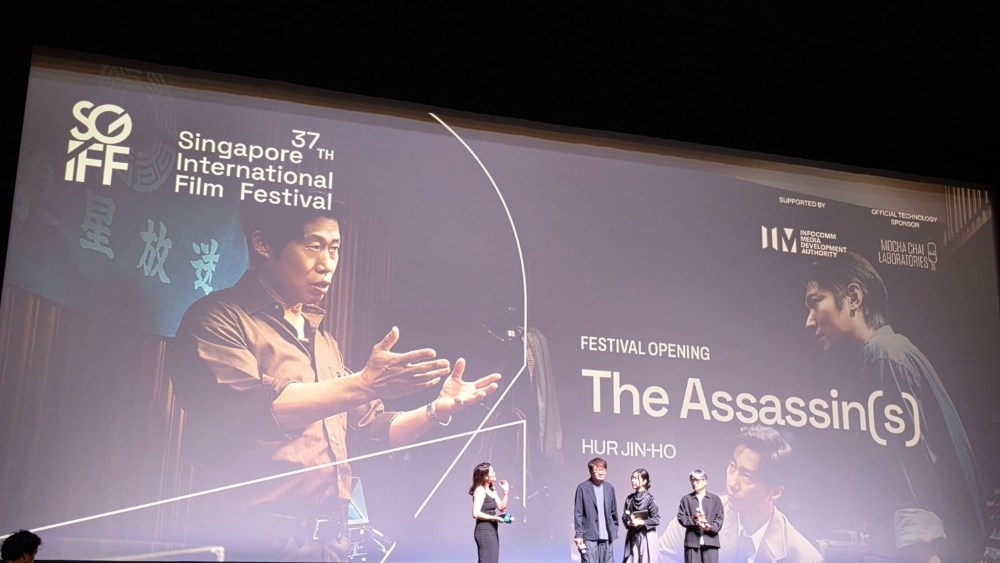
South Korean director Hur Jin-ho thanked the Singapore International Film Festival (SGIFF) for defending freedom of expression as his political thriller “The Assassin(s)” opened the festival’s 37th edition on Wednesday, two weeks after the Korea’s conservative opposition asked SGIFF to pull it.
“I am truly grateful to the film festival for protecting artistic freedom and the freedom of expression in cinema, and I believe this decision by the festival will give great courage to those of us who made this film, including myself, the staff, and the actors,” Hur said as the end credits rolled.
The gala screening took place at the Sands Theatre at Marina Bay Sands, as the smoke haze that has hung over Singapore in recent weeks, carried from fires in Indonesia’s Sumatra and Kalimantan, lifted slightly.
On Oct. 6, the People Power Party (PPP) wrote to SGIFF executive director Jeremy Chua on behalf of all 109 of its lawmakers, asking the festival to reverse the selection. The festival kept the film, and in an Oct. 7 statement said it had been chosen “through SGIFF’s independent curatorial process for its artistic merit and contribution to contemporary Asian cinema.”
Festival chair Boo Junfeng, the Singaporean director of Cannes selections “Sandcastle” and “Apprentice,” told the opening-night audience that the team had been flooded with messages from a group in South Korea pressing it to cancel the screening, and had also received many notes of support. “SGIFF has carefully considered the various arguments put forth, and we see the film as an artistic interpretation of historical events, and we respect the creative vision of the makers behind it. Therefore, we stand by our decision to have the film as our opening,” Boo said.
He also thanked Hur and his team “for making their way here to join us despite the pressures back at home.”
“We have a no-cut policy. We refuse to show anything that has been censored, because we believe films should be seen as their makers had intended, and nothing should alter their vision,” Boo said.
Boo called the direct link between a filmmaker’s vision and a paying audience a legacy that the festival’s founders fought to secure and that the current team means to protect.
“It is not always easy to remain steadfast in the face of pressure, but I suppose choosing the path of least resistance isn’t quite in our DNA,” he added.
“The Assassin(s),” which opened in Korea on Sept. 23, returns to Aug. 15, 1974, when first lady Yuk Young-soo, wife of then-President Park Chung-hee, was shot dead at the National Theater during a Liberation Day ceremony. Yoo Hae-jin stars as a police inspector who sees the attack and heads the inquiry. Park Hae-il plays a senior newspaper editor and Lee Min-ho a cub reporter. Investigators at the time held gunman Mun Se-gwang solely responsible, claiming he was working for North Korea and for Chongryon, the Japan-based association of pro-Pyongyang Korean residents. Hur’s film stops short of naming a culprit, and its critics argue that the open ending implicates Park or his government.
In its letter, the PPP argued the film distorts history “in a manner that runs deeply counter to public sentiment in the Republic of Korea.” The party cited a survey in which 58.2% of respondents said the film distorts history, along with objections from Park Ji-man, the son of Park and Yuk, and from foundations linked to the couple.
“Nowhere in the film is any specific individual defined as being behind the incident, and the film’s hypotheses and dramatic settings are not presented as historical fact,” the film’s producers said in a Sept. 28 statement.
The dispute had already disrupted the film’s festival outing at home. The Busan International Film Festival called off a career talk with star Lee Min-ho, and distributor Hive Media Corp. pulled the cast and crew from all Busan appearances on safety grounds, while a conservative activist group said it would picket Yoo’s home every day. A former PPP Seoul city councilor has also asked police to investigate Hur, Hive Media CEO Kim Won-kuk and the film’s two writers for defamation, and the Directors Guild of Korea and Producers Guild of Korea have both spoken out against the targeting of those who worked on the film.
On stage in Singapore, Hur said the 1974 shooting took place when he was in fifth grade and had stayed with him as among the darkest chapters of Korea’s modern history. “Regarding that incident, there were discrepancies between what was officially announced at the time and the actual facts that came to light later on. I wanted to craft that aspect into a pursuit thriller format, which is why I chose to make this film,” he said.
Kim, who joined Hur on stage, has worked on four consecutive films with the director: “The Last Princess,” “Forbidden Dream,” “A Normal Family” and “The Assassin(s).” He said Hur’s “Christmas in August” was one of his favorite films long before the two met. “Whenever we work together, he is a director who places immense value on details – details regarding human nature as well as the details of the incidents,” Kim said.
Present in the audience were Indian superstar and filmmaker Aamir Khan, and celebrated Asian director Peter Chan Ho-sun, both of whom will deliver masterclasses at the festival on Thursday.
SGIFF runs through Nov. 1.


Leave a Reply