

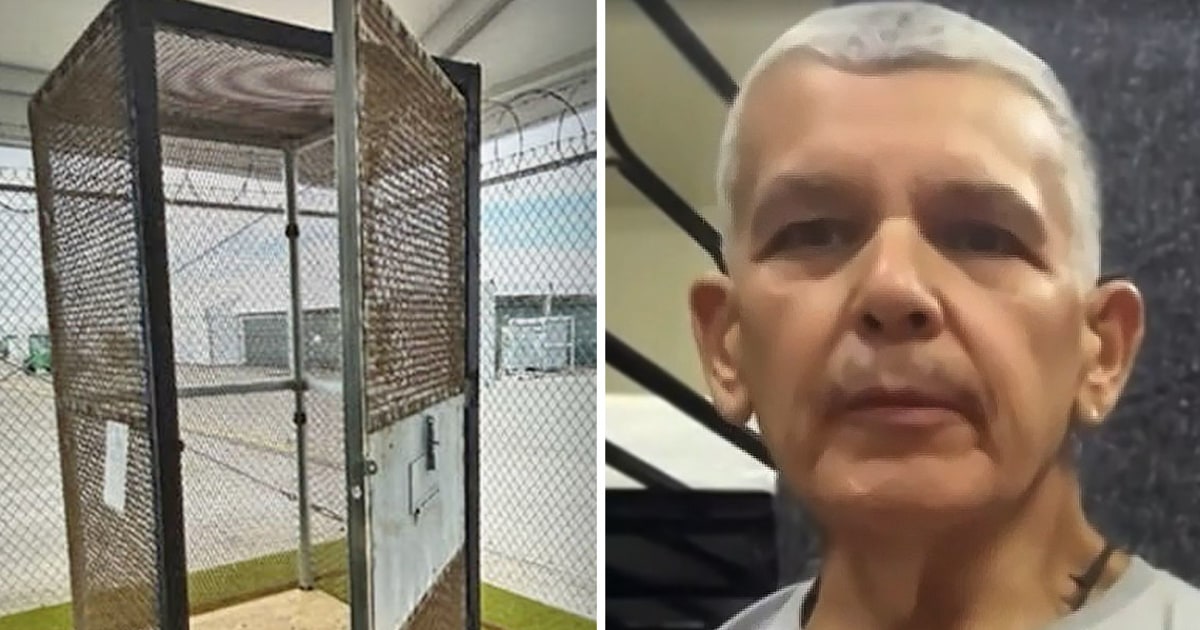
For around 15 hours, immigration detention officers kept Raúl Suárez Herrero confined in a cage slightly larger than a phone booth, where he feared snakes and endured mosquitoes in the middle of Florida swampland, the former detainee alleged.
Suárez, 59, told José Díaz-Balart in an interview for Noticias Telemundo’s “Ahora 360” that he was forced into the cage, measuring 7 feet, 9 inches high and 4 feet, 3 inches square, for praying out loud for an ill young man at “Alligator Alcatraz,” an ICE detention site.
“I feel like I was in hell,” Suárez later told NBC News in a phone interview from Mexico, where he was deported.
Suárez spoke days after a Department of Homeland Security watchdog confirmed the use of the phone booth-sized cages at the now-shuttered Florida detention camp in a Sept. 11 report.
“The use of such restrictive spaces is highly unconventional and does not align with standards for humane treatment,” the report said.
The DHS Office of Inspector General report documented its inspectors’ findings during an unannounced January visit to the Ochopee, Florida, site.

In December, Amnesty International issued its own report on conditions at the detention site based on interviews with detainees and its own tour of the facility. The organization detailed the use of the small cages and said it amounted to torture.
The facility staff told inspectors that the cages were “calming areas” where immigrants could de-escalate and have time alone and that no one spent more than two hours inside them.
But Suárez told Noticias Telemundo that “they took me there and I spent more than 15 hours inside in that little hole,” referring to the small cage. He said he was forced in around 1 p.m. and taken out at about 5 a.m. “when morning was breaking.” According to Suarez, the cage was in a recreation area where detainees took exercise time. Suarez said he couldn’t stretch out on the cage floor and got little sleep for fear of what might slither into the cage.
“I had to be careful because on the ground there were snakes and you don’t see them. You can’t fall asleep because they can come into the cage,” Suárez said in a video interview.
DHS did not directly address Suárez’s allegations or case in response to questions from NBC News. But a spokesperson rejected “claims that there were ‘inhumane’ conditions” at the immigrant detention center. Those claims are “categorically false” and any allegations of excessive use of force are “FALSE,” the spokesperson said in an email.
“No detainees were being beaten or abused,” the DHS spokesperson said. DHS provides long-standing medical, dental and mental health services, three meals a day that are evaluated by certified dietitians, clean water, clothing, bedding and hygiene products and access to phones to talk with family and lawyers, the spokesperson stated.
Alligator Alcatraz’s standards were consistent with those under other administrations, the spokesperson also said. Further questions were referred to the state of Florida, “as this facility was managed by the State of Florida through the Division of Emergency Management.”

The facility in the heart of the Everglades was built by Florida Gov. Ron DeSantis as part of the state’s push to support President Donald Trump’s aggressive immigration crackdown.
Alex Lafranconi, a spokesman for DeSantis, has dismissed criticism of the small cages. Lafranconi has described the small cages as a confinement area for “violent criminal aliens who have proven they cannot remain peaceful,” and said “we’d make them smaller, if we could.”
Although DHS said the inspector general “indicated” all recommendations have been administratively closed, the OIG said in its report that the administration did not address its 10 recommendations, including that it “discontinue the use of the small metal enclosures to hold detainees for any reason or amount of time.”
The OIG also said that at the time of the inspection, all the detainees were ICE detainees and there was evidence that ICE had some degree of oversight authority and engagement at the facility.

Originally from Cuba and in the U.S. since he was 12, Suarez was detained by ICE in July 2025 during an ICE check-in.
Before it was recently ordered closed, Alligator Alcatraz had been denounced by multiple detainees and legal and immigrant advocates for its conditions.
The detention facility’s records state the average time people were placed in the smaller cages with metal fencing was 59 minutes and 27 seconds, according to the OIG report. But the OIG said it could not confirm or refute ICE officials’ assertions regarding use of the enclosures or detainees’ allegations they had been denied food or other abuses.
The small cages at the facility were supposed to be a “safe and secure place” where people could “reflect on their behavior choices, manage their emotions, reduce stress, and practice self-directed behavior” according to the detention camp’s policies, the report stated.
According to detention center records cited by the OIG, 79 people were held in the small cages during the period of July 17, 2025, to Jan. 18, and none were held more than two hours. Detainees in the small cage “may leave at any time by detainee request or per staff directive,” according to the report.
But Suárez was adamant that his confinement was not voluntary and lasted far more than two hours.
“Everybody lied” about the small cages, Suárez said, disputing that he could have gotten out or requested to be let out.
He said he was forced into the cage after praying out loud for a man who had an epileptic seizure as they were waiting to get registered at the detention camp.
Help for the man was taking “too long,” according to Suárez. That’s when he said he started praying aloud, as he used to do at the evangelical church he attended before his arrest.
“I asked God for the young man’s life,” he said.
Suárez alleged two guards then forced him to stand up, asked where he was from and then grabbed him and dragged him “all the way back to where that little cell was.” He said he was kicked in the leg so hard he thought they broke it. “My leg was so big and black.”
“They just dropped me over there and locked the doors,” he said. He said he got no medical treatment for his leg or a medical evaluation after the confinement.
Suárez said his experience has left him psychologically “shattered.”
Suárez was removed to Mexico in February after more than four decades of living in the United States. He was detained on July 16, 2025, when he went to an immigration check-in.
Suárez had been ordered removed from the U.S. in 2000 after serving a prison sentence stemming from a plea agreement on a drug charge. Because Cuba was not accepting U.S. deportees then, Suárez was released and told to check in with ICE annually, a court document states. Cuba has allowed few of its citizens to return after U.S. deportation.
An attorney attempted to get Suárez released from detention. The federal judge had given DHS until late January to remove him or release him, but the judge then extended the government’s time for two weeks. On the deadline date, Feb. 11, DHS deported Suárez to Mexico and the judge closed the case.
“Forty-seven years. They took me to the U.S. as a 12-year-old, when I was a child,” Suárez said. “I was raised my whole life there [in the U.S.]. I’m bilingual and everything. I went to school there and everything. And everything happened from one moment to the next. I still can’t absorb what happened.”
Suárez said he had been a truck driver since he was 17 and had built his own truck driving business with his brother, an American citizen, who died in 2021 from Covid. His father had died in Cuba when he was 3 and his mother, who became a U.S. citizen, died about a decade ago.
When immigration laws were toughened in 1996, making legal residents deportable for certain crimes, he could no longer seek U.S. citizenship, he said.
His mother had urged him to get citizenship, but he didn’t do it, he said.
“I was pretty young. When you are pretty young, you don’t listen to anybody,” he said. He had no other encounters with law enforcement, he said. He said he’d been living a normal life, preparing to buy a house and had a girlfriend.
“Life is changed. I don’t know what is going to happen here in Mexico.”





Leave a Reply