

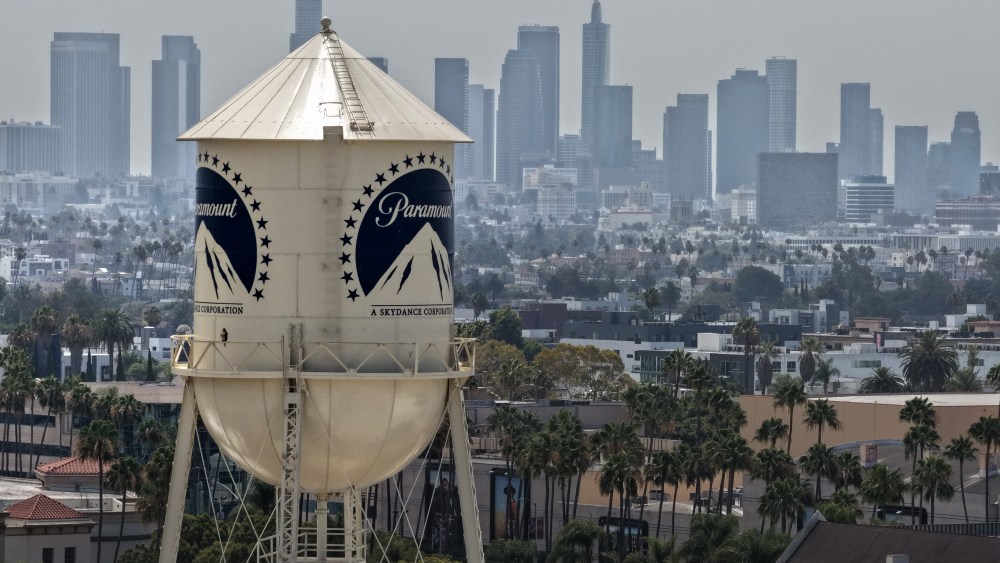
A judge on Friday heard arguments on a state coalition’s bid for a restraining order to pause the Paramount-Warner Bros. Discovery merger, and said she would issue a ruling by next Wednesday.
Judge Araceli Martinez-Olguin suggested at one point that Paramount had conceded that it will not suffer harm if a temporary restraining order is granted, which would put the merger on hold for up to 28 days.
Led by California, 12 states are seeking to block the merger on the grounds that it will harm competition in the theatrical and basic cable markets. Paramount’s lead attorney, Jeffrey Kessler, argued that the states had failed to make the necessary case that the deal is anticompetitive. Paramount has argued that the success of recent releases like “F1,” from Apple, and “Project Hail Mary,” from Amazon MGM Studios, shows that the theatrical business is open to new entrants.
“In this industry, talent is completely mobile,” Kessler argued. “So actors, writers, directors — they go from studio to studio.”
James Weingarten, arguing for the states, noted that “F1” was actually distributed by Warner Bros. — emphasizing the stable role of incumbent players in a mature marketplace.
“That’s the power of the five majors,” Weingarten argued. “Apple is not in the movie business. They’re in the cell phone and laptop business.”
Martinez-Olguin seemed inclined to grant that the questions of market concentration are sufficiently in dispute to at least grant a restraining order. Citing the evidence put forward by Paramount, she asked Kessler: “Why doesn’t that just bolster the conclusion that there are serious questions here as to the legality of the merger?”
She also focused on the difficulty of reversing the merger if it is allowed to proceed and later ruled to be unlawful, asking the parties to address the challenge of “unscrambling the egg.”
Kessler made clear that the company is most focused on getting a ruling on a preliminary injunction by early September. He offered to stipulate that the deal will not close in the next 30 days if the parties would agree to a hearing on the injunction motion sometime in late August.
Starting on Sept. 30, Paramount will be on the hook to pay investors $7 million a day if the deal has not closed — marking a key deadline in the case. Paramount has previously promised not to close the transaction before July 22.
The hearing lasted about 75 minutes. Kessler argued that the court should not rely on the states’ statistics for market concentration, noting that subscribers to basic cable are dwindling. In response, Weingarten noted that 50% of TV households still have cable TV — or 67 million Americans. He also argued that the five largest theatrical distributors — Paramount, Warner Bros., Disney, Universal and Sony — have held consistent market share for the last 10-15 years.
“These are not dying industries,” Weingarten said. “These are $10 billion, $40 billion, industries in movie theater distribution and cable, respectively.”
The states have argued that the merger threatens to increase prices and reduce output, harming theaters, cable and satellite distributors, and ultimately harming consumers as well. The states’ complaint alleges that the combined company will control 30% of the market for “anticipated top-grossing films.”
Kessler previewed Paramount’s challenge to that market definition, noting that “Obsession” would not be considered a blockbuster by the states’ definition because it did not open on at least 3,000 screens. He also noted that Lionsgate — not one of the five top distributors — scored one of the year’s biggest hits with “Michael.”
Kessler also argued that the Paramount and WBD cable lineups are complementary — not overlapping — and thus combining them won’t harm competition. Weingarten scoffed at that argument.
“You don’t need a fancy degree in economics to understand that if one company owns both of the packages, they’ll have increased bargaining leverage,” he said, adding that the combined entity will control 50 of the 189 basic cable channels.
“There has not been a new one since 2020,” Weingarten added. “Not a single new basic cable channel since 2020. That shows how little entry there is into this market.”





Leave a Reply