

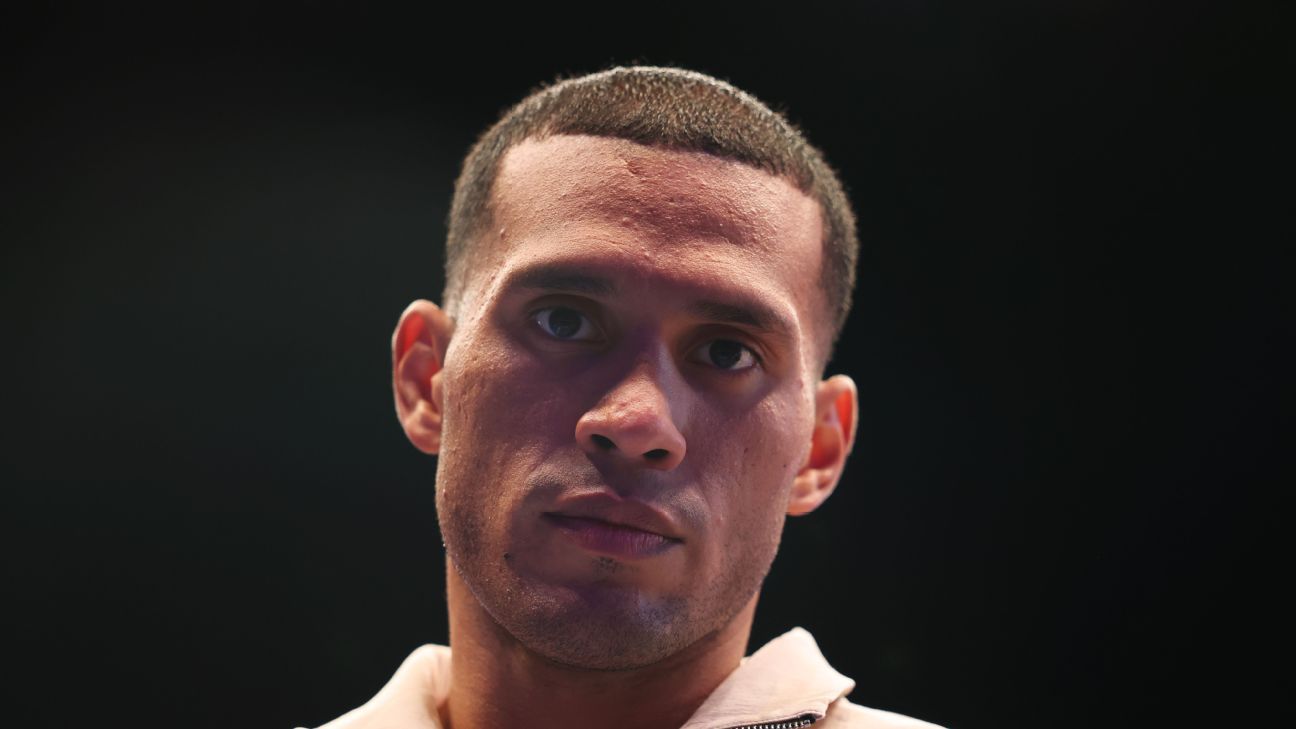
In May 2013, Gennadiy “GGG” Golovkin was at The Summit Gym in Big Bear Lake, California, making final preparations to defend his WBA middleweight title against Matthew Macklin. Golovkin was still on the rise with an impressive knockout and title defense streak while also being on the verge of being recognized as one of the best pound-for-pound fighters in the world. Despite all of this, Golovkin’s trainer, Abel Sanchez, couldn’t help but go out of his way to gush over a 16-year-old sparring partner who had a granite chin, unbelievable hand speed and — as boxing trainers tend to say about highly valued sparring partners — was giving Golovkin and everyone in the gym “good work.”
Sanchez predicted back then that the teenager, who was barely old enough to drive but was standing toe to toe with grown men with established boxing pedigrees, would become a world champion.
That teenager was David Benavidez.
“He had a lot of gumption for a 16-year-old to want to spar with a seasoned pro,” Sanchez told ESPN. “I thought he had good skills and a bright future. He was developing the hand speed and combination punching back then and has matured into an exceptional fighter.”
Thirteen years later, Benavidez (31-0, 25 KOs) is a two-division world champion and ESPN’s No. 5 pound-for-pound fighter. From his willingness to face all comers to a style that produces fireworks, the traits that Sanchez spotted in the teenager are matured and refined.
Benavidez’s style has made him a fighter who doesn’t know the meaning of “cruising to victory.” Every moment of a Benavidez fight is a situation where he is trying to break his opponent by any means necessary. His mindset leads to riveting fights that, at least for him, are all gas, no brakes. That approach has earned him respect from his peers and fans alike, something he’s been looking for since he left his home as a teenager to pursue greatness.
A pivotal moment for Benavidez could still be ahead. If he defeats unified cruiserweight champion Gilberto “Zurdo” Ramirez on Saturday (PBC on Prime Video PPV, 8 p.m. ET), it would not only add a significant name to his résumé but also allow him to move beyond constant comparisons to perennial pound-for-pound king Canelo Alvarez, the long-discussed fight between them that never materialized and the the opportunity to take the baton from Canelo as the best Mexican fighter of his generation.
“I don’t just want to be the face of Mexican boxing or even boxing; I want to be that face of entertainment, period,” Benavidez told ESPN. “I want to be that fighter who you know you’re going to get in an action-packed fight no matter who he’s fighting against. Once you see me fight that one time, I guarantee you that you will never stop watching me.”
In a world where leveraging social media as a marketing tool, protecting undefeated records and manufacturing beef are the recipe for generating interest, Benavidez eschews the idea of selling himself, instead relying on a simple concept that he’s carried since his early years when he was learning how to jab.
“I just like beating people up.”
JOSE BENAVIDEZ SR. had a rough upbringing, from working in the fields of Sinaloa, Mexico, at age 11 to his teenage years in California filled with violence, drugs, guns and gangs. The chaos in his life led him to believe that he wouldn’t live long enough to grow grey in his beard. He felt haunted, so much so that when he and his Ecuadorian wife brought their two sons into the world after moving to Phoenix in the 1990s, the only thing he wanted was for them to have the ability to defend themselves.
“I wanted to show them everything that I could in case something happened to me and they needed to protect themselves,” Benavidez Sr. told ESPN. “I wanted to make warriors.”
David and his older brother, Jose Benavidez Jr., were thrown into every sport from baseball to distance running to test their physical ability, but it was boxing that stuck with both boys. Jose Jr. was a prodigy, fighting elementary school kids of his age in amateur boxing matches and later becoming the youngest ever Golden Gloves champion at 16. David came along later, with much less fanfare, but was noticeably gifted with remarkable hand speed. Benavidez Sr. boasts about David having his first boxing match at 2 years old, but it was his older brother who was the agent of chaos largely responsible for cultivating David’s aptitude for throwing hands.
“My dad didn’t know how we really were at school,” Jose Jr. told ESPN. “I used to make him fight because I wanted to fight. I’d always pick the kids who had older brothers around my age so if they jumped in, I would be there to fight them.”
When they weren’t boxing in the gym, David and Jose Jr. were sharpening their tools against any neighborhood kid who wanted to test them. Jose Jr. enjoyed starting fights and having David finish them. When you speak to them, you quickly realize Jose Jr. fought because he wanted to and David fought because he had to.
“My brother was a knucklehead who made me fight everybody in the neighborhood,” David said. “I was the calm guy. I didn’t like to fight people in the street but would if I had to. I always liked fighting, though. I was born into it and have spent my entire life trying to get better at it.”
After Benavidez Sr. and his wife separated in 2000, Jose Jr. moved to California with his father, while David remained in Arizona with his mother, Alma, and younger sister, Isabel. Jose Jr. thrived in the amateurs while David went through a difficult stretch during which he wasn’t able to channel his natural ability into boxing. By age 13, his weight had climbed to around 250 pounds. Meanwhile, Jose Jr. built a 120-5 amateur record and turned pro in 2010. Jose Jr. remembers seeing his brother for the first time in two years when he visited him in Arizona shortly after Jose Jr.’s pro debut and being stunned by how out of shape he was. Junior refused to watch his brother eat his life away and hatched a plan to help David before it was too late.
“I wasn’t going to let him waste his ability,” Jose Jr. said. “I picked him up from my mother and took him to California with me. My mother called and asked where he was at because he had school. I told her, ‘I’m sorry to tell you, Ma, but David isn’t coming back anymore.’ She was mad and didn’t talk to me for a year because I kidnapped my brother, but I wasn’t going to allow him to waste his talent and took him with me to Wild Card Boxing Club.”
David dropped out of high school, and Jose Jr. and his father threw David to the wolves at Wild Card, the gym in Hollywood owned by renowned trainer Freddie Roach. Jose Jr. remembers everyone scoffing at his overweight brother but having a change of heart after stepping into the ring with him.
“He just started breaking motherf—ers apart,” Jose Jr. said. “I always knew what my brother had. I just had to bring it out of him.”
Rather than emulate his older brother’s amateur career, David opted to spend the next few years fighting off the extra weight. He plied his craft primarily as a sparring partner at gyms all over the country, standing across the ring from former champions such as Kelly Pavlik and Peter Quillin. That plan not only got him in shape but also molded his style into the exciting fighter who is always looking to hurt his opponent.
“I have never tried to outpoint somebody in a fight,” Benavidez said. “I was always sparring against older guys who had more experience, and most of them tried to run through me. There was no point system; it was either kill or be killed for me. It was a real fight whenever I stepped into the ring. No judges. I had to defend myself from not getting knocked out and would end up getting the best of those guys.”
The Benavidez brothers relocated back to Arizona in 2014 and burned through the opposition, with Jose Jr. being the first to win a title that same year by beating Mauricio Herrera for the interim WBA junior welterweight belt. David was working his way up, stopping his first seven opponents. Jose Jr.’s bank account grew while David was still making a name for himself.
Everything changed for the brothers in 2016 when Jose Jr. was shot in the leg while walking his dog in Phoenix. The incident shattered his knee and put his championship dreams on pause. Around the same time, the brothers lost two family members, with the death of his grandmother and his uncle being murdered. David chugged along, carrying the weight of both his and his brother’s aspirations.
“When I was a kid until I turned about 20 years old, I was angry at my dad because of that, because I didn’t have a childhood,” he said. “Now that I’m older, I see it and I talked to my dad and told him thank you very much for everything you did for me. … So many things happened to me and so many people I couldn’t be there for in their last moments because of boxing. We’ve sacrificed everything to boxing. It’s a difficult life, a difficult path, but this is what we wanted and we achieved it, and we’re still giving it our all because many things happened that helped us get there.”
The brothers relocated back to Los Angeles and David won the WBC super middleweight title in 2017 at age 20, making him the youngest champion in the division’s history. With success came money and Benavidez drifted into a stint of self-destructive partying that eventually led to him losing the title without a fight when he tested positive for cocaine in 2018 and was suspended.
Looking back, Benavidez said that he needed that to happen as early as it did so he could learn from his mistake, refocus and get back on track.
“I had to get that out of my system,” he said. “I’m way different now because I had my fun after going through a dark period and got off track at 20. If I didn’t live through that back then, imagine how I’d be now with 20 times the money I was making back then. Things could have gone way worse for me. I’m more mature now. I’ve grown up.”
SINCE BENAVIDEZ MADE his professional debut in August 2013, three months after that camp in Big Bear Lake, he has yet to lose a fight. “The Mexican Monster” has exceeded Sanchez’s lofty expectations as an undefeated two-division world champion who has torn through 31 straight opponents with a fan-friendly style predicated on relentless forward pressure, video game-like combination punching and an innate ability to shatter the will of his opponent.
Benavidez has become a fighter’s favorite fighter, the kind of boxer other fighters admire and fans can’t ignore.
“I love watching him fight,” former pound-for-pound king Roy Jones Jr., a member of the International Boxing Hall of Fame, told ESPN.
Jones knows what it means to create highlights. His career was one long viral moment pre-social media. Clips from Jones’ fights still make the rounds more than 20 years since he was in his prime.
“He doesn’t duck or dodge nobody,” Jones said. “A lot of fighters today hit you with a punch here and there and play it safe to win on points. Not Benavidez. He wants to hit you with five punches in a row, 10 if you let him. He’s fast with high volume and he’s punching all the time. People want to see fighters fight, and he comes forward and throws all kinds of combinations. Those combinations are both difficult and unique, and I love seeing it.
“He’s electric all the time, and that’s what is missing in boxing.”
YouTuber-turned-prize fighter Jake Paul told ESPN in the build to his fight with former heavyweight champion Anthony Joshua that Benavidez was the only fighter he wouldn’t step into the ring with because “some people are just built different.” And that was rich considering that he was about to step into the ring with — and subsequently have his jaw broken by — a much, much larger man with an elite boxing pedigree.
“Benavidez is always my No. 1 [fighter to watch],” Paul told ESPN. “I think he’s just electric, bro. That guy is different. His power, his speed, his cardio, his nonstop punching. Whenever I watch a Benavidez fight, I know I’m going to see something spectacular.”
Benavidez’s career has been built on action, and that approach has earned him respect across the sport as one of the most entertaining fighters to watch.
“David Benavidez can fight his ass off,” Terence Crawford said.
“At first, I didn’t know he was one of them guys until I went to his fight and saw him close up. I’m definitely excited to be on a card with him,” Gervonta Davis said of sharing a fight card with him last year.
Asked who was the best he ever fought, former world champion Anthony Direll said, “Benavidez, for sure.”
“I think he beats everybody,” said Mike Tyson.
Benavidez is already recognized as one of the best in the world, while also being must-see TV, a rare combination necessary to break through into the mainstream.
Benavidez routinely uses the word “respect.” For his entire life, he has fought to prove that he’s the better man. At no point in a fight did Benavidez want anyone to think that his opponents were getting the better of him.
From the kid on the playgrounds of Arizona to the teenager sparring in sweaty boxing gyms to the adult in world title fights where three judges can determine the outcome, Benavidez has always wanted to leave no doubt who is better.
That means challenging himself against the best opponents possible, even when those plans don’t pan out, such as fighting Canelo.
His incessant pursuit of a fight with Canelo, who for many years was the best fighter in the sport and the face of boxing, turned out to be fruitless. But Benavidez acknowledges that freeing himself of that dream showdown put him in a position to move on and challenge Ramirez for the unified cruiserweight championship with the potential to take over as the main event on the traditional Mexican boxing dates, Cinco De Mayo in May and Mexican Independence Day weekend in September.
Should he beat Ramirez, he plans to go back down to light heavyweight to fight either unified champion Dmitry Bivol or former champ Artur Beterbiev.
“Everything is finally falling into place,” he said. “I’m getting these big dates with big fights and I’m finally getting the respect I deserve. And all of that was because I had to be patient. Instead of getting frustrated, I knew my time would come. The face of the sport is changing hands, and I’m here to take advantage of these opportunities.”


Leave a Reply