

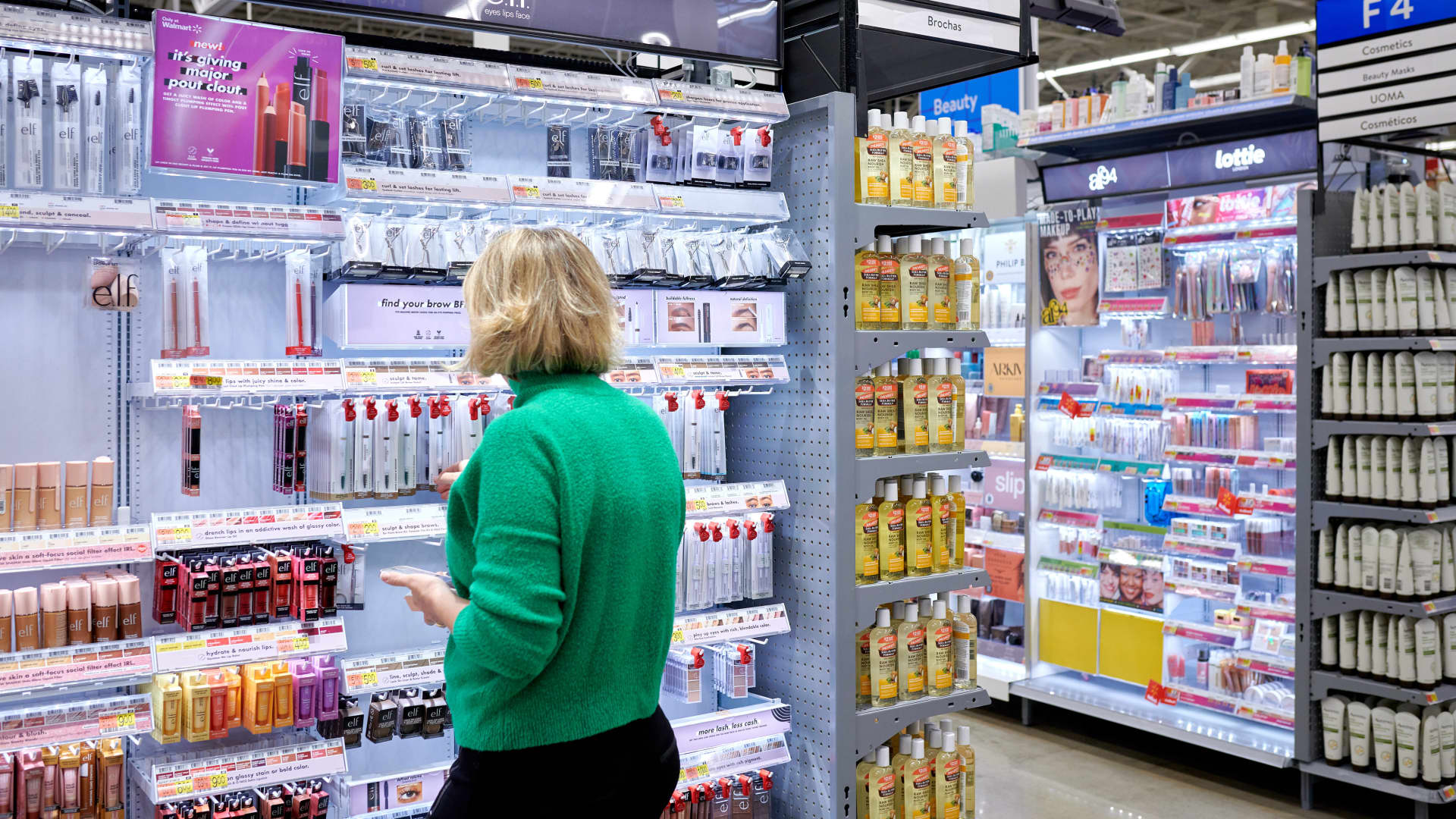
A customer shops for makeup at a Walmart store in Secaucus, New Jersey, March 5, 2024.
Gabby Jones | Bloomberg | Getty Images
As consumers become more educated about the products they’re buying and look to make more holistic purchases, a new retail category is emerging.
What were once three separate sections — beauty, health and wellness — have converged into one large category as consumers look for products that serve multiple purposes. That change in consumer behavior is creating more competition for companies racing to win over the corresponding share of customers’ wallets, industry experts said.
According to a new study from consulting firm AlixPartners, nearly 100% of consumers surveyed believe that the category is just one budget item, whereas it was three before.
The survey, conducted jointly between CEW and AlixPartners between May and June, sampled 1,000 consumers age 18 and over and split across gender, age, income brackets and regions. The survey also polled 127 executives in the beauty, health and wellness industries.
“What we found in the data is a consumer is just as likely to trade off a night cream for another night cream as a night cream for a personal trainer,” Lindy Firstenberg, co-lead of the company’s beauty, health and wellness practice, told CNBC. “Anything in beauty, health and wellness is within the consideration set.”
As wellness becomes more mainstream, 40% of consumers in the survey said they want traditional beauty companies to expand their reach in terms of the products they offer. At the same time, the AlixPartners study found that 42% of executives said they wanted their companies to stay in their lane.
“What that shows is a fundamental disconnect that consumers are asking for more; they’re asking for different, they’re asking for a new playbook, and executives are saying, ‘No, that’s way too scary. That’s not going to happen,'” Firstenberg said.
Firstenberg said she believes companies may be hesitant to take on a big bet that won’t necessarily immediately pay off on a quarterly cycle. It’s a move that would also include lengthy time for research and development and consumer profiling.
“They’re not willing to look outside of themselves in order to see that broader beauty, health and wellness bucket, which is the exact opposite of consumers,” Firstenberg said.
That trend comes as consumers are also becoming more knowledgeable about the products they’re buying and integrating a more science-backed approach to their beauty purchases, a trend AlixPartners calls the “consumer PhD.”
Firstenberg said people are also looking to other consumers, especially on social media, for which products to buy and which ones will have the best results, instead of relying on the brands.
How retailers are responding
Ulta is expanding its wellness shop to have more health-focused brands and more shelf space for those items.
Melissa Repko | CNBC
Some companies are choosing to team up with existing brands on the other side of the sector to expand their offerings.
In 2022, luxury brand Gucci partnered with wearable fitness tracker brand Oura on a specially designed ring. Last month, consumer packaged goods company Procter & Gamble agreed to acquire supplements brand Thorne for $3.8 billion in a bid to grow its health business.
Another approach is making sure those products are highlighted together.
Ulta Beauty has launched in-store wellness boutiques, which feature product categories such as supplements and skin and hair serums. Target launched the Target Beauty Studio on Sept. 10 after phasing out its shop-in-shop partnership with Ulta in August. And Sephora now has a dedicated wellness and skincare section on its website.
Walmart has been investing in varied product assortments in its stores over the past few years and leaning into both entry-level price points and premium brands, said Silvia Kawas, who leads the consumables business for Walmart U.S.
“Our customers today are actually thinking about solving problems across their health and wellness and beauty journeys more holistically than ever, and so you’ll see a lot of blurring of the lines,” Kawas told CNBC.
Kawas said Walmart, which is currently in the process of remodeling many of its stores, is placing beauty products in high-traffic areas to ensure the company stays ahead of trends. It’s also making sure store associates who are knowledgeable in the beauty and wellness industry are available to help customers, in addition to leveraging the expertise of its pharmacists.
“We have this unique advantage of being an omnichannel retailer that allows us to help service customers both from a store perspective through great assortments. … [And] we also are trusted for our everyday low price and consistency,” Kawas said.
She added that Walmart has seen its consumers going through a trial-and-error process, so the company has had success with its mini and single-serve products.
“We’re very intentional about creating this exploration, discovery and navigation in-store and online that gives [customers] confidence in the solutions that they’re buying from Walmart,” Kawas said.
A new retail landscape
Walmart’s mobile wellness tour, offering flu vaccines, immunizations, boosters and free health and vision screenings.
Michael Siluk | UCG | Universal Images Group | Getty Images
While some larger players in the retail space are leaning into the trend, others may be missing the mark, said Pierre Dupreelle, the global leader for beauty at Boston Consulting Group.
Dupreelle said the “revolution” of the beauty and wellness industry is leading to a “complete reshape,” especially with the rise of GLP-1 drugs as consumers focus on how health intersects with beauty.
“The brands that consumers are now favoring are extremely efficacious brands that are very focused on science, derm-backed, doctor-backed type of products, so there’s a set of brands that are really benefiting from this explosion of the category,” Dupreelle said. “The more traditional, more sensible skincare brands, even at the top of the price points, are definitely struggling.”
Even as consumers are squeezed by macroeconomic pressures like high gas prices, rising inflation and uncertainty from global politics, Dupreelle said they’re more likely to cut their spending on other categories before they rein in their beauty, health and wellness budget.
According to an August report from market research firm Circana, unit demand in the beauty industry remained positive through the first half of 2026 despite consumer selectivity.
The report found that skincare sales revenue grew 8% in the first half of the year, benefiting from consumers’ interest in whole body wellness.
For retailers like Walmart, that means leaning into the product assortments and price points that customers are looking for to ensure they keep coming back.
Kawas said the company is already seeing returns on that strategy with customers building bigger baskets on their way to the cash register.
“That’s the advantage, is affordability, access and flexibility to customize and personalize,” Kawas said. “I think that’s the role that we need to be playing. … The more we do that, the more repeat and loyalty we will get out of them because we’re consistent in our offering.”









Leave a Reply