

Army Secretary Dan Driscoll’s resignation follows a strained relationship with Defense Secretary Pete Hegseth and repeated warnings to the White House, including Chief of Staff Susie Wiles, about what has been described as Hegseth’s widespread and seemingly indiscriminate firing of senior military officers, according to sources familiar with the matter.
Driscoll also warned the White House about unprecedented efforts by Hegseth to block others from advancing into the military’s highest ranks after they had been thoroughly vetted, the sources said.
Driscoll resigned Monday last week at one of the busiest moments for the service since the height of the wars in Iraq and Afghanistan, creating a potentially significant leadership void as the Army takes on a growing list of demands.

Secretary of the Army Dan Driscoll, Secretary of War Pete Hegseth and President Donald Trump attend a dignified transfer at Dover Air Force Base for military casualties of the war with Iran, July 22, 2026, in Dover, Del.
Kevin Dietsch/Getty Images
Driscoll also spoke with President Donald Trump last week when he submitted his resignation, according to two sources familiar with the conversation. He told Trump that Hegseth’s chaotic removal of some of the Army’s most experienced leaders, often with little or no explanation, was hurting the force and shrinking the pool of officers available for future senior commands, one of the sources explained.
Trump appeared surprised by the extent of the problem, the source said.
More than two dozen senior U.S. military officers have been fired or sidelined by Hegseth without any public explanation.
“The President has complete trust in Secretary Hegseth, who is doing an incredible job leading the Pentagon,” Anna Kelly, a White House spokesperson said in a statement, adding that results in recent military operations, including the war in Iran “speak for themselves.”
In a statement, Pentagon spokesperson Sean Parnell said, “Secretary Hegseth communicates with the president daily and is grateful to serve a commander-in-chief who loves our military,” and he added that Hegseth “takes great pride in keeping the White House informed.”
Driscoll arrived at the Pentagon as an unconventional choice. He had no national security experience and was a little-known figure whose background was largely in venture capital and Republican politics.
He served in the Army from 2007 to 2010 as a cavalry officer with the 10th Mountain Division and deployed to Iraq in 2009. He left the service as a first lieutenant, a junior officer rank that would have given him limited exposure to the large-scale operational planning and institutional management required to run the Army.
In 2020, he ran unsuccessfully for North Carolina’s 11th Congressional District, finishing sixth in a crowded Republican primary. He later advised the Trump-Vance transition team and worked for the Republican National Committee.
But Driscoll quickly became one of the most popular figures in national security circles and earned bipartisan support on Capitol Hill. Some of that goodwill came simply from contrast with Hegseth, according to officials familiar with the dynamics.
Driscoll was widely seen as less combative and positioned himself as a driving force for modernizing the Army through updating its doctrine and integrating robots, drones and other emerging technologies into the force.
“This is a big hit to the Army,” one senior defense official said about Driscoll’s exit, speaking on the condition of anonymity because they were not authorized to talk to the press.
The official believed Driscoll had served as a buffer between Hegseth and the Army, particularly by pushing back through the White House on Hegseth’s purge of senior officers, even if those efforts ultimately did little to slow it.
Driscoll befriended Vice President JD Vance years earlier when they attended Yale Law School together. That relationship was widely viewed as a key reason Hegseth was unable for a while to push Driscoll out despite tensions between the two.
Driscoll’s popularity also grew from his work with Democrats, including Sen. Elizabeth Warren, D-Mass., on so-called right-to-repair reforms aimed at cutting through Pentagon rules and defense industry restrictions that can prevent troops from fixing their own equipment. In many cases, defense companies require their own personnel to make repairs or replace parts, an expensive process that can leave equipment sidelined for months or even years.
The Army secretary job has often been marked by turnover, with acting officials and tenures of roughly two years or less being common in the past two decades. John McHugh was a notable exception, serving from 2009 to 2015 under President Barack Obama and becoming one of the longest-serving Army secretaries in recent decades.

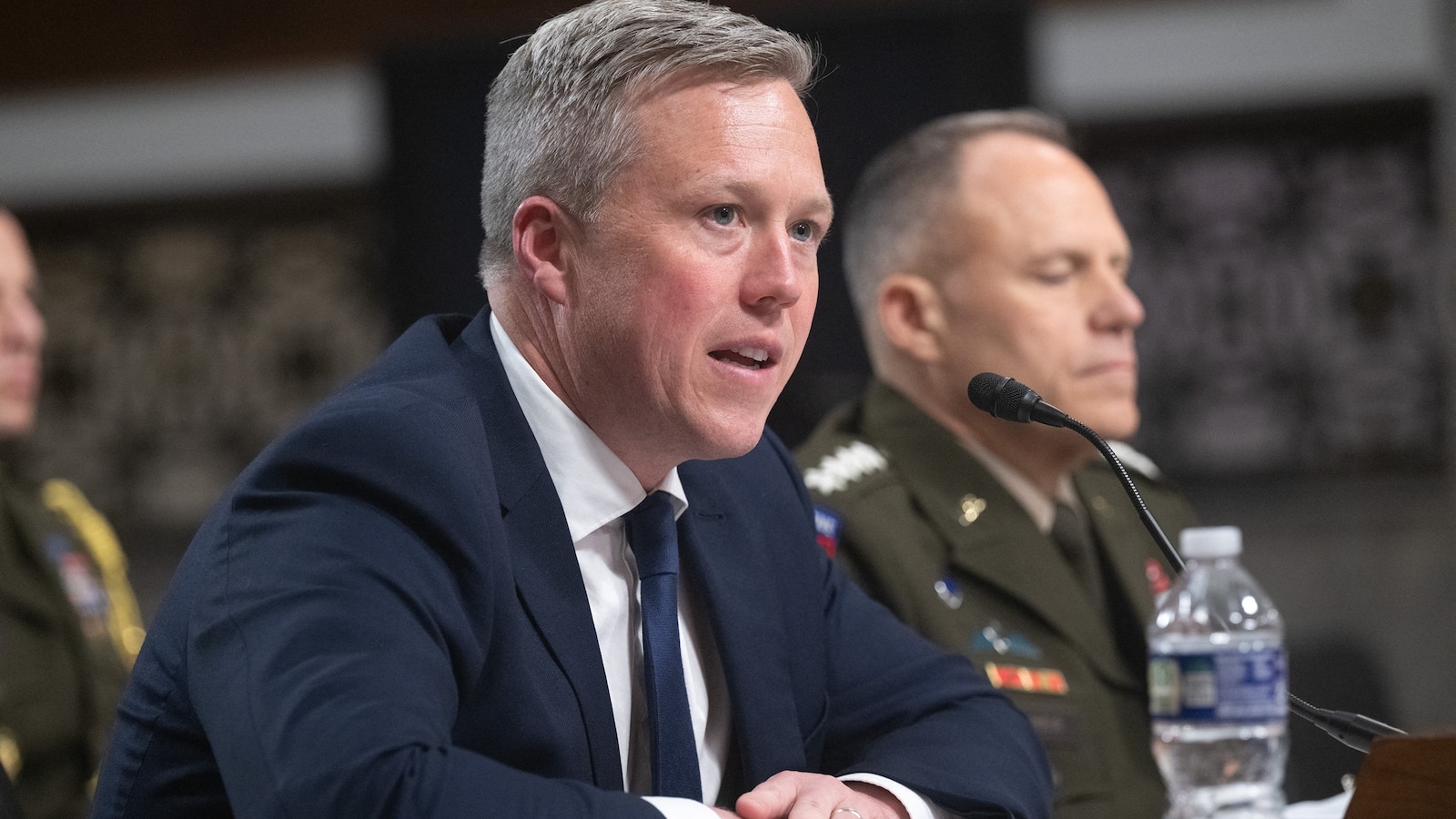
Secretary of the Army Dan Driscoll testifies on budget requests during a Senate Committee on Armed Services hearing on Capitol Hill, May 12, 2026.
Saul Loeb/AFP via Getty Images, FILE
Parnell, the Pentagon spokesperson and an Army veteran, is widely viewed as a potential replacement for Driscoll and has advocated for the job behind the scenes, according to multiple U.S. officials familiar with the matter.
However, Parnell would face a difficult confirmation fight. He dropped out of a Pennsylvania Senate race in November 2021 amid allegations from his estranged wife of abuse during a contentious child custody case. Parnell has denied the allegations.
Driscoll’s departure is the latest high-profile departure of a senior defense official during Hegseth’s tenure.
In April, then-Navy Secretary John Phelan was abruptly forced out without explanation, as was Gen. Randy George, the Army’s top officer at the time, serving as Driscoll’s most senior advisor.
On Tuesday, former Air Force Secretary Frank Kendall expressed concerns in a New York Times op-ed that the military’s senior officers have chosen to keep a low profile when it comes to some of the Trump administration’s actions involving the U.S. military, singling out Gen. Dan Caine, the chairman of the Joint Chiefs of Staff.
“When they aren’t ignoring how abnormal things have become, they turn to the other approach, claiming that they have no responsibility for the actions the armed forces have been ordered to take because those orders were ‘policy’ choices outside the scope of their duties,” wrote Kendall. “This is a cop-out, and it is putting our democracy at risk.”
When asked about Kendall’s comments, Joe Holstead, a spokesman for Caine, said: “The Chairman of the Joint Chiefs of Staff remains focused on his responsibilities as principal military advisor to the President, the Secretary of War, and the National Security Council, which include providing best military advice and a range of military options along with all associated risks, impacts, and secondary considerations.”


Leave a Reply