

“It’s so confusing sometimes to be a girl.”
Over the past several years, there’s been an ongoing — and, in many cases, much-needed — dialogue around pop stars and body image. In 2020, Taylor Swift disclosed to Variety’s Chris Willman that she would sometimes “just stop eating” and had developed an “unhealthy” relationship with food, a pattern she characterized as a Pavlovian response to constant feedback on her size from outside observers. In dialogue with Charli xcx on a remix of 2024’s “Girl, so confusing,” Lorde sang about a “war with [her] body” that entailed starving herself and then gaining the weight back — the latter seeming to cause her as much emotional pain as the former. She further elaborated in her 2025 album “Virgin,” admitting she got “sucked in” by bodily measurements like a “new waist-to-hip” ratio on a song aptly titled “Broken Glass.”
To many fans, these revelations were welcome. Just as Swift distills universal experiences like loss and heartbreak, so too can she put to words what many people feel in a world where bodies are constantly on display. The pressures Lorde faces as an exceptionally visible person are more intense than the average social media user’s inner turmoil over whether and how to edit a selfie, but they’re identical in nature. It’s reassuring to have community in that struggle, and to hear that it’s possible to come out the other side.
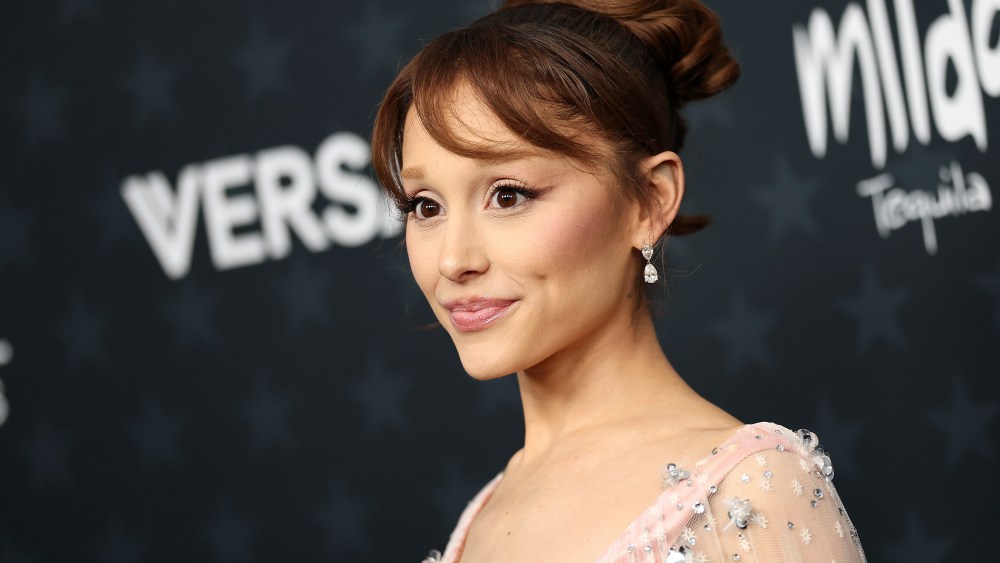
Now, Ariana Grande and the millions of eyes on her have again kicked that conversation into high gear. But this time, there’s one stark and essential difference: Grande hasn’t joined the conversation on her own terms. She’s been conscripted into it.
Concerns about Grande’s noticeably thin appearance had already been percolating since her back-to-back press tours for the blockbuster “Wicked” and its sequel “For Good,” but her new album “Petal,” the much-dissected music video for the title track and her current “Eternal Sunshine” tour have added fuel to the fire. Grande’s representatives announced on Sunday that after the tour, she plans to take “a step back from visibility” amid “endless, ongoing public scrutiny.” To that end, Grande has backed out of an upcoming commitment to star in a West End revival of Stephen Sondheim’s “Sunday in the Park with George.” But the statement made no mention of Grande’s physical or mental state apart from a clause about “finishing the tour…healthily and happily.”
On Monday, Grande put the news in her own words, while still largely avoiding specifics. “The announcement that was made yesterday was not a reactive or impulsive thing,” the singer said, without naming what she might be seen as reacting to. The “negativity” her reps cited is not keeping her from enjoying this moment of her career, she claimed. But “multiple things can be true at the same time. Yes, boundaries, they need to be set. Human beings can need a break sometimes.”
Since the release of “Petal,” social media has been flooded with screenshots showing Grande’s visible ribcage and speculation on her potential use of a prosthetic chest in one sequence of the video. Horrified, some users have shared close-ups of a handwritten list that partly reads, “Couldn’t hurt to lose a few LBs.” It should be noted that, in the video’s narrative, this sentiment isn’t expressed by Grande herself; instead, it’s an observation from a committee of male gatekeepers who pronounce her “not good enough.” But that discrepancy only complicates the matter even further.
The video, directed by Christian Breslauer, is about Grande rejecting others’ expectations. In it, she plays an anxious aspiring starlet who auditions for a panel of leering Hollywood types at “Fame, Inc.” who ignore her talent, instead finding ways to criticize her appearance no matter how she presents herself. “Should get some work done,” the execs note at one point; “Too much work done,” they write in the next sequence — the one in which fans believe she used a breastplate. Eventually, she snaps and picks up a chainsaw, earning the gratitude of all the women auditioning alongside her.
There’s certainly a worthy point somewhere in Grande’s allegorical rebellion. Given the response to the video, though, it’s downright jarring to watch the action play out to defiant lyrics like “I don’t need someone to save me” and “This is not a cry for help.” Together, the implication is that discourse about women’s bodies is always out of bounds, no matter the tone or source. But lumping together nitpicking haters and concerned well-wishers isn’t an honest way forward.
It’s true that the conversation about Grande’s body online has been cruel and unproductive. The most extreme online perspectives unfairly paint Grande as a proud proponent of anorexia — a villain proudly encouraging her massive fandom to join her on a journey of self-deprivation. On the other end of the spectrum, there are hyperdefensive stans who declare that their pop idol is healthier than ever and pile onto anyone who dares to wonder if there’s a problem. Therefore, finding a constructive middle ground between these two poles is the difficult yet worthwhile task before us.
We are now left at a place where several indisputable and yet conflicting truths ram into each other. One is that Grande is a public figure sharing work with an audience that has every right to respond, form opinions and share their own experiences, including those related to disordered eating. Another is that none of the laypeople sharing their thoughts online are medical professionals with firsthand knowledge of Grande’s diet, exercise, health history or symptoms; armchair diagnoses, even ones based on genuine, logical concern, can be irresponsible.
Yet another of those truths is that there’s a tangible danger in declaring that we should never comment on other people’s bodies. Grande herself has a responsibility to her fans, many of them impressionable young girls, who may interpret photos of the star slotting comfortably inside a narrow guitar case as an aspirational ideal rather than cause for alarm. It isn’t a cruel instinct or a parasocial delusion to point that out. Organizations dedicated to eating disorder treatment and prevention encourage creatives to employ nuance in depictions of anorexia and similar illnesses. “Avoid using pictures of emaciated individuals” and “stereotypical images” like empty plates and other items meant to symbolize thinness, one such media guide advises. Of course, social media is meant to feel casual — not subject to the same standards and guidelines as music and films released via corporate media entities. Still, Grande and her camp are well aware that a sizable contingent of her followers believe she may have an eating disorder. They don’t have to acknowledge that in public, but must know that snapshots of her on Instagram are being consumed through that lens.
And finally, there’s the reality that even when a person absolutely needs help, they typically have to want it, too. If the goal is truly to help Grande get well, such extreme external pressure is likely counterproductive.
The fact of the matter is that none of us — the authors of this column included — understand Grande’s life intimately enough to draw definitive conclusions about her health, as “obvious” as the signs may seem. Yes, her body looks different than it used to. Even drastically so. But there are an unlimited number of reasons a person’s appearance can change. Many of them are terrifying, and few are solved through public comment or intervention.
For years, people laughed about “Black Panther” star Chadwick Boseman appearing to be tired of crossing his arms across his chest to symbolize “Wakanda Forever.” In the early days of his Marvel fame, he enthusiastically reciprocated the gesture to any fan who offered it to him first. As is the case with the most obsessive observers of Grande’s body, they wanted to feel close to him. With time, though, Boseman began making the motion with a faraway look in his eyes and his arms held weakly in front of his navel. Memes were made and headlines were written about his weariness, with some going as far as to label him ungrateful. But the joke became a lot less funny when his family shocked the world by announcing he had died after privately suffering from colon cancer.
This isn’t to say that Grande’s struggles can be explained by Boseman’s. The latter case is nonetheless a cautionary tale about the limits of using isolated, curated tidbits of a person’s life to make them the poster child for something bigger. The upper echelons of pop music can indeed be a breeding ground for disordered eating, as Grande’s peers have attested. But if Grande ever does admit to such struggles, it will likely — and probably should — be after the fact, incorporating the hindsight that comes with recovery.
Until that hypothetical future, shouting from the rooftops that Grande is anorexic and in crisis doesn’t do much to save her or the young people she’s supposedly harming. Shame is rarely, if ever, an effective tool for healing. There is room to gently point out that the images we’re seeing of Grande appear abnormal. At the very least, they resemble tendencies that might be cause for intervention with a real-life loved one. Acknowledging that resemblance is an essential act of empathy — as is offering Grande some benefit of the doubt. As onlookers, the best we can do is hope Grande’s time away gives her space to find what she needs, whatever that may be.
Nearly 20 years after Britney Spears shaved her head, the world has come to understand that they should have spoken about her body and mental health differently. With Grande, and with other stars who will inevitably find themselves in her shoes, we can course-correct. We can choose to be generous, to act in a way we won’t later regret. And we can do that without demanding to hear her secrets.



Leave a Reply