

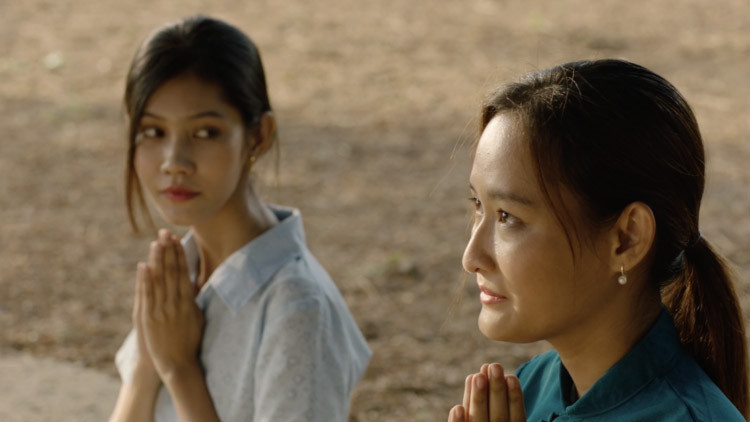
Acts of kindness are few and far between in the punishing Myanmar textile factory where young San Kyi (Nandar Myat Aung) makes a meager living, hunched over a sewing machine. When new employee Theint (Nandar Myint Lwin) tells a white lie to cover for her after an unauthorized bathroom break, San Kyi’s face turns positively radiant with gratitude, while Teint merely winks in response. On this simple moment of solidarity between strangers, a close friendship is founded. But in Aung Phyoe‘s tremulous, allusive drama “Fruit Gathering,” the possibility of something more chafes against the women’s insecurities and social boundaries — while an unspoken current of queerness permeates proceedings long before a single, reckless kiss forces characters to address it.
With dispatches from Myanmar — where same-sex sexual activity remains illegal — still a rarity on the world cinema scene, the vivid, unusual particulars of its milieu distinguish “Fruit Gathering” from other, comparable screen stories of gay repression and self-realization. In many senses it’s a poignantly old-fashioned work: If the film seems cautious or tentative in some ways, it’s a pointed reminder of battles for queer visibility that are still ongoing in many parts of the world. Co-produced with France and the Czech Republic, Phyoe’s first feature (following a run of well-received shorts, including the 2019 Locarno competition entry “Cobalt Blue”) premiered at Karlovy Vary in the main competition, and should enjoy extensive festival travel, particularly in LGBTQ-specific showcases.
Aung is an effectively brittle, soft-spoken presence as San Kyi, a young woman who has become accustomed to making herself invisible. Browbeaten at work by her supervisors and at home by her judgmental, domineering mother (Thida Soe Khant), she’s been taught to desire little in life but a basic living — which the factory, on the industrial fringes of Myanmar’s commercial center Yangon, provides. Quietly, she yearns to return to her rural home village up north, frequently dreaming (in stylized sequences shot to evoke early Technicolor processes) of simpler times there, and of mangoes hanging bountifully from the trees. Her rigidly unsentimental mother, however, sees only urban labor and profitably arranged marriage in her future.
In the more rebellious, free-spirited Theint, San Kyi sees not just a glimpse of who she could be, but who she could be with, and the two women build a fast, firm bond: At one point, when they escape for an outing together to the riverside, Theint takes a photo of their shadows together on a rippling water, and the snap endures as a symbol of their suddenly, intensely merged identities. But as much as San Kyi idealizes the other woman, Theint is a flawed, erratic figure, quick to borrow money from her new friend and slow to return it; after a brief, unexplained disappearance, she returns with a new husband, to San Kyi’s confusion and dismay. It’s at this point that the romantic nature of San Kyi’s feelings for Theint are finally confirmed; whether they’re reciprocated, however, continues to be a painful point of ambiguity.
“Fruit Gathering” is most artful, and most moving, when it interrogates the terms of this relationship through silent, pregnant gazes and gestures, shot with dreamy stillness in summery light by DP Thaiddhi, unaccompanied by any score: an image one woman looking quizzically into the mirror where the other is brushing her hair; the subtly increasing pastel matchiness of Akari Diraki’s beautifully tailored costumes; the outwardly platonic but internally loaded significance of holding hands in a public place. Any greater eroticism is largely kept off screen, but such scenes crackle with sensual possibility.
We’re on less certain footing when the tension between the women blooms into confrontational melodrama, complete with heated, hasty outbursts and physical violence. Though the pinched desperation of Aung’s delivery here rings true — as a woman having to speak her feelings for the first time, lest they never be heard or recognized at all — the newly sharp swerves of Phyoe’s writing do not, though the film steadies itself for an affecting coda that returns to its favored mode of tacit, bittersweet yearning, shaped and curtailed by stark socioeconomic reality. The stakes are consistently, palpably high in a story about love that is forbidden in the most literal, systemic sense — and felt in brief, ecstatic moments of release.











Leave a Reply