

The first time I saw Nicolas Winding Refn flash the sign of the horns on the red carpet (it was sometime in the 2010s), I thought it was cool. It was the last gesture you expected from a prestige filmmaker. But then Refn not only had a distinctive aesthetic but, it would seem, a rather outré set of values. On the surface, he looked so civilized and Danish, but on the big screen he’d become a punk transgressor who flouted narrative conventions, not to mention the rules of good taste. By the time he brought the loopy slasher revenge opera “Only God Forgives” to Cannes in 2013 (I was there at the premiere showing where it was roundly booed), the fact that he’d made a movie this purple and garish and brazenly solemn in its pop vulgarity became part of his mystique. He dressed nicely, but he had shot past respectability, or even the desire for it. Maybe the devil made him do it.
Then I started to notice something. At every photo op, Refn would flash the sigh of the horns — and each time he did it, it was less cool. Your allegiance to the devil wasn’t supposed to be a brand. But Refn’s performative mischievousness (he also liked to pose in a boxer’s stance) was all of a piece with his films. He was turning into the movie-director version of a punk showoff.
To me, the grand folly of Refn’s career is that he became this maker of luridly pretentious art-trash curiosities, but before all that got rolling, when he was willing to be a teller of conventional tales, he was actually a fantastic filmmaker. “Drive” looks better than ever — a classic urban Western thriller with synth-pop stylings. And I think Refn’s greatest achievement apart from “Drive” is the “Pusher” trilogy. If you’ve never seen those three amazing early Refn films, do.
I had hopes pinned on “Her Private Hell,” Refn’s first movie since “The Neon Demon,” which premiered at Cannes a decade ago. That film generated some moody power before collapsing into a pile of surrealist-horror shards. But “Her Private Hell” just starts where “The Neon Demon” left off — or maybe I should say where “Twin Peaks: The Return” left off, since the new movie plays like a knockoff of David Lynch at his most bafflingly obscure crossed with the hellscape fetishism of Gaspar Noé crossed with the world’s most avant-garde perfume commercial (which makes sense, since directing avant-garde perfume commercials is now part of how Refn earns his living).
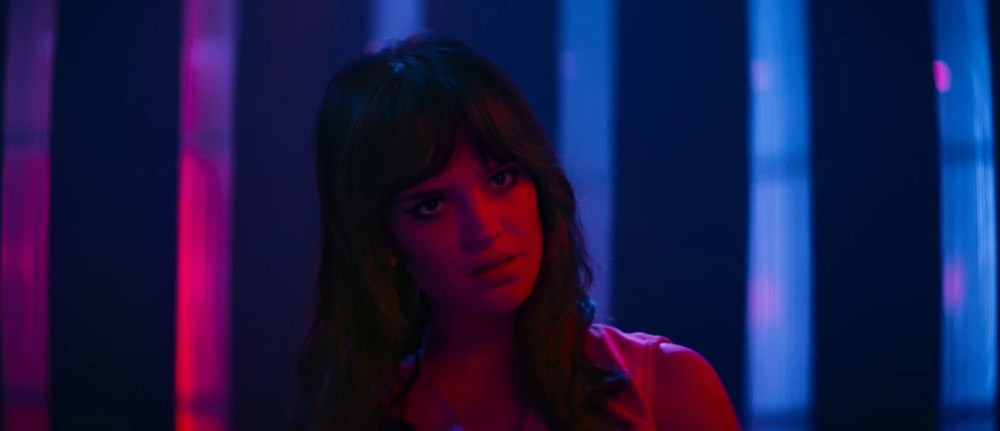
The film has no story. It has lavish sets (the two main ones: a hotel with gold-gilded drape walls and a barren-looking hell). It has a collection of actresses in bejeweled eye make-up who pose and snarl. And it has a gorgeous and absurdly old-fashioned romantic symphonic score, composed by the great Pino Donaggio (who’s like Bernard Herrmann meets Rachmaninoff), that plays under every inch of the movie. That might sound like a bit much (and is), but when you watch “Her Private Hell” you’re grateful to have that music to hang onto. Without it, the film would be even more hellish.
What, exactly, is Refn up to in this movie that’s not really a movie? He creates an abstract situation (in his mind it’s a “mythology”), where Elle, portrayed by Sophie Thatcher, who suggests the young Juliette Lewis playing a member of the Runaways in Tura Satana’s eye shadow, is trying to reconnect with her father, a rotter named Johnny Thunders (Dougray Scott) who’s like one of Lynch’s ironic middle-aged greasers. Elle has arrived at the Tower Hotel, which pokes up into the clouds, and that’s where she meets Hunter (Kristine Froseth), a sexy brat of an influencer who’s supposed to make a movie with her. Hunter might be called a nice bitch, whereas Dominique (Havana Rose Liu), who is Elle’s stepmother, is more of a dominatrix bitch. But the upshot is that all three actresses are shot like models, so the fact that they’re “playing characters” never totally takes hold.
After a while, the film cuts to hell, which is like the Asian underworld landscape of “Only God Forgives,” only with minimal sets. Charles Melton plays an American GI named Private K who’s trying to locate his daughter and keeps getting into bloody altercations. The fusion of violence and rapture comes from Kenneth Anger, filtered through Lynch, reduced by Refn to fashionista “subversion.” Refn also recycles motifs from his other films, like a torn-out eyeball and the chopping off of hands. And there’s a Lynchian monster — he’s known as the Leather Man and looks like a sadomasochistic fetish figure. The Leather Man wants a woman to say “Daddy!” just before he rips her chest open and tosses her body out a plate-glass window.
It’s obvious that all of this coheres in Refn’s mind, because he wouldn’t have made it otherwise. But he has become seriously deluded about what an audience wants. “Her Private Hell” is a disaster, but even that’s part of its hipster factor. The film practically announces that it’s too cool to be coherent. Speaking at Cannes, Refn talked about a near-death experience he had in a hospital where he claims to have been dead for 25 minutes before he was revived. It’s good news that he survived, but as a filmmaker he has yet to return to the land of the living.









Leave a Reply