

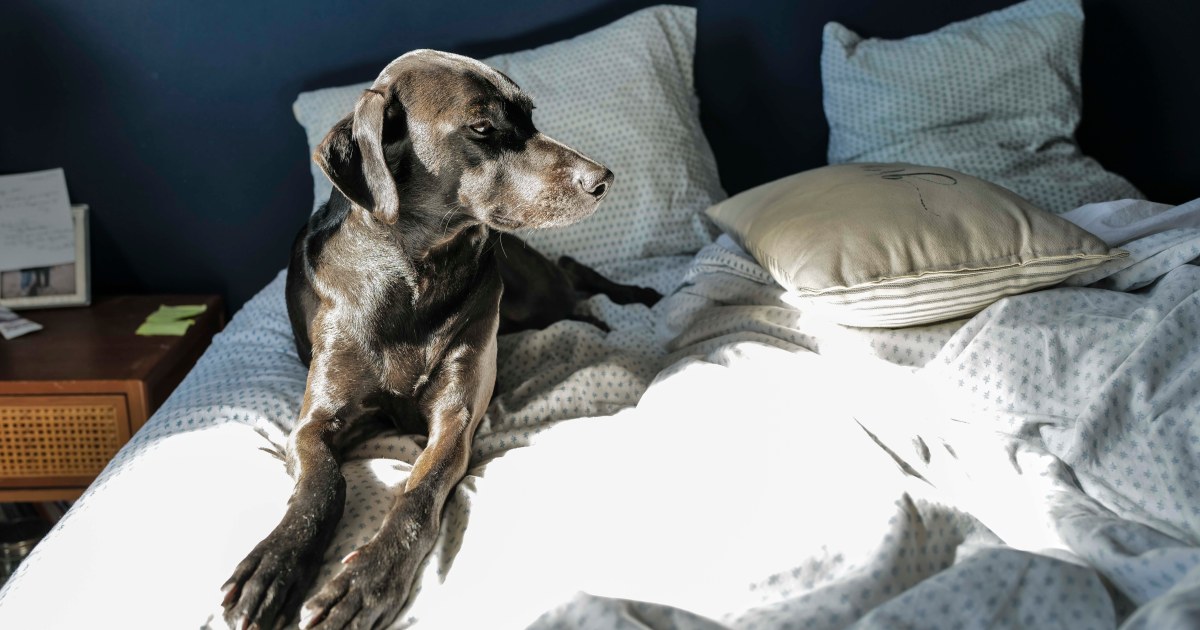
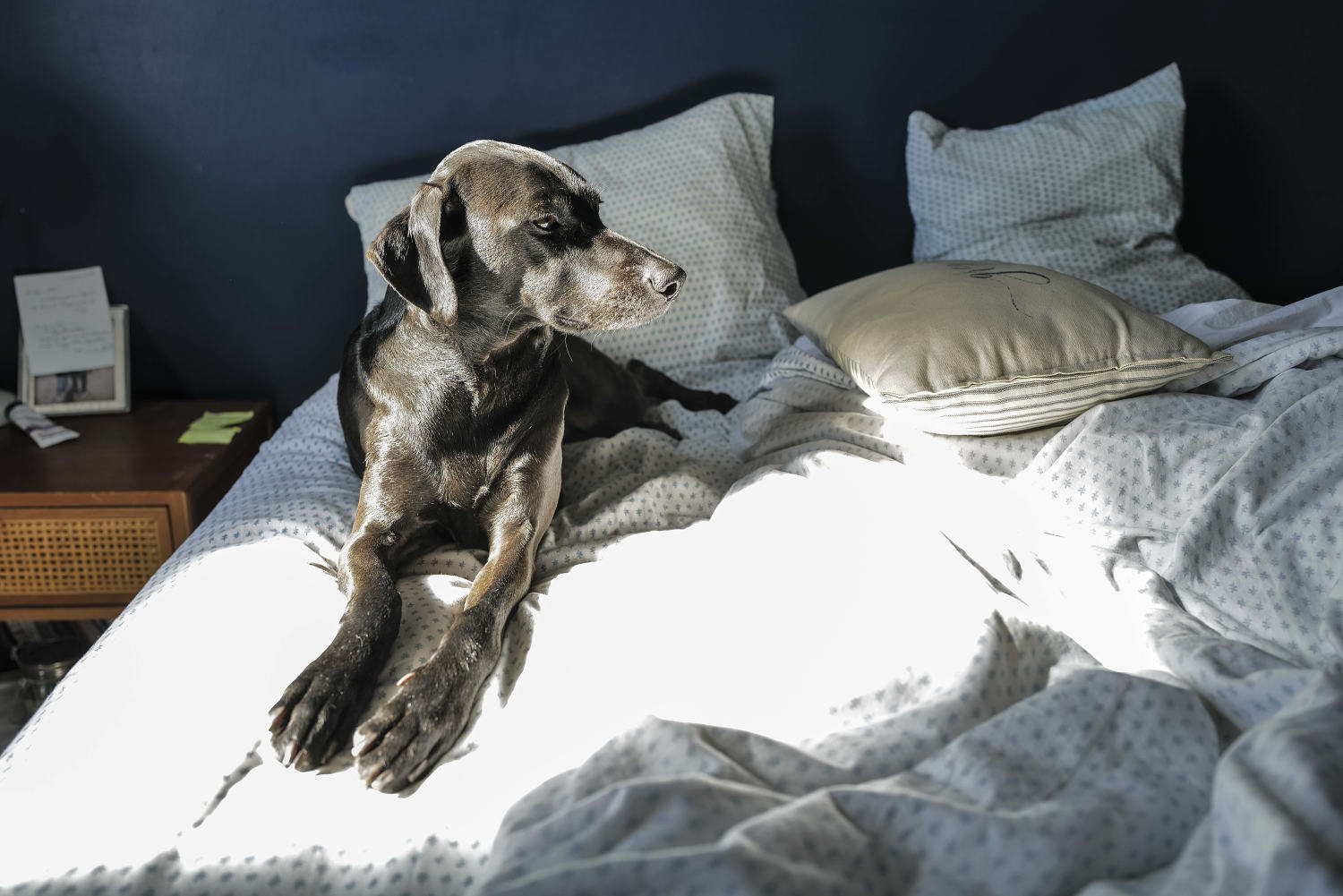
There’s no feeling in the world like cuddling up at night with your pooch, even when we think they’re messing up our sleep by hogging space, stealing covers and yapping at random sounds.
A surprising new study found that people who sleep near their dogs don’t experience disrupted sleep. If anything, the University of Toronto researchers discovered, we humans are the ones disturbing our dogs’ sleep.
And we feel safer sleeping with our dogs, hinting at “a deeper evolutionary history” between humans and dogs, said study co-author Ming Fei Li, who was a graduate student of evolutionary anthropology during the research.
Activity trackers similar to Fitbits monitored the nighttime activity of 25 human volunteers and their 38 dogs in southern Ontario to monitor how each affected the other’s sleep. The study, which was published Wednesday in PLOS One, was conducted during the Covid pandemic as part of a larger project comparing the activity patterns of socialized wolves and domestic dogs.
For four weeks, the humans wore the devices on their wrists while the dogs, all huskies and malamutes with no health problems, wore them on their collars.
Most dogs slept on the bed or in the same room as their humans. A few dogs slept in different rooms, said anthropology researcher Lavania Nagendran, who was also a study author.
Using the activity trackers, they analyzed “objective sleep measures” of the people and their dogs, including sleep duration and sleep quality, Nagendran said.
The human volunteers also self-reported their sleep quality in an accompanying survey.
Though half of the people, particularly those who slept with more than one dog at a time, reported interrupted sleep, the activity tracker data found that sharing a bed with their dogs didn’t affect how well or how long the pups or their humans slept.
“When we looked at the subjective, or people’s perceived, sleep, we saw that there were people who reported poor sleep if they had multiple dogs,” Nagendran said. “But, again, that wasn’t seen in the devices.”
When they observed “synchronized activity states” with the devices, they found that humans and dogs became active around the same time while they were sleeping but that it was the humans who moved first and disturbed their dogs, not the other way around, Li said. That contradicts a 2020 study that found dogs influenced human movement more than humans influenced dog movement during the night.
The researchers also found it made no difference whether people’s dogs slept directly in the bed with them or in a nearby area.
There were limitations to the study, including the small group of volunteers, which consisted of more women than men, and a lack of variation in dog breeds, Li said.
Previous research on co-sleeping with a dog has shown a link between poorer sleep and owning a pet and found that people sleep well with a dog nearby, but not in the bed.
A 2023 study published in the journal Human-Animal Interactions found a link between pet ownership and poorer sleep, while a 2017 Mayo Clinic study found people slept better with a dog nearby except when the dog slept on the bed with them.
Dogs may actually improve our sleep habits by forcing us to adjust to consistent bedtime schedules — as anyone with a sleepy, whining dog can confirm.
Dogs are “zeitgebers”; that is, they provide cues about when it’s time to eat, take a walk or go to sleep, said W. Christopher Winter, a sleep medicine expert at Charlottesville Neurology & Sleep Medicine in Virginia.
“Dogs want things done on a certain rhythm, and that can be really positive for people who struggle with that,” Winter said.
Most sleep research shows that “creating internal consistency” around sleep habits may matter more than the amount of sleep a person gets, he said.
“It’s the consistent nature of sleep that is really important, and I think dogs do a wonderful job of creating that,” he said.
Not all dogs are good sleepmates, though.
A large dog, for example, may take up a lot of bed space and “hog the sheets,” while dogs of any size can wake during the night when they hear random sounds or see flashes of light, said Winter, who wasn’t involved in the study.
Some dogs, particularly dogs with upper airway abnormalities like pugs, Boston terriers and French bulldogs, may snore loudly, which could disturb their human companions, he said.
“Some of the worst snoring and sleep apnea I’ve ever heard has been a dog at 4 o’clock in the afternoon sleeping when you’re watching a football game,” Winter joked.









Leave a Reply