

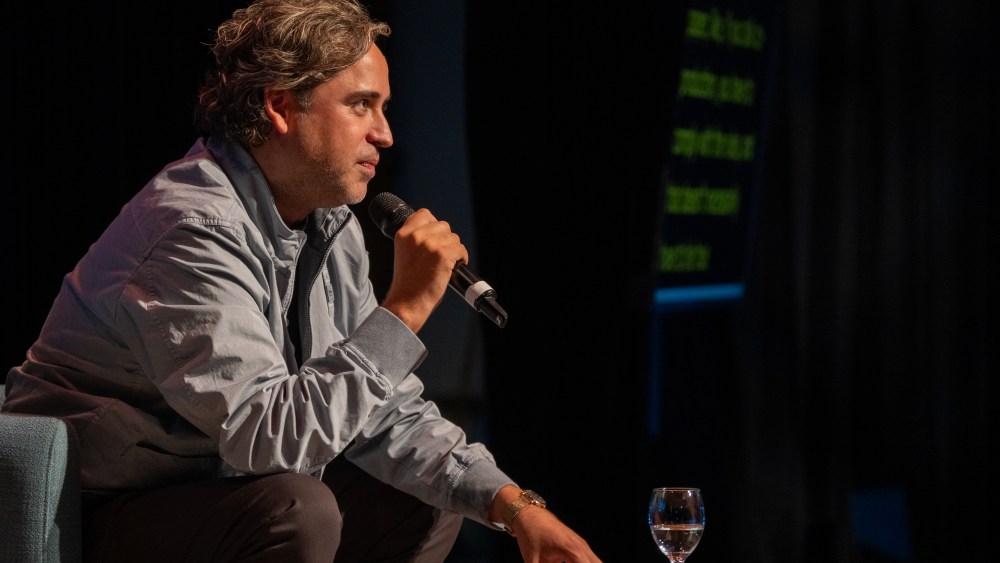
Even U.S. independent filmmakers are lining up for international public funds from Canada, Mexico, Latin America and European countries now, Chilean producer Giancarlo Nasi told attendees at his Industry Masterclass “Exploring the Art and Strategy of International Co-Productions,” which took place at the Vancouver International Film Festival (VIFF) on Oct 2.
As private financing dries up, producers are looking for foreign subsidies. “In America, many, many folks, especially independent filmmakers, really want to co-produce. They really want to get public money from other countries of the world,” he said.
Nasi, founder of Quijote Films and an intellectual-property lawyer who’s now based in LA, has produced 29 features– many of which have been co-productions. His latest, the South African film “The Smell of Apples,” a co-production with the Netherlands and Chile, recently premiered at TIFF.
Public funds, he says, have traditionally been reserved for the types of films that traditional studios or streamers aren’t likely to finance. But competition is getting fiercer. “I feel the U.S. independent movie distribution is in crisis,” he said. “Theaters are more and more focused on horror or huge studio movies with superheroes.”
“This year, there were many movies from the official competition in Cannes that had no distribution in North America. Which, 10, five years ago, would be crazy.”
Last year, a significant share of titles at Cannes’ Directors’ Fortnight he added, had no sales agent at all.
Nasi is also seeing U.S. independent filmmakers who once assumed they didn’t need money from abroad now looking to tap into international public funds. “Many of the Latin American funds and the European funds are very eager to support U.S. filmmakers as well.”
But co-productions have been a necessity for producers like him for quite some time. There’s insufficient funds in Chile, for example, to make films at the size Nasi wants, and the market is too small.
“Why would I make a movie only for Chile?” he asked. “There’s no business.”
But having international co-production partners isn’t simply a matter of finding another country to put money into a film. It can determine where a film is shot, impose requirements around local crew or post-production, affect casting and limit various creative choices.
“If you’re a director and suddenly you have to have a Canadian DP, or you have to have a Canadian editor, you need to know if you want that,” Nasi said.
The best-co-productions, he argues, are those that make creative as well as financial sense.
He kept returning to Felipe Gálvez’s 2023 debut, “The Settlers,” a lauded period Western shot in the far south of Chile, which he produced. Officially a three-country co-production, it unofficially drew companies from eight or nine territories, among them France, Argentina, the U.K., Taiwan, Sweden, Denmark and Germany as well as tapping U.S. equity. It premiered in Un Certain Regard at Cannes in 2023, won its Fipresci Prize and played TIFF. It took eight years to finance.
“It becomes complicated,” Nasi acknowledged. “Nine countries is a lot.”
But, he explains, “We were very desperate. It was a first feature, a period piece and very ambitious, very expensive.”
Official co-productions follow treaty agreements. Canada has one of the densest networks of co-production treaties in the world, potentially opening access to more public funding options and giving the film recognition as a national production in both countries. But those treaties also come with additional requirements. A number of other funds, including most German schemes, Luxembourg’s and a newer U.K. fund, do not require treaty status and may be a better fit.
Nasi urges producers, however, to study spending rules closely. Chile, for example, imposes no obligation to spend the grant at home, while France typically wants half spent in France. Some German funds demand as much as a 150% spend in Germany. Such requirements can impact creative choices, not just production logistics.
Before signing on with an international partner, Nasi warns, producers need to get absolute clarity. How much is the co-producer contributing? What production fees and expenses will be deducted? Who controls which rights? Who has final decision-making authority? “You need to go and read the guidelines and the rules of the funds you’re getting so you can actually make an informed decision.”
Further, while public money might not require repayment, it might not always arrive when it’s needed. Some funds pay in installments: one at start of production, another at the end of the shoot and a final payment when the film reaches its theatrical release – potentially as much as two years later. This can create significant cash-flow problems, requiring producers to borrow gap finance or find other “creative” ways to finance their film while they await payments.
Public money is also political money, he warns. Brazil and Argentina froze systems after changes of government, including awards already won. “I’m waiting for my $500,000 from Brazil, and I’m going into pre-production. Where’s my money?” Italy went quiet after Giorgia Meloni took office. Chile, he said, tends to pay when it promises. Brazil pays more, but is less predictable.
Still, Nasi views international co-production funds as a bright spot in an increasingly difficult independent film economy. Governments are willing to invest in cinema not just because of economic benefits, but because of the prestige and “soft power” that comes along with it.
“Call it geopolitical bullshit if you want,” he jokes. “But I mean, it’s great for us.”




Leave a Reply