

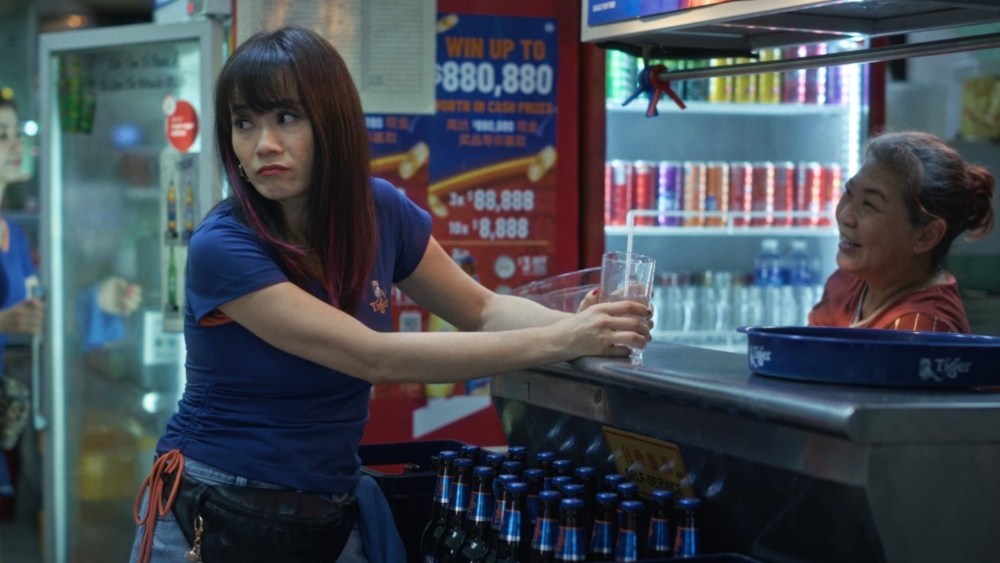
For Yeo Yann Yann, the journey to Anthony Chen‘s “We Are All Strangers” has been one of profound personal and artistic transformation.
The acclaimed actor’s performance as Lee Bee Hwa marks her third collaboration with the Singaporean filmmaker — an evolution that mirrors both their maturation as artists and the 13-year span of Chen’s “Growing Up” trilogy. Yeo won Golden Horse Awards for best actress for “Wet Season” (2019) and best supporting actress for “Ilo Ilo” (2013).
“When I saw him again, he maintained that boyish smile, but he was way heavier on his shoulder, the way he discussed things,” Yeo reflects on reuniting with Chen for the Berlin competition entry. “I can feel this maturing, and I am maturing as a human too, after becoming a mother since ‘Ilo Ilo.’”
The drama, set in contemporary Singapore, explores themes of class, inequality and the fragile dynamics between inherited and chosen family. Yeo’s character, a beer supplier at a hawker centre, is an immigrant woman who arrives in the lives of a father and son, embodying the film’s central tension between belonging and estrangement.
“She is a stranger amongst the family,” Yeo explains of her character’s late entry into the narrative. “She’s almost like a mystery that’s going to be revealed later.”
Drawing from her own experience as someone from Malaysia who grew up immersed in Singaporean culture before moving to the city-state, Yeo found personal resonance in her character’s search for home. “When I moved to Singapore, I felt strange at times,” she says. “I felt like I am constantly looking for a sense of belonging and a sense of family.”
“We Are All Strangers” marks the first Singaporean film to compete for the Golden Bear at the Berlin Film Festival. The film reunites Yeo with Koh Jia Ler, who first worked with Chen as an 11-year-old in “Ilo Ilo,” for which he earned a Golden Horse nomination, and returned for “Wet Season” in a Golden Horse-nominated supporting role.
Throughout the trilogy, Yeo has watched co-star Koh grow from an 11-year-old discovery into a seasoned actor. “Jia Ler maintains that happy-go-lucky little child,” she says with evident affection. “And that was something that we will discuss, like, my God. How did he do that, he’s like a little child even now — we envy him.”
The actor describes her character’s pivotal decision to commit to a relationship as born from a moment of crisis, informed by her own experiences with work-permit uncertainty. “There is a sense of survival, there’s a sense of maybe a family,” she explains. “I think I experienced that before, when I was younger, like you have to just leave because you don’t belong here.”
The production itself proved challenging, with approximately 50 locations testing the cast and crew. “I hated shorts,” Yeo adds about the costume requirements. Yet she describes a familial atmosphere on set, with the production team living and working together in a house that served as both office and rehearsal space.
“I remember one day Anthony was telling me that he couldn’t believe it’s already 13 years, that we were strangers before, and now we’re like family,” Yeo recalls. “It makes me want to cry actually thinking about that.”
The evolution of their working relationship has been marked by significant life changes. Chen was fresh out of film school for “Ilo Ilo,” which went on to win the Caméra d’Or at Cannes and several Golden Horse Awards among over 40 accolades. During filming, Yeo was pregnant and gained 30 kilograms. By “Wet Season,” Chen had become a father himself, bringing new depth to his directorial approach.
“‘Wet Season’ was one of the toughest shoots for me,” Yeo admits, noting the technical challenges of filming in extreme weather conditions and the emotional toll of her deeply repressed character. “I couldn’t get out of the character for at least another half a year after the filming.”
For “We Are All Strangers,” Yeo notes Chen’s growth. “Anthony is really maturing into a collaborator, focusing even more on collaborating,” she says. “We discussed a lot about how this person’s journey, how are we going to present her in the most authentic way.”
As the film prepares for its world premiere at the Berlinale, Yeo hopes international audiences will connect with its universal themes despite its specific Singaporean context. “No matter where you are, there will still be people who work really hard and struggle with different subjects, different problems in their life,” she observes.
Asked to identify the film’s central takeaway, Yeo doesn’t hesitate: “Even though these people are in a difficult situation, they never give up hoping. Every character works really hard to not giving up on hope.”
The film is presented by Giraffe Pictures in association with 127 Wall Prods. and Jasper Prods., with participation of Singapore Film Commission, and is in co-production with Red Sea Fund. International sales are handled by Paradise City Sales. Yeo is represented by Andrew Ooi at Echelon Talent Management.



Leave a Reply