


Rachel Kryshak

Multiple Authors
With the NHL trade deadline passing on Friday — and even a flurry of deals announced late Friday afternoon after 3 p.m. ET — a handful of teams added some prospects to their pipelines.
Some have modest NHL experience, but will be expected to step in and play an NHL role with their new teams, while others are further away from challenging for ice time at the top level.
Fans are always curious about the prospects their teams acquired. Here is a guide to the traded prospects of the 2026 deadline: who they are, what they can be reasonably expected to do at their best, why they were available and when they may see NHL action.

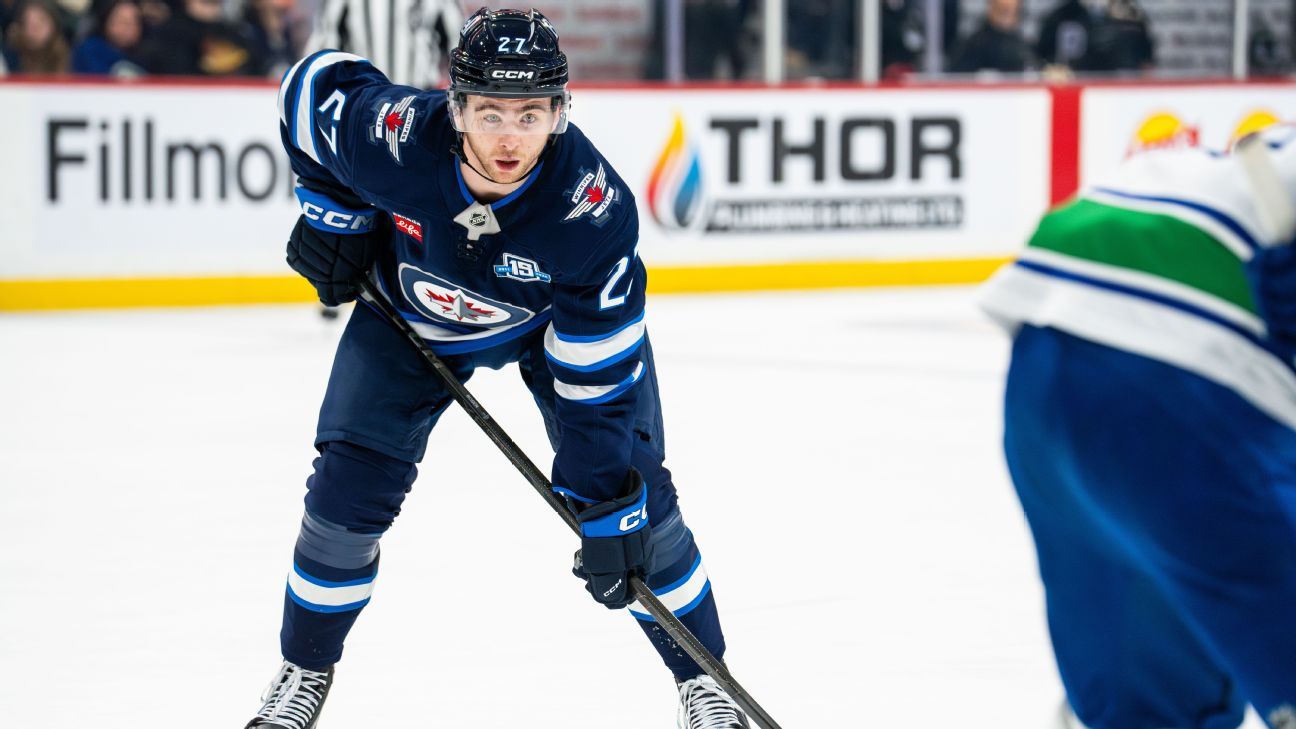
Buried in the cavalry of young players in Buffalo, the Jets are getting a middle-six player with 20-goal potential based on his AHL production. In fact, there is a very real possibility the Jets end up with the best player in the deal that sent Logan Stanley and Luke Schenn to the Sabres.
Rosen has some power-play capability, and should get an opportunity to play on the second unit in Winnipeg. He also brings much-needed speed to the Jets’ lineup, makes good decisions with the puck and has a decent shot. He can dart into the middle where he prefers to attack, but his weakness on the wall will need to improve to earn the trust of his coaches at the NHL level. He lacks strength, but his skill and skating are top tier in the AHL.
He’s the type of player who flashes high-end skill to overwhelm defenders, but gets pushed to the outside by more physical opponents. If he can add strength and improve his hard skill, he’s got the soft skill to an impact scorer in the middle six for the Jets.

The sixth overall pick in 2022, Jiricek has now been traded twice before playing 100 NHL games. It is exceedingly rare that a big, right-handed defenseman who is drafted in the first round is dealt once before he plays 100 games, let alone twice.
Jiricek’s ceiling is lower than it was in his draft year, but there is a serviceable No. 4/5 defenseman there. The Wild have too many talented players on the back end, and Jiricek’s development was impeded by that. He should benefit from the coaching and greater opportunity in the Flyers’ system.
He’s got a heavy shot and the desire to be a punishing physical presence; that fits well with Rick Tocchet hockey. To be effective in the NHL, his skating needs to improve dramatically. The Flyers can work with him to improve on that front, and with the better skating should come time to make better decisions on and off the puck.
He fits with what the Flyers are trying to build, and if you’re going to take a swing on a young player, this is the type of player you do that with.

The 24-year-old Vikman provides depth at the goaltending position for the Capitals. The 6-4 goaltender has struggled to keep the net at the AHL level since turning pro in 2023. But given the Capitals organizational depth in goal, Vikman will provide depth insurance in the event of injuries ahead of him.
Vikman has long limbs, which is always a plus for development potential. He needs to work on the foundation of his goaltending to mitigate errors and increase his reliability in goal. There is a long way to go to be considered an NHL-level prospect again, but he has the physical tools that a new goaltending coach may be able to unlock.

Acquired in the Brayden Schenn deal, Gidlöf was the second-best goaltending prospect in the Islanders’ pipeline (behind Dmitry Gamzin). Given the Isles’ proven ability to identify Russian goaltenders with NHL potential, this is a really good get for the Blues.
At 6-foot-7, he’s already demonstrated an ability to take up the entire lower portion of the net. His performance has been inconsistent in the SHL this season, but regularly playing in the SHL during his 20-year-old season bodes well for his NHL projection.
If Gidlöf can improve his mobility in the crease, he’s got potential to be a backup at the NHL level. There is a long runway with him, as he’ll slot in behind Love Härenstam in the Blues’ prospect pool. He’ll likely end up with a role in the AHL that will allow him to be a 1B goaltender in that role.
Buchelnikov is a candidate to come to North America when his contract with CSKA expires in May. His KHL production projects him to become an NHL regular. A left-handed, right winger who can provide secondary scoring, he turns 23 just before training camp for next season opens.
He’s not big, but he’s a speedy play driver in the KHL and the Blues need young play drivers in their lineup. A fearless attacker, Buchelnikov is dangerous in transition, attacks the slot with passes to create chances for teammates, and will cut in off the rush to rip a shot through defenders. His two-way game needs some work to be NHL-ready, as is the case with many KHL players, but Buchelnikov’s offensive skill set and play-driving ability is promising.

Thompson was one of the most mature prospects moved at the deadline. The 24-year-old won an NCAA national championship with Denver, and his production in the NCAA suggests he has bottom-six potential, though more likely as a winger than up the middle.
His production has not translated in his first AHL season thus far, but increased opportunity in a thin Rangers forward pool should boost his chances. Thompson could be a future fit on the third line next to Noah Laba, because he plays with excellent pace and is smart defensively. He’s a volume shooter, playing a simple game involving north-south skating and resulting in pucks on net.
He’s a worthwhile swing as the Rangers look to inject youth into their lineup and is more ready for a look in the NHL than a 19- or 20-year-old. If he isn’t a full-time NHL player in the bottom six, he’s a good candidate to be a routine call-up.
Battaglia, acquired for Brennan Othmann, turns 20 next week, plays the same position and is the same size as Othmann. Essentially, the Rangers did not believe Othmann was a fit, and opted to swap him for a player who is three years younger.
Battaglia is a versatile winger, with good playmaking ability, a hard shot and is not dissimilar in playstyle to Liam Greentree, who was acquired by the Rangers from the Los Angeles Kings in the Artemi Panarin swap. He sees the ice well, playing off his teammates in transition, making quick passes, and creating scoring chances.
His skating holds him back, but he’s managed to have success despite that. He consistently gets the puck to the middle of the ice, creates advantages with his physicality and ability to win battles, and draws defenders before making plays to open ice.
He’s likely a checking winger at the NHL level who can chip in offensively, if he can improve his agility and speed.

The Flames need NHL-ready players who are young, and Othmann fills that need. Othmann is a physical, in-your-face winger who was not given a lot of opportunity to develop or succeed in New York. Blake Coleman is a good comparison for Othmann, who would do well to learn from the veteran who carved out his role as a hard-nosed player with scoring skill.
Othmann has more skill than Coleman, and should be able to contribute offensively in a middle-six role. Othmann’s development runway is not long given that he’s 23 years old, but if the Flames can unlock him, he’s frustrating to play against and can take advantage of defensive miscues.
There is untapped potential with Othmann, who should get a much better opportunity with the Flames to play offense and develop in that role.
Acquired in the deal that sent Nazem Kadri back to the Colorado Avalanche, Curran was my third-ranked prospect in the Avs’ pipeline. He is not nearly that high in the Flames’ prospect pool, but back-to-back productive WHL seasons earns him a third-line NHL projection.
Curran is a 6-3 forward who is likely to be a winger when he turns professional. He’s a very clever playmaker who can drive play and impact the game in a variety of ways. His two-way game is already well ahead of schedule, and has proven he can be an all-situations player. Curran has playmaking upside as a secondary producer at the NHL level if his skating continues to improve. He reads the play very well, identifying and attacking space, and driving offense with his puck distribution.
He will benefit from a year or two in the AHL when he turns pro, but has real potential to be a long-term solution in the bottom six even if he does not hit his ceiling.
A sneaky good pickup for the Flames in the deal that sent MacKenzie Weegar to the Utah Mammoth, Castagna has more than doubled his production in his draft-plus-3 season. He’s improved his NHL prospects dramatically, and has a reasonable shot at becoming a fourth-line player or NHL call-up.
Castagna is good in transition, attacks the middle of the ice and has the smarts to play the center position. He is already a plus player in terms of his details, is excellent on faceoffs, finishes checks, and constantly makes an impact with his skating.
His habits will endear him to coaches, and given Calgary’s vision of getting younger, he is a player that should have an opportunity to make a training camp impression if he signs at the conclusion of the season. The Flames are accruing young players closer to NHL games, and Castagna is further along in his development, which fits with the Flames’ plan.






Leave a Reply