


Dan Wetzel

Multiple Authors
In a truly heartwarming display of economic justice, politicians are finally offering up valuable tax breaks to a class of workers who really, truly deserve a little help:
Highly paid athletes.
If you happen to be a star college player in Mississippi, good news, you may soon be exempt from paying state income tax on your direct revenue sharing and NIL earnings. Yes, you can make millions and owe nothing.
As for the cops, first responders, teachers, plumbers, bartenders, baristas, fellow college students trying to cover their own tuition or really, any other worker in Mississippi … well, sorry, you are out of luck.
You non-college-athletes will keep paying the state 4% on everything you earn over $10,000 in 2026. (The rate is slowly dropping until it hits 3% in 2030.)
“Soak the rich,” is an old populist battle cry. “Protect the point guard” is apparently the new one.
What’s next: no sales tax on your second yacht?
Welcome to the wonderful world of college sports in 2026, which is so full of confusion and panic that the Mississippi House of Representatives felt compelled last week to advance a bill declaring that any money made by college athletes is tax-free because, well, it might help in recruiting.
This has, to say the least, caused a stir.
“I’m getting a ton of calls from police, teachers, state employees all asking, ‘Why are you giving those guys a break?'” Rep. Jonathan McMillan, who authored the bill, told ESPN on Tuesday. “Believe me, I get where they are coming from.
“We’re trying to move the needle here in Mississippi, change the perception of Mississippi,” McMillan explained. “We are looking at every facet of business in our state and turning over every rock to be competitive in everything. The way we conduct business, the way we do our schools and even in sports. Mississippi hasn’t been known for being innovative, but it’s a new day here.”
McMillan said this was about the ability of Ole Miss and Miss State to compete in the SEC, which includes five schools located in three states (Florida, Tennessee and Texas) that don’t levy an income tax. Additionally, Arkansas passed a similar NIL tax exemption last year.
An athlete can go to those places and save the 4%, or $40,000 per $1 million earned. (They’re still on the hook for federal taxes, of course.) The fear that those sneaky Razorbacks or Volunteers were getting a leg up was enough that Mississippi House Bill 4014 passed overwhelmingly (the vote was 76-32), optics be damned.
It still must get through the Senate and be signed by Gov. Tate Reeves.
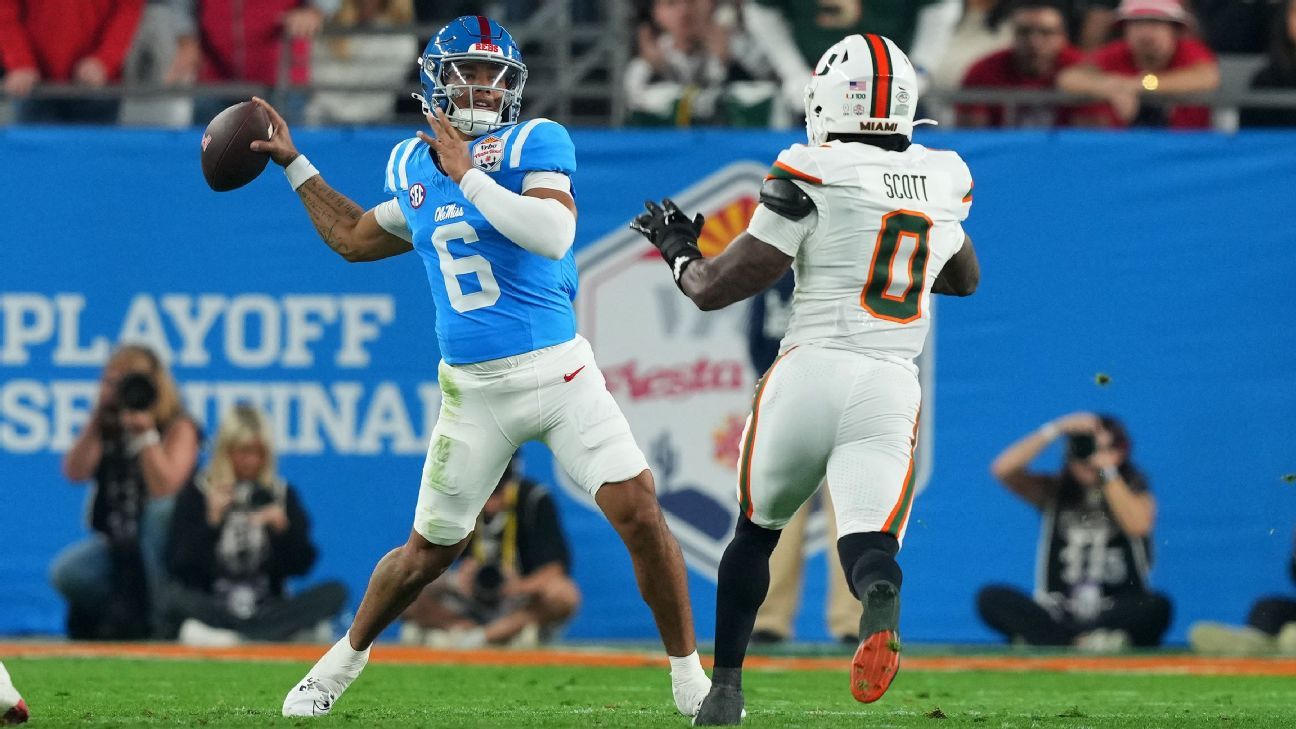
Perhaps there is an outcry against this. Ole Miss star Trinidad Chambliss, who actually hails from Michigan, could earn at least $5 million this year. Are waiters, delivery drivers and factory workers fine paying their share despite knowing the multimillionaire quarterback isn’t?
In essence, because the purpose of the bill is to increase the athletes’ take-home pay, this trend is akin to having a state government directly compensate players. You can only wonder if that’s next.
Or will some state dare propose a similar deal for athletes in professional leagues? After all, there was once a time when the idea of taxpayers building billion-dollar stadiums for rich team owners was incomprehensible. NHL players have, for example, cited Florida’s no income tax as a reason the Panthers and Lightning attract free agents.
“If we were not in a no-tax state, it wouldn’t work out,” Panthers forward Brad Marchand said in September when re-signing with the Stanley Cup champions. “That’s a benefit that this team has that we were able to utilize.”
Indeed, who out there will think of the economic plight of LeBron James or Josh Allen?
Ole Miss and Miss State will each spend the NCAA-allowable $21.3 million on direct pay to athletes during the 2026-27 school year. There will be an estimated $30-35 million on additional NIL payments. Southern Miss and other D-Is will add a few million more.
Let’s call it $80 million in total earnings statewide, which means an approximate $3.2 million in collective tax savings for the players.
That’s not going to make or break the state’s $7.1 billion annual budget. Then again, it’s still $3.2 million. A lot of Mississippi workers would like a sliver of that. Or, conversely, a lot of Mississippi communities would like to put it to use on roads, or infrastructure or clean drinking water.
It’s not like Mississippi doesn’t need the money. It’s among the states that require the most federal money just to remain solvent. The state’s 18.0% poverty rate in 2024 was the nation’s second highest, per Census.gov.
Then there’s the message the bill projects. Is attracting college athletes more important than attracting, say, doctors and nurses to serve, often for lower pay, in rural hospitals?
McMillan said he understands all of that and is working on those issues as well. However, he argues, state governments incentivize lots of things. If the tax break helps secure a few extra players, which leads to more success and attracts more out of state visitors or applicants to a school, let alone lucrative home College Football playoff games, then the money was well spent.
Just the excitement of winning teams can retain residents, a long-standing problem for the state.
“In Mississippi, we’ve been good at being last a lot,” McMillan said. “The last few years we’ve been doing things differently. It just made sense. We’re trying to get more business, more industry, more athletes in our state. We can’t be stuck in that old mindset.”
Last year, Mississippi passed a law to abolish its income tax, perhaps as soon as 2040, so to McMillan and other supporters, this is just a step in that direction. And since rev-share and NIL are new things, it has basically found revenue that the state wasn’t counting on.
“I don’t think anybody was filing tax returns based off of $100 handshakes pre-NIL,” Rep. Trey Lamar said in support of the bill per the Magnolia Tribune. “So it’s a new tax, a new arena.”
Apologies to everyone who chose a career that existed before 2021.
Bonus points to Lamar, though, acknowledging the old college bagman. That’s peak SEC.
Tax carve-outs for the wealthy are hardly new. It’s just that they are usually buried in the fine print for their accountants to exploit. Perhaps the most incredible part of this trend is that it is happening unapologetically, right out in the open.
No tax on tips? No tax on football!
It Just Means More, tax-code edition.



Leave a Reply