

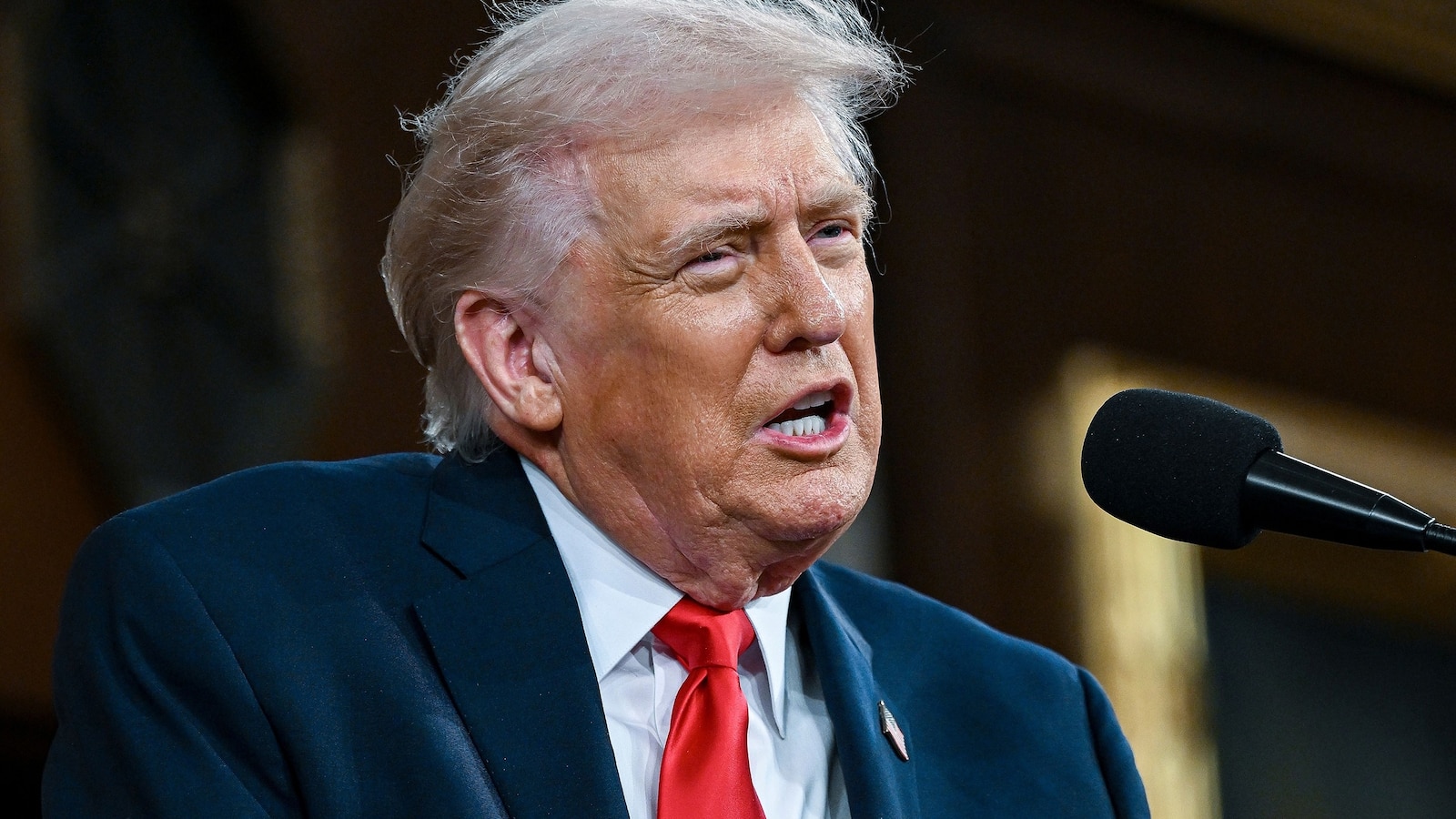
Navy Adm. Brad Cooper, who oversees troops in the Middle East as head of U.S. Central Command, briefed President Donald Trump on Thursday on potential military options in Iran, according to a person close to the president.
Gen. Dan Caine, chairman of the Joint Chiefs of Staff and the president’s top military adviser, also was present, according to a second person familiar with the discussion.

President Donald Trump delivers the first State of the Union address of his second term to a joint session of Congress in the House Chamber of the US Capitol in Washington, Feb. 24, 2026.
Kenny Holston, Pool via EPA via Shutterstock
The briefing by the top military commander in the region comes on the same day as U.S. and Iranian officials held indirect talks in Geneva on Iran’s nuclear and ballistic missile program.
Neither side announced a deal had been reached. Iran’s foreign minister said progress was made and that “technical talks” will resume in Vienna, Austria, next week.

An F/A-18E Super Hornet, attached to Strike Fighter Squadron 41, prepares to launch from the flight deck of Nimitz-class aircraft carrier USS Abraham Lincoln in the Arabian Sea, Feb. 15, 2026.
Petty Officer 3rd Class Nathaly/US Navy
Several Republicans and some Trump officials in recent days have privately advocated for Israel to take the lead in striking Iran instead of the U.S. initiating hostilities, two people familiar with discussions tell ABC News.
It was not clear as of Thursday that such a plan has been embraced by Trump, who is said to be growing increasingly frustrated with Iran’s refusal to agree to his demands to halt uranium enrichment and cap its ballistic missile program.

Oman’s Minister of Foreign Affairs Sayyid Badr bin Hamad Al Busaidi, right, holds a meeting with White House special envoy Steve Witkoff, centre, and Jared Kushner, as part of the ongoing Iranian-American negotiations, in Geneva, Switzerland, Thursday Feb. 26, 2026. (Foreign Ministry of Oman via AP)
The Associated Press
The president is known for fielding varied opinions before making a decision. Politico first reported that some senior advisers and Republicans to Trump were advocating for Israel to take the lead.
Sources say a joint U.S.-Israeli operation is still possible, with the U.S. having moved an eye-popping number of ships and fighter jets to the region — all within striking distance of Iran.

The US Navy aircraft carrier USS Gerald R. Ford departs Souda Bay on the island of Crete, February 26, 2026.
Costas Metaxakis/AFP via Getty Images
“The media may continue to speculate on the President’s thinking all they want, but only President Trump knows what he may or may not do,” said White House Deputy press secretary Anna Kelly.
Political analysts said that suggestions of Israel throwing the first “punch” is likely intended to serve as a kind of political cover to Republicans in Congress facing a tough election year. Trump campaigned on the promise that he would end wars, not start them.
If Israel struck Iran, defense officials predict Iran would almost certainly retaliate. Trump could then argue that U.S. intervention in the conflict was in line with decades-long policy of defending Israel, analysts say.
But that strategy could backfire if the operation is seen across the Middle East as an “Israeli-backed coup,” said ABC News contributor Ramesh Ponnuru, a conservative pundit and editor of National Review.
Regardless of how it begins, “if it becomes an involved campaign and we take casualties, then you get some political risks,” Ponnuru said.
“I think it’s important for President Trump to articulate the strategy and mission in Iran,” he later added. “But before that, he has to have a clear strategy and mission, and I don’t know that he has settled on that yet.”

Secretary of State Marco Rubio speaks to reporters in a departure lounge before returning to Washington following meetings with Caribbean Community leaders in Basseterre, Saint Kitts and Nevis, February 25, 2026.
Jonathan Ernst/Reuters
Secretary of State Marco Rubio and CIA Director John Ratcliffe on Tuesday briefed a small group of top lawmakers on Iran, although the details of the classified briefing were unclear.
Democrats emerged from the meeting saying they appreciated that the administration was consulting with lawmakers this time, which they said had not been the case in the past ahead of major foreign policy action.
“This is an extraordinary, serious time, [a] serious moment in the Middle East” and a “serious moment for America,” said Sen. Mark Warner, the top Democrat on the Senate Intelligence Committee, told reporters on Tuesday.
Sources have told ABC News that among Trump’s options is a limited strike on ballistic missile launchers and nuclear sites as a kind of warning to force Tehran to agree to Trump’s demands.
Also under consideration is a major operation hitting a large number of targets over a sustained period of time, sources say.

An F-35C Lightning II, attached to Marine Fighter Attack Squadron 314, prepares to make an arrested landing on the flight deck of Nimitz-class aircraft carrier USS Abraham Lincoln in the Arabian Sea, Feb. 12, 2026.
Petty Officer 3rd Class Sonny Escalante/US Navy
An opening salvo on targets in Iran, led by Israel, would not only be a form of coercion in diplomatic talks. The strikes also could serve to cripple more of Iran’s air defenses should Trump decide to follow up with a much more sustained military campaign aimed at toppling the regime, sources said.
Analysts say such an operation could last for weeks and be extraordinarily risky without any guarantee that Iran would emerge with a government more favorable to U.S. interests.
Of particular concern is that Iran try to attack the some 35,000 to 40,000 U.S. troops stationed in the region.
Rubio on Wednesday told reporters on Wednesday while traveling in St. Kitts that Iran is trying to rebuild its nuclear program after it was bombed by the U.S. last June.
“You can see them always trying to rebuild elements of it. They’re not enriching right now, but they’re trying to get to the point where they ultimately can,” he said.
Rubio also said Iran also was on a “pathway” to try to obtain ballistic missiles capable of reaching the U.S.








Leave a Reply