

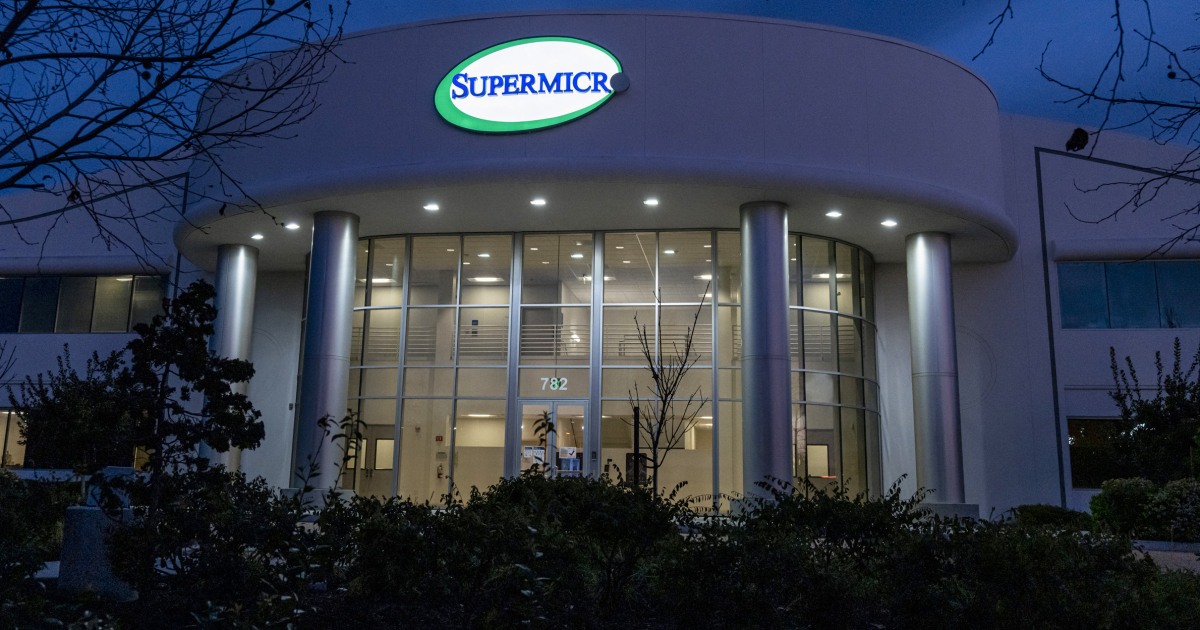

Three people affiliated with server maker Supermicro were charged Thursday in connection with allegations they conspired to smuggle advanced Nvidia chips into China, in violation of U.S. export controls barring their sale to China without a license.
The indictment from the U.S. Attorney for the Southern District of New York alleges that Wally Liaw, Steven Chang, and Willy Sun conspired to sell $2.5 billion worth of servers to a company based in Southeast Asia, which then repackaged the boxes to send $510 million worth of servers with banned chips to final destinations in China.
The Department of Justice said Liaw, a U.S. citizen who co-founded Supermicro, and Sun, a citizen of Taiwan, were arrested today while Chang, also a citizen of Taiwan, remains a fugitive.
The three men are each charged with a count of conspiring to violate the Export Controls Reform Act, carrying a maximum prison term of 20 years, if convicted. The three also each face one count of conspiring to smuggle goods and one count of conspiring to defraud the United States, each count carrying a maximum prison term of five years.
In 2022, the U.S. tightened its export controls on selling advanced artificial intelligence chips to China, citing national security national security concerns. The bans covered Nvidia’s B200 and H200 graphics processing units, among the company’s most advanced AI chips, and only allowed sales to China through a license granted by the government.
The three men are charged with selling servers, without a license, to China that included B200 and H200 GPUs.
“They did so through a tangled web of lies, obfuscation, and concealment — all to drive sales and generate revenues in violation of U.S. law,” said U.S. Attorney Jay Clayton. “Diversion schemes like those disrupted today generate billions of dollars in ill-gotten gains and pose a direct threat to U.S. national security.”
Chang and Liaw did not immediately respond to a request for comment sent via email. Contact information couldn’t be found for Sun. It was not immediately clear if the men had attorneys who could speak on their behalf.
Liaw, 71, co-founded Supermicro in 1993, and serves as a senior vice president of business development and a member of the company’s board of directors. Chang, 53, is a sales manager based out of the company’s Taiwan office, and Sun, 44, is described in the indictment as a “third-party broker and ‘fixer’” who worked with the other two.
Supermicro was not named in the indictment, but the company confirmed the roles of the three individuals. In a statement, the company said the two employees are on administrative leave and the relationship with the contractor has been terminated, effective immediately.
“The conduct by these individuals alleged in the indictment is a contravention of the Company’s policies and compliance controls, including efforts to circumvent applicable export control laws and regulations. Supermicro maintains a robust compliance program and is committed to full adherence to all applicable U.S. export and re-export control laws and regulations,” the company said in a statement to NBC News.
Supermicro added it is “cooperating fully” with the government’s investigation.
In a statement, Nvidia said strict compliance is a “top priority,” adding that it is working with customers and the government on compliance programs.
“Unlawful diversion of controlled U.S. computers to China is a losing proposition across the board — NVIDIA does not provide any service or support for such systems, and the enforcement mechanisms are rigorous and effective,” an Nvidia spokesperson said.
The alleged scheme comes amid concerns that banned chips are slipping into China, oftentimes “transshipping” to China through nearby countries like those in Southeast Asia. A Financial Times report from last July estimated that China was able to secure about $1 billion in advanced AI processors in the three months after President Donald Trump tightened export controls.
Chris McGuire, a senior fellow for China and emerging technologies at the Council on Foreign Relations, said the indictment shows that the government should more closely look at the “glaring loopholes” of exporting through Southeast Asia.
“This operation is further evidence that China is aggressively stealing U.S. technology to help power its AI industry — which is unsurprising, given U.S. AI chips are far superior to any chips the Chinese can make,” Mcguire said.
More recently, the Trump administration has warmed up to allowing limited chip sales to China.
In August, the White House agreed to let Nvidia sell its more limited H20 chips to China on the condition that it would share 15% of chip sales with the U.S. government. Earlier this year, Nvidia CEO Jensen Huang said sales of small amounts of H200 products for China-based customers were approved by the U.S. government.









Leave a Reply