

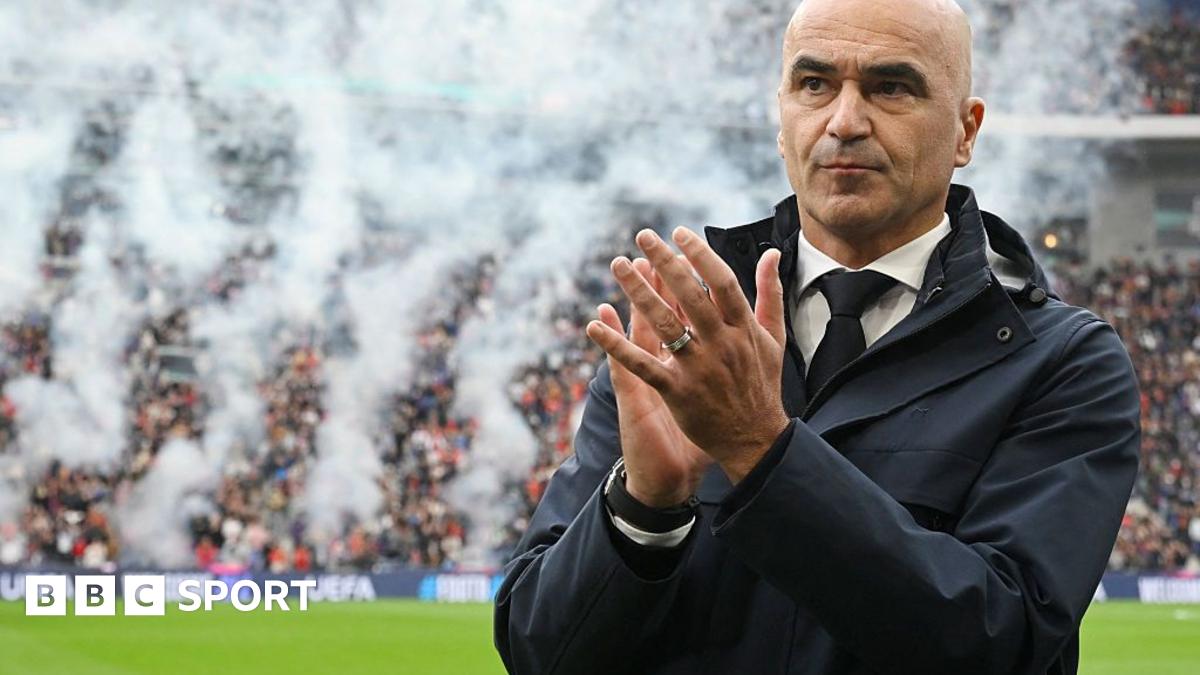
Kelly: Let’s discuss your time with Belgium, because what an incredible group of players you had there – the ‘golden generation’, they said. What challenges did that job bring with it and what did you get from that period?
Roberto: First and foremost was to cope with that tag of ‘golden generation’. It wasn’t a pressure that the players were not used to because obviously you’re talking about the players that were in the most demanding dressing rooms. From Eden Hazard to Kevin de Bruyne, Dries Mertens, Romelu Lukaku, Axel Witsel, Jan Vertonghen, Thomas Vermaelen, Vincent Kompany, Thibaut Courtois, Yannick Carrasco… you’re talking about the generation. But I think we managed to focus on, ‘OK, let’s be as good as we can together and let’s become the golden generation.’
I think that was a beautiful journey to go to the World Cup in 2018. After seven games, we won six. We only lost the semi-final against France 1-0 – there were little margins – but then we came third by winning the bronze medal in the last game. That is the moment that it became the golden generation. At that moment, it was a shift into what we could do from that point on and that team stayed four years consecutively with the number one ranking. It was a very interesting time to try to get a focus of everybody having that common goal that was trying to make history for Belgian football and it was really, really enjoyable.
Kelly: I always ask in these interviews for my interviewee to tell me a game from their career, playing or managerial, that they wish they could relive…
Roberto: I think if I could relive a game it would be the semi-final with Belgium against France because we lost 1-0. I felt we were the better team – we had almost 60% possession – and it was just decided by one action… and if it is one game that I could relive to try to change it, it would be that one.
Kelly: Do you think about it a lot, or are you able to just park it now?
Roberto: No, sometimes I like to think about it. If we were going to play it again with the same situation, what could have been done differently? And that helps. I think the margins are so small. You’ve got the best players possible of two generations and I think you can learn from already having the experience of being in a game like that.
Kelly: And you’ve not got a bad crop of players now at Portugal, have you? You’ve already won the Nations League and what an opportunity potentially ahead for you. The pressure is going to be there again.
Roberto: But it’s an enjoyable pressure because it is true… we arrived in Portugal – huge tradition, always created big players through the history now that we celebrated the moment that Eusebio won the Ballon d’Or in 1965. You’ve got players like Luis Figo, Joao Pinto, Rui Costa… it’s a tradition in Portugal, but they won everything apart from the World Cup. We got an incredible commitment from the players because this is probably a mixture of four generations. You’ve got the captain [Cristiano Ronaldo], who is 41 years old, to the youngest player who was born the year the captain made his debut for the national team. So, we’re looking forward. The first step was to qualify. We did that and I always believe that there has never been a winning team that arrives to the tournament. The winning team becomes the winning team in the tournament.
Kelly: That captain, of course, is Cristiano Ronaldo. What’s it like managing him?
Roberto: Very easy, because of his high standards, his expectations of how the work should be done and his commitment to the game. He truly is an example of what you should do to represent Portugal and the national team. And now he’s adapted, obviously, after 21 years in the national team – he’s adjusted. He’s a goalscorer, he’s an important player for us, and it’s the player that he is now that is important for me. As a national team coach, a player that has scored 25 goals in the last 30 international games… it’s not that he’s playing because of what he’s done in the past, it’s what he’s done now.
Kelly: The question everyone’s asking at the moment is: ‘How long can he go on for?’ As someone that’s seen him close up, how long do you think he can keep playing for?
Roberto: Well, we got all the stats. If you were going to analyse a player that is dropping at physical level, that’s not the case. His physical stats are of a player that could go on and on and on. I think it’s more a question of when he’ll feel that is the right time. I think he’s a player that is very critical with himself. When he doesn’t see that he can help the team, he’ll be the one that will decide when to stop.

Leave a Reply