


Hallie Grossman

Multiple Authors
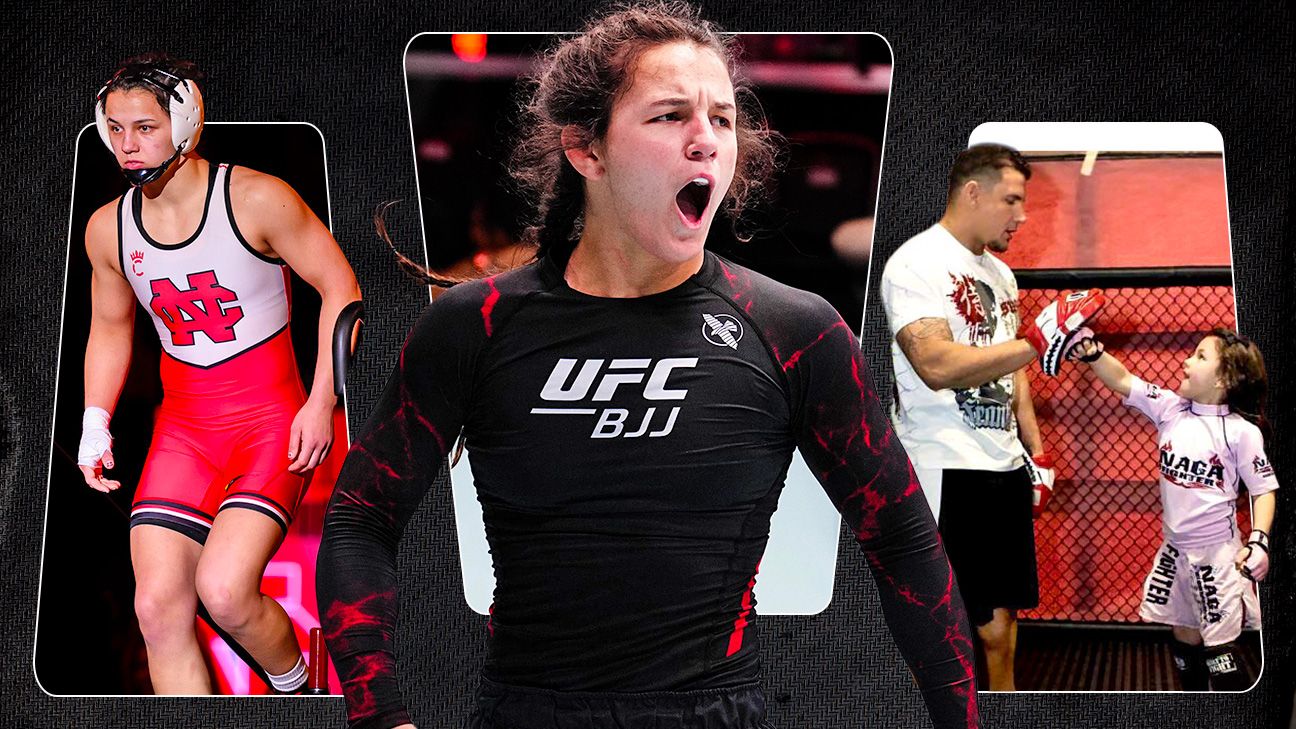
THE TEMPERATURE IN the gym is climbing into the mid-80s, and the humidity from the pool one floor below is wafting upward. The mats in the wrestling room are literally starting to sweat, turning into small puddles on the floor. Or maybe Merner Field House is just showing its age and springing leaks. “It’s 96 years old,” says Joe Norton, coach of the women’s wrestling team at North Central College. “Old as my grandma.”
Into this swelter, Bella Mir begins to jog. She’s decked out in a full sweatsuit, perhaps the better to sweat out the 1.5 pounds she must shed to make weight for North Central’s dual in a few hours. Mir is one of the best wrestlers in the women’s college game right now, but even that lofty distinction seems too small, too finite, to capture what she is and what she intends to be.
As she continues her laps around this fetid wrestling room, her hands are balled into fists. They loop upward in small, quick uppercuts, like she’s shadowboxing. Even when she’s a wrestler, she can’t just be a wrestler. Mir is a fighter.
Five hours — and 1.5 pounds — later, the man who set her down this path taps Mir on her shoulder. She’s sitting on the North Central bench, a few minutes from starting her match, but before all that, her father would like a word. Frank Mir won the heavyweight title twice in the 16 years he fought in the UFC. He helped recast the UFC from fringe spectacle to professional juggernaut in the public imagination. He passed down his devotion to martial arts to his two sons, Kage and Ronin, and daughter, Bella, as though headlocks and armbars were just your classic genetic traits. Like eye color, or dimples.
Go out there and be a samurai, he whispers into her ear. Be sharp. Be smart. You know what I mean? I love you.
Frank’s calculus boils down to this: His daughter is in the same weight class as her opponent, but not the same class class. He knows the only way for Mir to lose is if Mir beats herself. This is when they write stories of the unknown warrior coming out there and beheading you, he tells her. Stay focused.
Mir then proceeds to stay focused for 43 seconds. That’s all the time it takes for her to score a takedown, snare her challenger by the calves, and turn her a full 360 degrees on the ground. Then again, and again, and again. It looks a little like she’s rolling up a yoga mat — about as strenuous as that, too — but good for a 10-0 technical fall. It was not a case of the unknown warrior Frank had foretold. Just a woman who was defeated before Mir had even stepped on the mat.
“You could see it,” Norton says. “It was like that girl was walking to her execution.”
Because even when Bella Mir is a wrestler — the No. 2 ranked collegiate wrestler in her weight class of 145 (11-1) — she is not just a wrestler. She’s a two-time world champion in Brazilian jiu-jitsu. She’s 4-0 as a professional MMA fighter. She’s the daughter of a UFC legend, handpicked by the UFC to be its legend-in-waiting. And now she’s barreling closer to the UFC stage. The one that will, at long last, match her vision for herself.
“She wants to just prove that she’s the one,” Frank says. “The greatest martial artist of all time.”
Mir is a woman on the brink. For the UFC, it’s not a moment too soon.
ON A QUIET block a mile down the road from Merner Field House, nestled among a run of palatial homes, sits a squat ranch-style house that looks like it used to be white once. This has been Mir’s home since arriving in Naperville, Illinois, two falls ago, back when she first enrolled at North Central, and it’s nothing more than a shoebox. Frank can’t stay over when he and his wife, Mir’s mother, Jennifer, are in town.
“He’s too big,” Bella says.
It’s claustrophobic for her too, in its own way. She’ll sit in this too-small house and she’ll force herself to study, which she hates. Or she’ll steal glances out the window when the Midwestern winter rages as if it has a score to settle, which she also hates. Or she’ll look at the calendar and see it’s a Tuesday, which she supposes is fine, but it’s still a Tuesday when she’s not exactly where — or who — she wants to be.
“All the time,” she says. “I’m like, ‘God, I literally could be champ right now. Right now, in this moment, I could be a UFC champion.'”
Mir is 22. It’s early in her career, early in her life, but she was 5 years old when Frank won his second UFC belt, and in the postfight locker room during media interviews, she grabbed it and wrapped it around herself. The gold plate was as big as her whole torso. A decade and a half is a long time to ache for something.
“Since the day I saw his belt,” she says, “I wanted one of my own.”
Back then, she told her father — who had three children but only two belts — that he needn’t worry about winning a third. Her brothers could have each of his, and she’d go win one for herself.
How precocious that Mir girl was; how precious that a child so small could dream so big. How odd when people — correction, when the one person in this business who matters more than anyone — started to agree with her.
UFC president Dana White had long heard stories about Bella Mir, this young kid who was a native Las Vegan like him. This “freak of nature” athlete, which piqued his interest, seeing as he was one of the preeminent purveyors of freak-of-nature athletes in the world. That girl who played on the high school football team. That girl shattering weightlifting records. That girl mowing down people in jiu-jitsu. “She was like a Greek myth here,” he says.
The legend of Bella Mir had ballooned so large that by the time he hosted her for an in-person meeting when she was 18 or so, he almost felt duped. The first thing he told her: “God, you’re so small.” It has become something of an inside joke between the two at this point. “Apparently people were thinking I’m this 180-pound giant,” Mir says. “Like my dad was, just with long hair.”
That was the first and last time White would be underwhelmed by her. Since that day, Mir meets with him about twice a year. To catch up; to make sure she’s on track; to find out what he wants her to do next. Every time, Mir leaves with the same slew of affirmations.
You’re the next big thing.
You’re the next superstar.
You have no idea.
It’s a heady stream of praise that might sound like a bill of goods if White, in charge of the world’s biggest MMA promotion, didn’t act as invested as he said he was.
He signed her as the UFC’s first name, image and likeness ambassador back in 2023 at the start of her collegiate wrestling career. He was, in fact, the reason she pursued a collegiate wrestling career at all.
By the time Mir was wrapping up high school, she had won four Nevada state wrestling titles — and started to build her MMA résumé. She was 3-0 as a professional fighter; her first fight in 2020 took place in Mexico because, at 17, she was too young for a sanctioned fight in the United States. She planned to graduate, stay in Las Vegas, the UFC’s home base, and claw her way into its ranks. She grilled White: What did she have to do to make that happen? Go 4-0? 10-0? Name it, and she’d do it. She’d do it now. She’d do it yesterday.
White, noted man of restraint, preached patience instead. Fighters don’t hit their prime until their mid-to-late 20s, he told her. Time was on her side, he promised, so why not bolster her wrestling bona fides for a few years? With Mir sitting by his side, White picked up the phone to call Daniel Cormier, which was surreal in so much as one of Mir’s earliest UFC memories is wanting to holler at Daniel Cormier to stop grabbing the fence during his 2013 fight against her father. But before Cormier was a world-class UFC fighter, he was a world-class wrestler, and White trusted only the best when it came to Mir. “Where should she go to wrestle?” White asked Cormier that day, and Cormier told him Iowa, so off Mir went to Iowa.
The Hawkeyes’ program is young, but without equal. Olympians walk through its doors; women who go undefeated in college, too. But, still, Mir impressed. Iowa coach Clarissa Chun was taken with Mir’s physical strength, coachability and charisma. “Bella has a hard, competitive side to her,” Chun says. “There’s no softness to her touch when it comes to being on the mat. But off the mat, you know, Bella’s touch is soft.”
Mir spent two years in Iowa City but was beset by injuries in that time — a struggle she attributed to the Hawkeyes’ unforgiving training style. Chun takes some exception to that, says that her program takes pains to recognize athletes’ individual needs, and that sometimes things such as body makeup, chronic injuries, or even freak injuries just rear their head.
Still, once Mir chose to move on, White was undeterred. He picked up the phone again, this time to call Joe Norton at North Central to find out what he needed to do to get Mir to Illinois. The school in suburban Chicago was small but had a giant wrestling footprint: a National Collegiate Women’s Wrestling Championship in 2023 and runner-up status (to Iowa) the year after, just as Mir was looking for her new wrestling home. (Norton ignored White’s first attempt at an outreach, certain it was a scam. Dana White? Trying to get a D-III college coach? About a woman wrestler?) Norton, in the interest of transparency, told White the school did not have athletic scholarships.
“He’s just like, ‘I don’t f—ing care about the scholarship,'” Norton says. “‘She’s on a full deal from me. That’s not a f—ing problem.'”
White has poured all this capital into Mir because he is nothing if not a tireless businessman. And Mir? He thinks she looks good — great; perhaps generational — for business.
He is excitable by nature, but Mir does seem to have a knack for exciting the people who have lived and thrived in this sport.
Cormier: “She’s so physically strong and gifted. She’s aggressive. She’s big. She’s going to be a problem for so many women as her career gets going.”
Mike Brown, MMA coach for Kayla Harrison, the UFC’s current bantamweight champion: “That’s something her dad would do,” he says of her knack for unique and dominant submissions. “He’s famous for breaking a couple of guys’ arms. She looks good. Very good.”
Harrison sees a day when Mir could join her, then surpass her.
“If you are a good wrestler in women’s MMA, it’s kind of a cheat code,” Harrison says. “She could take everything Amanda [Nunes] has done or Valentina [Shevchenko] has done or Joanna [Jedrzejczyk] has done or I’ve done and crush all of those records.”
Mir is grateful for those votes of confidence and for all that capital. And she’s still a little stunned, if she’s being honest, that she has the ear and backing of White, combat sports’ most vital kingmaker. She has even found herself grateful for this detour to college wrestling that he proposed. It felt like a step backward at first, a kicking of the can down the road, but she concedes now it was a step sideways, just an alternate route to moving forward.
Still, she’s ready to do the moving forward. Her knee bounces whenever the UFC and its promise of gold come up, like she’s antsy, late for something important.
There’s unfinished business here at North Central. Because she fancies herself a hoarder of titles, she’d like to be national champion — individually; as a team — something that has eluded her, and North Central, in their time together. If you ask Mir what she has accomplished in Naperville, she’ll tell you: nothing at all. “I’m not up on that wall,” she says, then points to the banners of the women’s national champions who have come through North Central’s wrestling room.
Her moment to fix all that is here: This year, for the first time ever, the championship will be hosted by the NCAA, and it is being held this weekend — in Coralville, Iowa, to boot. Just the kind of grand platform Mir covets. It’s a mission that sates her, just as the BJJ and MMA bouts she schedules in the wrestling offseason sate her. Enough, for a spell, to soothe her fraying patience to get started on her next mission. Because she’s not just a wrestler.
“Sometimes you have to remind her that she’s in a wrestling match and not a UFC fight,” Norton says. “‘Someday you’re going to get to do that. And if you knock her out then, you win. That’s cool. But if you knock her out here, you actually lose.'”
Mir is a fighter. But even she can’t fight the inevitable.
“MMA is my destiny,” she says.
ONE DAY, BACK when Mir was 4 or 5, her father looked out the window of their home in Las Vegas and caught a flash of blue. It was Mir in a blue jiu-jitsu gi, outside alone — which was unremarkable, because their house at the time sat on a cul-de-sac, so she was allowed to roam free within reason. And she was loading up duffel bags with an array of makeshift weights — clothing, pads, equipment — which was remarkable, because Frank quickly deduced that his preschooler was creating her own workout regimen. He went upstairs to get a better viewpoint, and from his new perch he watched Mir grab those duffel bags and start sprinting around the cul-de-sac until she ran out of gas. She caught her breath, then began anew. This went on for about an hour.
Some families go to church. The Mirs went to the gym. Mir’s first pair of infant mittens — the kind to keep babies from scratching themselves — were pink boxing gloves. (“They were tiny!” she says.) Frank taught her proper punching technique when she was 2. As she grew to school age, most kids went home in the afternoon and played soccer. Mir went to the gym her family owned back then called Suffer, of all things, and adored it, unironically and completely.
In retrospect, Mir, at the wizened age of 5, pushing herself to her physical limits wasn’t just second nature. It was the natural order of things.
She has never not been that girl in a blue gi, grinding herself to dust to discover what her body is capable of achieving.
There’s the girl in the blue gi just this past January, sitting in Norton’s office: She’s pleading her case to wrestle at 160 pounds, instead of her normal 145, when North Central faces Iowa in the NWCA National Duals. She’s volunteering as tribute to wrestle Kennedy Blades, who won a silver medal in the 2024 Olympics and has never lost in college. Norton denied her request but still marvels at Mir’s brass. “The fact that she would be willing to say that,” Norton says. “Nobody wants to f—ing wrestle Kennedy Blades. Nobody.” Because Mir has tunnel vision for winning, she’s relentless and relentlessly optimistic. She’s sure she can do what no one else has done (beat Blades), just as she’s sure North Central can do what no other team has done (topple Iowa for a national title). “That’s why in here,” her teammate Taylor Graveman says, “she’s the glue.”
There’s the girl in the blue gi, then a grade-schooler, in judo class: The instructor has everyone do handstands and plant their feet to the wall, then issues a challenge: Who can last the longest? Oh, s—, Frank thinks, watching from the sidelines. If she comes down, it’s because she has lost consciousness. Now he always nudges her coaches not to push her too hard; they’ll kill his daughter, he tells them, or she’ll die trying.
There’s the girl in the blue gi at the 2012 World MMA Awards: She watches her father win Submission of the Year, then meets Ronda Rousey for the first time. Rousey, who is fresh off her historic signing with the UFC, the first woman to wear a title belt for the promotion that had loomed so large for Mir, for so long. “It’s so hard to lock yourself in a literal cage,” Mir says, “with somebody else trying to rip your head off.” Not all that many kids daydream about signing up for that kind of torment, but Mir did. Rousey did. So Rousey, for Mir, was both mirror and North Star.
Until Rousey came along and changed his mind, White swore no woman would ever fight under the UFC banner. Which meant that, until Rousey, all those visions of grandeur Mir had — all those times she put on Frank’s title belts to try them on for size and found they fit just right — were delusions.
“It opened up my whole world,” she says.
Mir had only ever wanted one thing — a UFC title — and there, in Rousey, was this incontrovertible proof standing right in front of her. She could have one, one day.
There, in Rousey, was the face of women’s UFC.
There, in Mir, was the future face of women’s UFC. Or so the UFC hopes.
ONE MONTH AFTER she opened up Mir’s whole world, Rousey defended her UFC title belt for the first time. After that win — after all her title fight wins, Rousey has said — she cried herself to sleep.
She had vowed to White that women’s UFC was worth his time. That she would make it worth his time. Then she had to carry the weight of following through on that promise.
“I felt like if I did anything less,” she said a few years ago, “that would have made me a liar.”
Her wins became a relief, no longer dreams realized, merely crises averted. She couldn’t just win, she had to dazzle. She couldn’t just dazzle fighters, she had to dazzle cameras. Get everyone into a lather, rinse, repeat. She had a sport to build.
Now, Bella Mir might have to save it. Women’s UFC is down bad.
It has been nearly a decade since Rousey last fought — and lost; crisis detonated — in the UFC. She’s staging a comeback this May against Gina Carano — with Netflix, not the UFC — but before talks with White & Co. broke down, she said the deal he presented her would have offered her the highest percentage of pay-per-view shares in the company’s history. All of which proves: “Since Ronda Rousey, we just haven’t had that single star,” says Lamar Reams, department chair of sports administration at Ohio University. “Someone who’s captured the minds of true, hardcore mixed martial arts fans, but casual fans too.”
Reams studies the intersection of sports marketing and combat sports, and the way those forces can sometimes, once a generation or so, combust into superstardom. Since Rousey, he’s quick to note, there have been GOATs (Nunes) and destroyers of souls (Shevchenko) and intriguing new blood (Harrison) but no one to capture the belt and then the zeitgeist along with it.
To be clear, UFC the Business is doing just fine. Gangbusters, even. This year marks the promotion’s first with Paramount after the two joined forces last August on a seven-year, $7.7 billion megadeal. But UFC, the Cultural Moment, is teetering. This league’s lifeblood is cult of personality. You can love its stars or hate them, but you will feel something, someway. Unless there are no stars.
White bristles at this idea, has said he has heard some version of this pearl clutching at every point in his quarter-century with the UFC. But in this post-Rousey, post-Conor McGregor, post-Jon Jones, even post-Nunes universe, the contingent of superstars with brand recognition beyond its most ardent fan base is dwindling. The contingent of women superstars with that brand recognition is a black hole.
Since UFC 300 in April 2024, which White hailed as “the greatest card ever assembled” — the UFC at the peak of its cachet — there have been 26 numbered events, including this weekend’s UFC 326, and only 12 of them featured a women’s bout on the main card. And though eight of those were co-main and title bouts, a woman hasn’t reached the mountaintop of main-event status in almost three years, since Nunes dominated Irene Aldana in UFC 289, then retired that same night.
Now into this abyss comes Mir, with all that pedigree and prodigy. Hers is a story that’s ripe for telling — and selling — right when the vacuum of talent and true star power in the UFC seems like it’s reaching a tipping point. Mir is not just arriving on the scene. She’s arriving right when the UFC needs her the most.
“I’ve had some fun times in my career,” White says. “The rise of Chuck Liddell. The rise of Ronda. The rise of Conor. There’s been really special people that have stood out in the history of the UFC and the sport. And I truly believe that Bella will be one of those too.”
It’s a gilded burden White is laying at Mir’s feet. It was, after all, the act of being “one of those” that chipped away at Rousey until her dominance became an albatross, as much a strain as falling short.
Perhaps Mir’s obsession with winning, and winning a UFC belt, in particular, will serve as a kind of armor. “Genuinely, just winning the UFC title is the only thing I care about,” she says. “Just winning that, and if the other stuff comes then it does.” For her own sake, she’ll have to believe it will. Women’s UFC is not a new story, not anymore, but it still needs a new hero.
Mir will insist in one breath that she doesn’t seek out, or really care at all about, the fame part of being a famous UFC champion. When her mother ribs her for how much Mir actively does not court attention, nor feel a burning desire to dress the part for such attention, Mir yells: “These are my Lululemons!” These are her fancy sweats, is her self-defense. She’s trying to be better.
Because in that same breath, she concedes that, yes, of course, she knows what’s waiting. She knows what comes with this gig. Years ago, when she was a young kid, Mir’s mother asked her what she thought Frank did for work. Mir took stock of all the magazine covers around the house that bore her father’s face. Of all the microphones in front of him. Of the spotlight that always found him. She came to a sound conclusion. “He’s a model,” she said. She has always known it’s part of the deal.
Even if she, herself, has not yet been at the epicenter of that storm, neither she nor Frank worry much about it being a shock to her system. What does keep Frank up at night is this: Winning wasn’t enough for Rousey, and it might not be enough for Mir either. She is Dana White’s golden child and Frank Mir’s actual child. There’s already this notion that she shouldn’t just win, she should romp. That she might not just be a UFC champion, but the rare champion who also becomes the face of this whole enterprise.
All before she has ever stepped foot into the UFC Octagon.
THERE WAS ONE fleeting moment when Bella Mir did not feel born for this.
Mexico, her first MMA fight as a professional, against a woman nearly twice her age. “She was fighting for probably almost as long as I was alive,” Mir says of Danielle Wynn, her opponent that night — and who, in a surprise twist, was a powerhouse. Most up-and-coming fighters start out by dipping their toes into the combat equivalent of a warm bath. Come on in, the water’s fine! They fight someone they’ll dispose of in the first round. Someone who will pad their résumé and their ego. Someone who would not, as Wynn was doing in that very moment, bring a war to their doorstep.
“The second she started,” Mir says, “jab, cross, coming straight to my face.” Mir’s nose turned into a spigot. She was covered in blood; Wynn was covered in Mir’s blood. And when Mir was in closed guard on top of her, she had this flash of clarity. Startling and stark. This was all a lie. I can’t fight.
She survived the early rounds how she survives most things, in the cage, out of the cage: By remembering Frank is in her corner and she just has to get to him. When she did, Frank looked at her. “Comfortable uncomfortable,” he said. She nodded back, because she must have said it thousands of times over the course of this, her first fight camp. She was comfortable being uncomfortable. She was, in fact, born for being uncomfortable. Born for this.
The next round, Mir kicked Wynn so hard Wynn incorporated a touch of ballet in her MMA repertoire and completed a 360-degree spin. Mir turned her like she was a top, a plaything, then picked up her first win as a professional via unanimous decision.
Since that day, her life has mostly been a series of reminders that none of this was a lie. And ahead of her, she’ll seek more assurances. Perhaps in the Olympics in 2028. Maybe as the first simultaneous UFC MMA and UFC BJJ champion. (She’s 2-0 already in UFC BJJ, White’s budding jiu-jitsu league.) Potentially with a paradigm-shifting run in MMA. Frank would like her to get about six more fights under her belt before she joins the UFC ranks. Then he thinks — and she thinks and White thinks — she’s off to the races.
Mir wants more than the two UFC titles he won (“I have to get at least three,” she says. “I have to beat him.”). But the ceiling she has set herself is no ceiling at all. She’s after the UFC submission record and the takedown record and the knockout record. She doesn’t want to share anything with Frank but one last stage.
It has been seven years since Frank has fought professionally, and only one since he temporarily lost the use of his legs and had to have emergency spinal fusion surgery. He still walks with a hitch in his step, but the limp is neurological. At this point, it’s just his lumbering gait — he limped for so long that his body, even when technically healed, has forgotten it doesn’t need to anymore. This life takes as much as it gives.
Frank knows MMA has evolved. He understands the way its athletes train now is so much more sophisticated, enlightened, backed by science, than it was for him in his fighting days. That gives him peace, even as his daughter courts this life and the violence it requires. Yes, this sport will take much from Mir too. So he would like to give Mir this one gift. To come out of retirement to fight, just once, on the same card as his daughter.
“The setting of my sun,” he says. “And the rising of hers.”





Leave a Reply