


Ryan O’Hanlon

Multiple Authors
In the most recent round of Premier League matches, the four teams in the Champions League race combined to win four total points, and the four teams in the relegation battle combined to win four total points.
Now, go back to the round before that. Manchester United, Aston Villa and Liverpool combined for three points, and Leeds United, Tottenham Hotspur, Nottingham Forest, and West Ham United won four.
I’m not sure there’s a better way to sum up the volatility of this season better than that: Over the past two weeks, the teams trying to avoid relegation have more points than the teams trying to qualify for the Champions League. It’s not even simply a schedule quirk: Liverpool just drew with Tottenham at home, and Manchester City have drawn in back-to-back matches against Forest and West Ham.
Amid all of the uncertainty — and with one game left until the season’s final international break — we have returned with the latest edition of ESPN’s monthly Premier League Power Rankings.
– What do assistant managers actually do?
– USWNT transfer grades: Record deals worth it?
– Ogden: Arsenal are making the game worse
How the Premier League Power Rankings work
Allow me to quote myself:
These aren’t meant to be the most accurate power rankings in the history of power rankings — the goal here is to create something that is simple and intuitive but still has some predictive power. The value comes from comparing the rankings to the table, seeing what looks different, and trying to pry apart the reasons why.
The first edition of the rankings contains a more detailed discussion of the methodology, but the rating system uses four inputs: (1) Transfermarkt’s combined squad values — a proxy for talent, (2) non-penalty expected-goal differential — the best single metric to predict future performance, (3) passes allowed per defensive action — or PPDA, a proxy for pressing intensity — and (4) buildup pass-completion percentage — or the percentage of passes outside of the attacking third completed, a proxy for a team’s ability to withstand a press.
It’s a simple model, but all four numbers have correlated with winning over the past couple of seasons. And here’s where everyone currently sits:


As City slide down the table and get knocked out of the Champions League by Real Madrid, they … move up to No. 1 in our rankings? What the heck is going on?
Well, as we talked about last time, City’s playing style had started to change after their January transfers. They’d begun to press a little more aggressively, higher up the field, which is something these rankings will reward. And the press continued to tick up over the past month.
But it’s worth taking a step back and really zeroing in on this shift. Brighton lead the Premier League with a PPDA of 10.23. Since the calendar flipped to January, City have produced a PPDA below 10 in seven matches, and they’d done it only three other times before then. But even those matches speak to this being a new development: two came in late December and the other in late November. Since the midway point of the season, City have the lowest PPDA in the Premier League.
On top of that, yes, they did drop points both to West Ham and Nottingham Forest, but those were two of City’s better matches of the season, as measured by non-penalty xG differential. The West Ham match, in particular, featured something you might only see once or twice a decade: a team attempting one shot and scoring one goal.
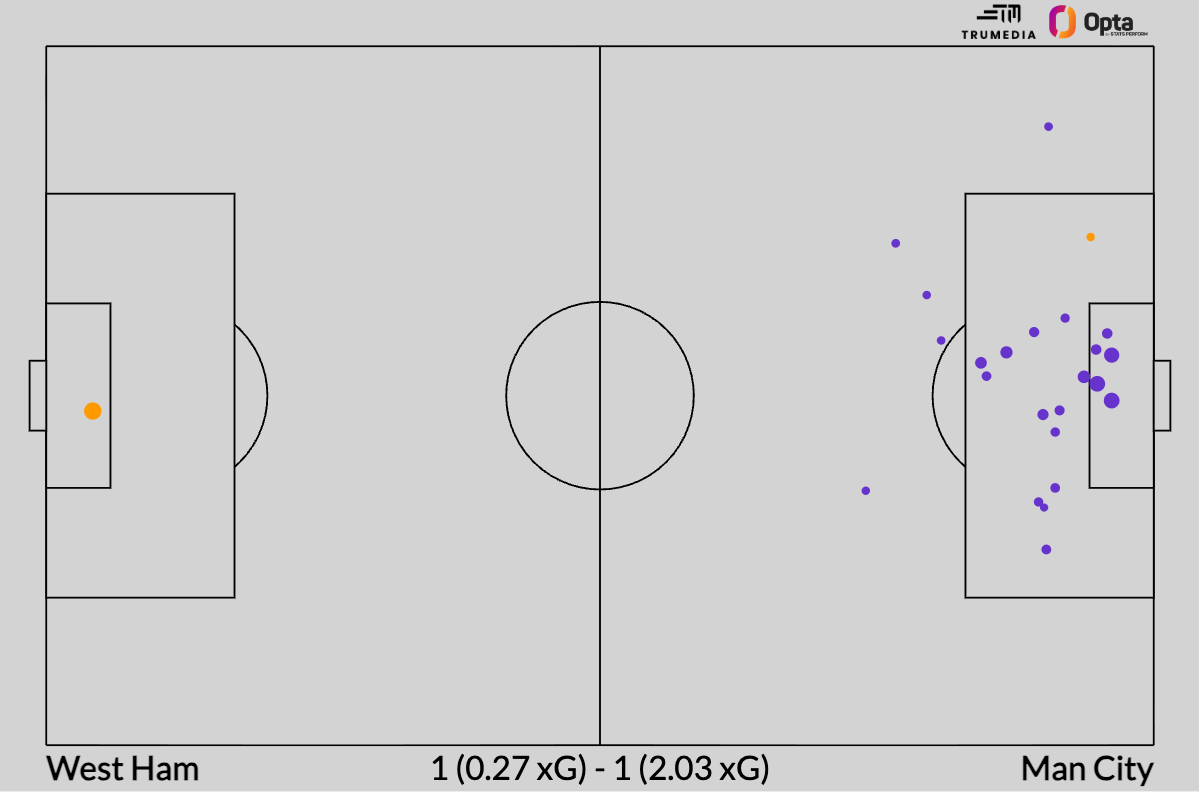
(Shots are purple, orange are goals, and the larger the circle, the higher its expected goals value.)
Had I ranked these teams more subjectively, I’d still have Arsenal first. City are just way too inconsistent and light in midfield, and their roster still doesn’t really make any sense. But they continue to dominate possession outside of the final third, and the press continues to get more aggressive. The more you do both of those things, the more you tend to win.
Allow me to repeat myself, in a safe-for-the-internet tone: What the heck?
The Gunners are going to win the league, barring a massive collapse. At DraftKings currently, you need to bet $1,000 to make a $100 profit from Arsenal finishing first in the table. Per Simon Tinsley’s projection model, Mikel Arteta & Co. have a 96% chance of lifting the Premier League trophy. What already looked very likely in October is close-to-certainly going to happen.
And yet, they’ve fallen to second in a table that is arguably more important and certainly more illustrious than the Premier League’s: these power rankings. Rather than looking at this as telling us that Arsenal is no longer the best team in England, let’s shift that frame slightly and change it to “this ranking change is telling us that Arsenal have gotten a little worse as the season’s gone on.”
If you’ve watched them play recently, you’ve seen it. They either can’t or won’t hold onto possession as patiently as they used to. Halfway through the season, they’d completed 86.9% of their passes outside of the attacking third — second in the league only to City. Since then, that number has plummeted to 81.8% — ninth in the league, stuck between Brighton and Everton.
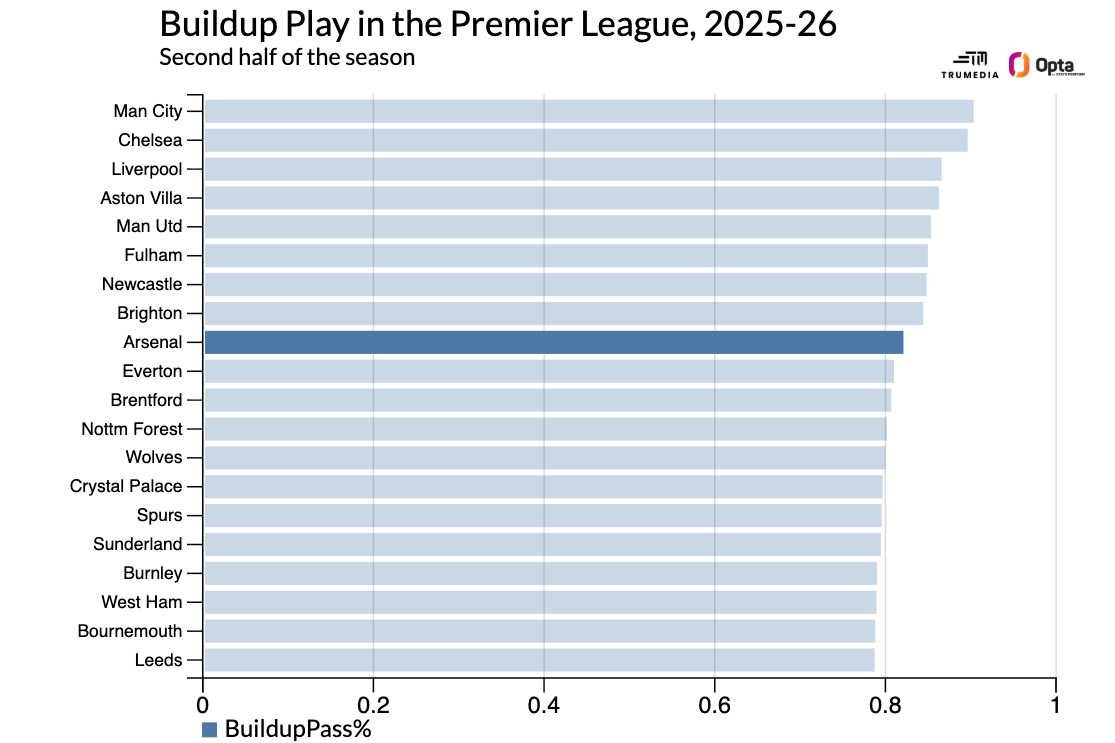
Take it all together, and they’ve dropped to sixth in buildup-pass completion percentage. This certainly feels like a tactical choice by Arteta, as I can’t imagine opponents suddenly decided to play more aggressively against the best team in the league.
They are probably gripping the steering wheel a little too tightly, but it’s not going to matter. Their two worst matches of the season were probably the away games against Brentford and Brighton over the past month-plus — and they still ended up with four points from those two.
 3. Chelsea (unchanged)
 3. Chelsea (unchanged)
Here is Chelsea’s non-penalty expected goals differential under their two full-time managers this season:
• Enzo Maresca: plus-0.23
• Liam Rosenior: plus-0.74
They’re not pressing as aggressively as they were under Maresca, but they’re generally playing much more patiently in possession. Overall, there’s a clear picture of a new manager coming in, calming things down, and convincing everyone that the team is better … right? Right?!
Not quite. They just lost to PSG 8-2 on aggregate in the Champions League. The overall numbers are quite good, but on a game-to-game basis, Chelsea feel like a dice roll.
Will their goalkeeper give the other team a couple free goals? Will they obliterate one of their competitors for the top five? Will they be dominated by a midtable team and still win? Will they play like garbage for most of the match before they bury the opposition under an avalanche of chances as they chase the game? Will Pedro Neto pick a fight with a helpless teenager? Might Rosenior make his players start doing trust falls in the middle of a match they’re already losing by five goals?
There is a good team still hidden somewhere in here, and we’ll see if Rosenior can man-age his way out of the chaos. PSG were red-hot in front of goal: they turned a little over two xG into eight goals.
If Chelsea were a couple of points higher in the table, they’d be favorites to finish in the top five, but they’re currently in sixth, and they still have to play both Manchester clubs, Liverpool, and then relegation-battlers Spurs and Forest — theoretically, the latter two should be easy matches but might actually be tougher than a game against a 12th-place team with nothing to play for. Their odds of being in the Champions League next season look like a coin flip.
On one side, you have PSG, the defending European champs, who just beat Chelsea 8-2 on aggregate. They’ve got the defending Ballon d’Or winner, the deepest collection of athletic, game-breaking wingers in the world, the best fullback pairing on the planet, and also the most balanced midfield.
On the other, you have Liverpool, the team whose best player (Mohamed Salah) looks as if he aged 15 years over the offseason and frequently trips over the ball when he’s in on goal; whose manager seems as if he’s on the verge of being fired every time they take the field and looks increasingly overmatched on the sideline; whose best passer from last season is playing for Real Madrid; whose club-record striker signing has scored two goals; who lost to Wolverhampton Wanderers two weeks ago; who tied Tottenham last weekend; who got booed off the field by their own fans fewer than seven days ago.
These teams are about to meet in the Champions League quarterfinals, and where might you slate their respective chances of advancing? Say, 80-20 to the first group? Maybe you realize soccer is a little more random than that so you drop it down to 70-30?
Well, DraftKings has the odds up for the Champions League quarterfinals, and they do favor PSG over Liverpool, but just slightly: 55% to 45%.
1:22
Slot: Unrealistic for Liverpool to recreate Galatasaray performance vs. PSG
Arne Slot labels PSG as “incredible” ahead of Liverpool’s Champions League quarterfinal clash.
United’s odds of qualifying for the Champions League are about the same as — if not better than — Arsenal’s odds of winning the league. It’s not because of Michael Carrick or the return of Kobbie Mainoo or the lack of European matches or domestic cups games.
No, it’s because Bruno Fernandes is playing out of his mind. We are witnessing one of the greatest pure passing seasons of all time. I mean, just look at this ball.
But it’s not just a couple of highlight-reel plays.
Gradient Sports grades every pass in the Premier League each week on a minus-2 to plus-2 scale, and then it normalizes each player’s grade on a scale of zero to 100. Here’s how Fernandes has done this season:
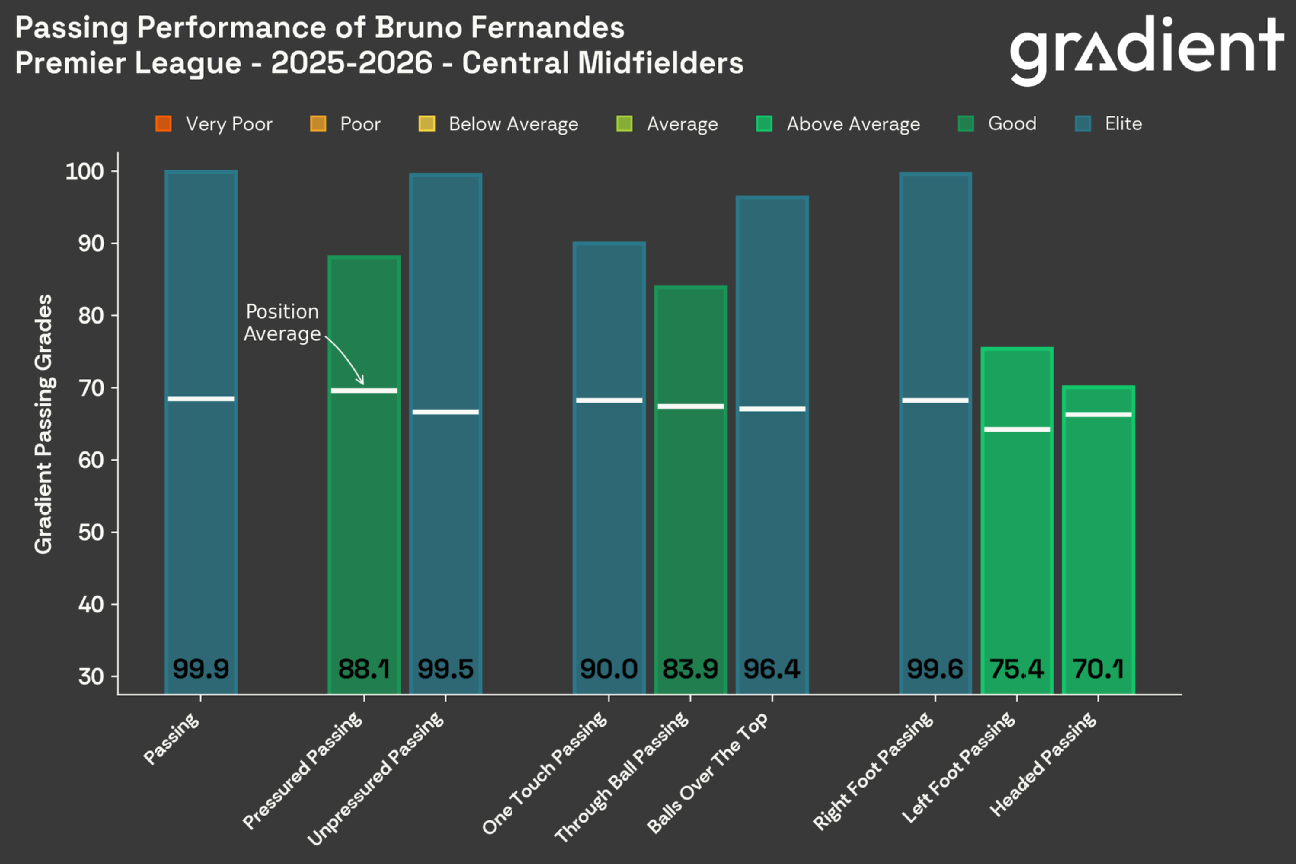
You’re reading that right: He’s a 99.9 out of 100.
The Champions League tie with Barcelona was Newcastle’s season in miniature: three really good halves of high intensity soccer, followed by a complete and utter meltdown.
It really seemed as if they might go to the Camp Nou and win straight up, then Kieran Trippier yanked Raphinha’s arm, Barcelona went up 3-2, and it all fell apart in the second half:
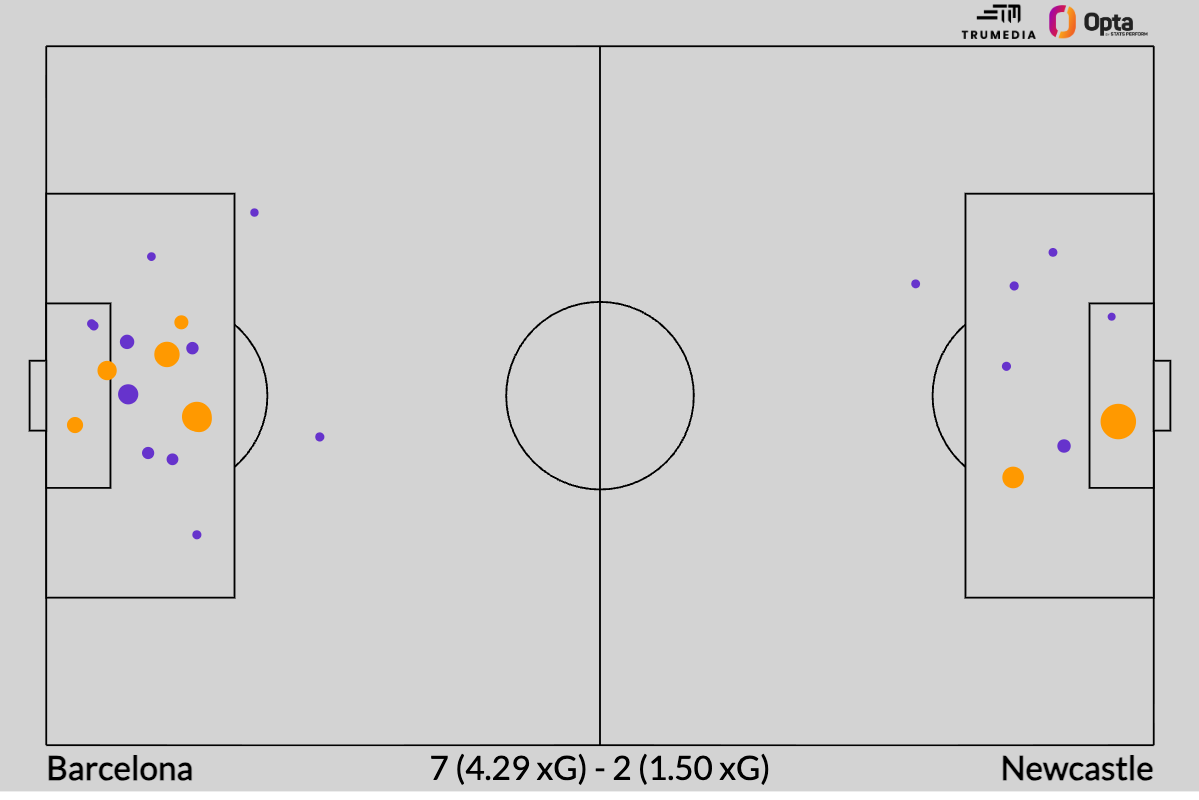
(Shots are purple, orange are goals, and the larger the circle, the higher its expected goals value.)
What was so impressive about the first 75% of this matchup is that Eddie Howe’s team did it without their best player, Bruno Guimarães. And what’s so concerning about those first three halves is that they did it, by choice, without Nick Woltemade and Yoane Wissa, the two strikers they paid a combined €130 million for over the summer. They were chasing the game the entire second half — and neither player left the bench.
Every team in the upper left corner of this chart has played in the Champions League at some point over the past three seasons — except for one:
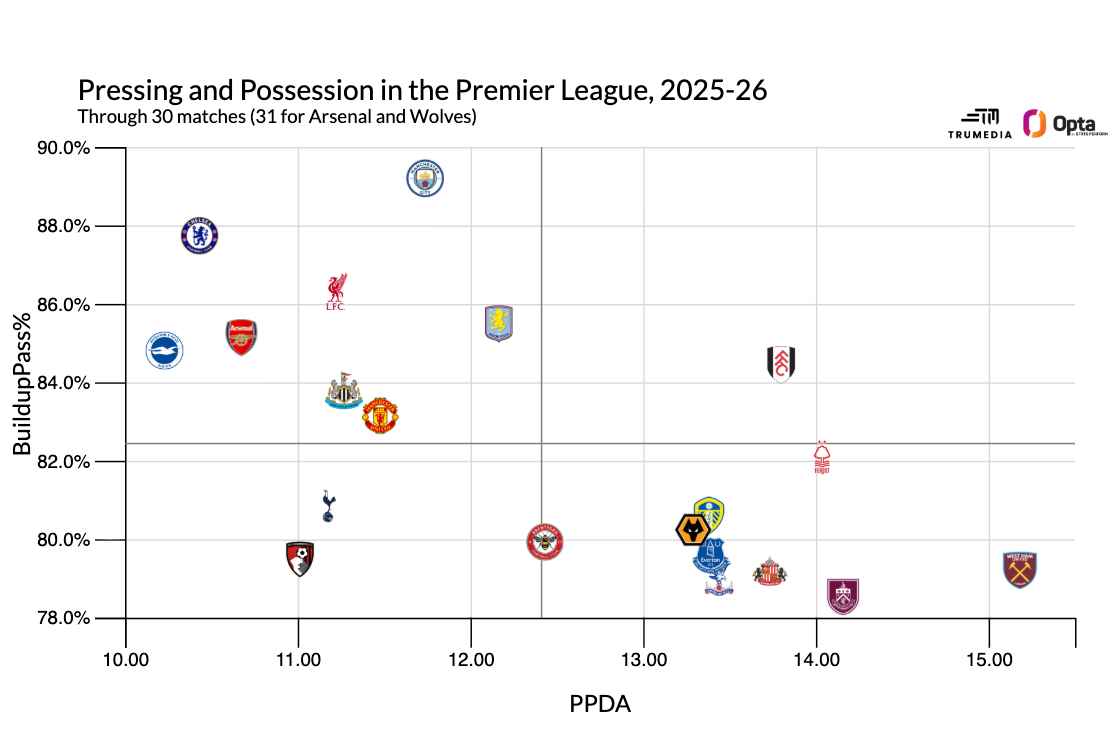
If Vincent Kompany got the Bayern Munich manager job because he played possession soccer with a terrible Burnley team that was relegated, might some bigger club take a shot with 33-year-old Fabian Hurzeler?
If we remove squad value from the equation, the Spurs would plummet down the power ratings, but still not into the bottom three.
Since they’ve been able to press sometimes and don’t always just bomb the ball upfield once they win possession, the model boosts them up beyond 17th, where their xG differential says they should be.
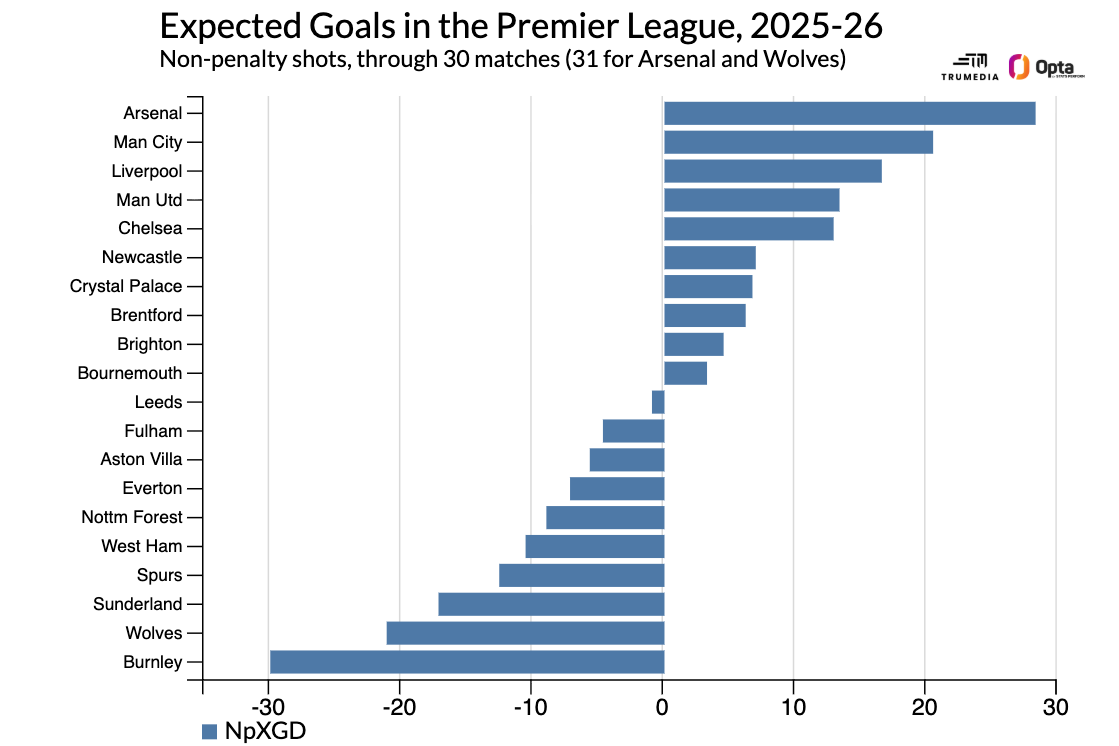
Ironically, their best path forward for the rest of this season might be to do something that’ll get them punished in these power rankings: sit deep and try to counter. It took Igor Tudor, who is Croatian and had never played or managed professionally in England, just a couple of weeks to realize he had no choice but to channel the ornery British relegation specialists of yesteryear and play a reactive 4-4-2.
They weren’t “good” against Liverpool, but they did just enough to frustrate the hosts and scrap a late goal for an unexpected point.
If you watch an English language television broadcast of a European soccer match in the year 2026, there’s a pretty good chance that you’ll hear someone who doesn’t understand statistics tell you that expected goals is a stupid statistic. Part of that is because, on broadcasts, it’s mainly used only for single games, and it’s really not meant for that purpose. I still use it for single games to get a sense of who created better chances, but it’s also not the be-all-end-all for understanding how a game went.
Now, the commentators could try to contextualize the xG numbers they’re given — or try to talk about why they don’t match up with what they’ve seen — but it’s way easier to just laugh at the nerds and point at the scoreboard.
The real power of xG, though, comes in aggregates. We know, for example, that after about 10 games, xG totals become way more predictive of future performance than points or goals or anything else.
Take this season, for example. Through 15 matches, Aston Villa were three points back of first-place Arsenal. Some commentators declared that they were part of the title race, even through their minus-3.12 was the 14th best in the league. Well, over the next 15 matches Villa won 21 points — tied for eighth most in the league — and produced a minus-4 goal differential — tied for 13th best in the league.
This slump was pretty easy to see coming, but only if you were willing to look.
Last season, Brentford averaged 1.5 points per game. Then, they lost three-fourths of their backline to PSG, Real Madrid and Liverpool. This season, Brentford are averaging 1.4 points per game.
Andoni Iraola is really good at this whole “coaching” thing.
They couldn’t … could they?
Brentford are only four points out of fifth place, and the three teams ahead of them in the table are all experiencing various stages of meltdown. The Bees already have a better goal differential than Aston Villa. Both Chelsea and Liverpool, along with Liverpool and Villa, still have to play each other. And then Brentford go to Liverpool on the last day of the season.
It’s not likely to happen, but it wouldn’t shock me if Keith Andrews & Co. were in contention for a Champions League qualification spot with one game left. It would be fascinating to see how Brentford, probably the best-run club in the world, would handle all of that new money and all of those extra matches.
They’re not at risk of relegation. They’re very unlikely to qualify for Europe. Their manager is leaving after the season. Their best player also seems likely to leave.
It’s rare that a team has so little to play for with this many games left in the season.
As things stand, Forest are third favorites for the final relegation spot. “Favorite” probably isn’t quite the right word there, but in the betting markets they’re the least likely among themselves, Tottenham, and West Ham to go down.
Why? I guess it’s because they have the best non-penalty xG differential of the three, so we can be more confident they’ll play at a higher level than the other two?
But man, I don’t know. We can’t be confident of anything with a team that’s on its fourth manager of the season. Sean Dyche had this team playing at a 46-point pace. Since Vitor Pereira took over, the schedule has been tough, but they have two points from four matches.
14. Fulham (unchanged)
 14. Fulham (unchanged)
This is the oldest team in the league, with an average age weighted by minutes played of 28.9. This was also the oldest team in the league last season, the season before that, and the season before that.
Marco Silva has done a fantastic job preventing the bottom from falling out, but this club is going to have to turn over the roster at some point.
1:58
Is Fulham a good move for USMNT’s Ricardo Pepi?
Gab & Juls discuss Ricardo Pepi’s potential transfer to Fulham.
They continue to be just mediocre enough to not fully escape from the relegation battle, but it bears repeating that Leeds, a team that was just promoted from the Championship, currently have a near-even xG differential of minus-0.95. That’s total, not per 90 minutes.
They’ve been the most impressive promoted team, and the betting markets agree. They’d be favored by around 0.2 goals if they played Sunderland on a neutral field.
16. Everton (unchanged)
 16. Everton (unchanged)
The Toffees are a good example of what happens when parity comes to the Premier League.
You can have the 14th-best xG differential and a negative overall goal differential and still find yourself within six points of the Champions League places with eight games still to go.
If you’d like to be bullish on the Hammers, here is your chart:
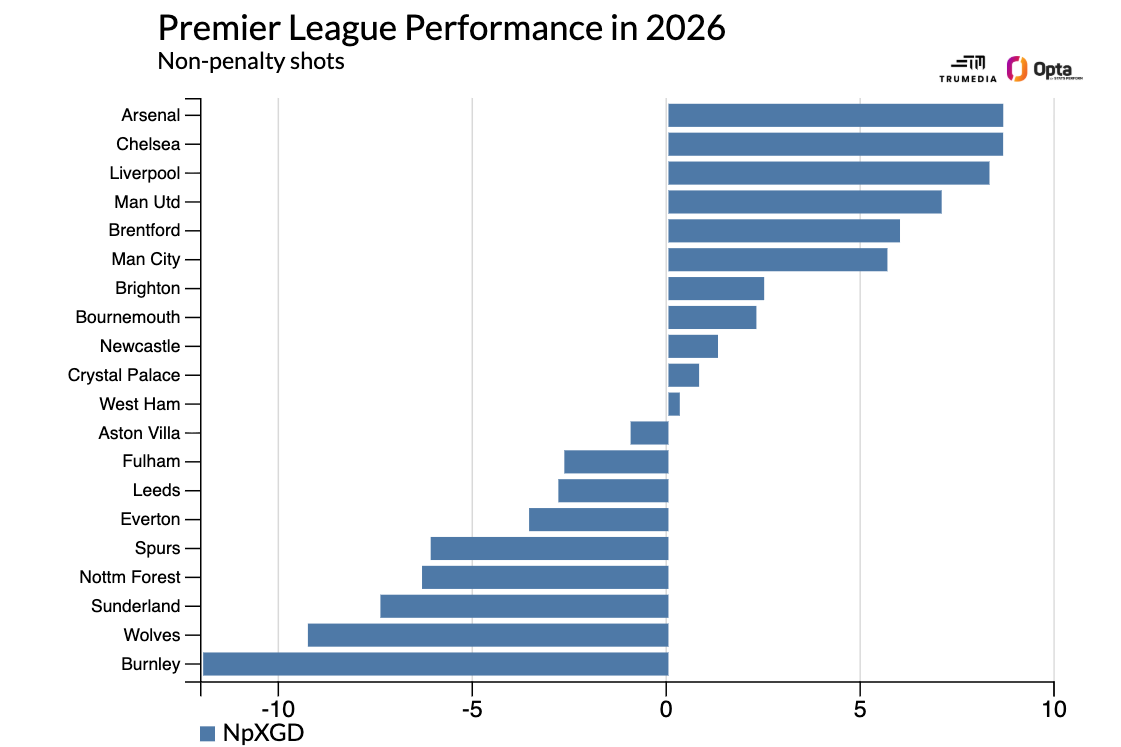
I think I’d still pick them as the favorites to go down, but that’s only because they’re the ones who are currently in 18th place. The remaining schedule includes only one team in the top five of these rankings, and they host Arsenal, who have clinched the title by then.
An added bonus for Nuno Espirito Santo: If he pulls it off, it’ll probably be at the expense of either Forest or Tottenham — two clubs that fired him.
I don’t buy the recent resurgence. See: the chart in the West Ham section.
These rankings have been pretty tough on Sunderland, who are currently in 13th in the table, and I do think they’re going to have a much tougher time staying up next season. But the upside for the Black Cats is that they’re the third-youngest team in the league after Chelsea and Bournemouth.
Plus, I think they’ve shown a decent aptitude for identifying and signing quality players. So, there’s good reason to expect both some external and internal improvement ahead of next season.
20. Burnley (unchanged)
 20. Burnley (unchanged)
They’ve attempted more shots than their opponent in five games this season. That adds up to 278 shots for and 500 against — both league worsts. They’ve also taken 511 touches inside the opposition box and allowed 974 — both also league-worsts.
It’s going to hard to stay up when you’re bad at everything.








Leave a Reply