


Kiley McDaniel

Multiple Authors
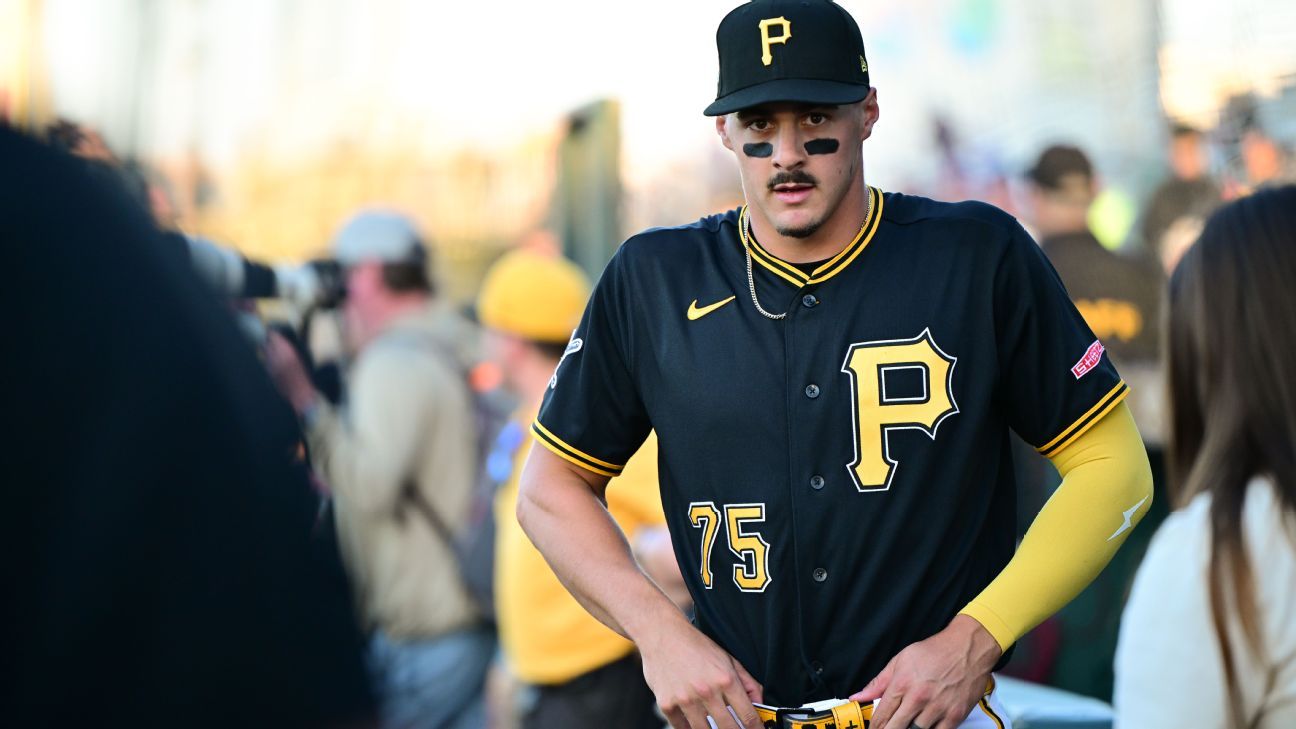
Konnor Griffin is headed to the majors!
The Pittsburgh Pirates are calling up the top prospect in the sport ahead of Friday’s home opener against the Baltimore Orioles.
Still a teenager for another three weeks, the 19-year-old shortstop is expected to become MLB’s first teenage position player since Juan Soto debuted in 2018.
There has been plenty of hype surrounding Griffin this spring, but just how good is he? What should fans expect from him early on — and in the years to come? And what does his debut mean for the Pirates? Let’s dig in.
How good is Griffin?
Griffin is the best prospect baseball has seen in years.
He is a plus-plus runner with a plus-plus arm and, in the past year, he went from profiling as a possibly average defensive shortstop who could eventually move to the outfield to an above-average defensive shortstop. He also has plus-plus raw power fueled by electric bat speed and his 6-foot-3, 222-pound frame.
Going into the 2024 MLB draft I compared Griffin to San Diego Padres star Fernando Tatis Jr. — particularly because of the thought at the time that Griffin could move to the outfield like Tatis did. It’s now more common to hear Bobby Witt Jr.’s name invoked as the primary comp. Griffin’s combination of bat speed and performance at this age also reminds some of Ronald Acuna Jr., who debuted in the big leagues just after turning 20 years old.
Griffin literally has all of the tools, size and pedigree to be a superstar and the list of players with these tools, this performance, and this prospect ranking to debut in the big leagues at this age is chock full of stars and Hall of Famers. Griffin isn’t a sure thing because nobody is, and almost all of these players had kinks to work out early in their big league careers, but all of the elements are here to justify getting quite excited.
I made an algorithm over the winter to consider age-, level- and park-adjusted performance; exit velo; speed; defense; and age vs. level to help sort through all of the Statcast-style data for position players in the minor leagues. Griffin beat the second-best prospect by this measure (Detroit’s Kevin McGonigle, the consensus No. 2 prospect in baseball and early AL ROY favorite) by over 25%. Second and third (St. Louis’ JJ Wetherholt) were separated by 3%, and third and fourth (Seattle’s Colt Emerson) were separated by 1%. You get the idea.
Can the Pirates get a bonus draft pick if Griffin is an immediate star?
Yes. Griffin has been called up soon enough to qualify the Pirates for a prospect promotion incentive pick if he wins Rookie of the Year or finishes in the top three in MVP voting before arbitration (likely Griffin’s first three seasons) because he will get a full season of MLB service if he stays up all of this season. The additional pick would be right after the first round. Last year, the Kansas City Royals got the 28th pick for Witt’s MVP finish and, in the 2024 draft, the Arizona Diamondbacks (31st pick) and Baltimore Orioles (32nd) were awarded for Corbin Carroll’s and Gunnar Henderson’s ROY wins, respectively.
Notably, the Pirates didn’t qualify for a PPI pick after Paul Skenes’ Rookie of the Year win because he wasn’t called up early enough to get a full year of service, but by winning NL ROY, he was granted a full year of service. Pittsburgh was smart to avoid repeating that situation, but this call is also easier to make with position players since there aren’t innings limits to think about.
In addition, there have been reports of Griffin and the Pirates talking about a potential contract extension all spring and the Pirates wouldn’t be eligible for a pick if he had signed it before being promoted. The idea behind the rule is for teams to call up players when they are ready, not once the team has locked in their salaries. Griffin could sign a deal after his debut and the Pirates could still get the pick if Griffin gets the required finishes for hardware.
Where did Griffin come from?
Griffin was a longtime elite prep prospect in Mississippi and the first position player from his draft class to hit the national stage. He essentially held that top spot all the way until draft time, even after reclassifying from the 2025 draft class to the 2024 draft.
He was in the consensus top tier of players ahead of the 2024 draft (it was give or take with 10 players) but needed a swing adjustment that scared some teams off. I ranked Griffin seventh in that class and he went ninth overall, landing the eighth highest bonus and being the first high school player taken).
Nick Kurtz was also in the top tier of players and went fourth overall, landing the sixth-highest bonus, before winning AL Rookie of the Year last season. Other stars could materialize from this 2024 draft class: Chase Burns, Jac Caglianone, Travis Bazzana and Wetherholt were also in that top tier, while Carson Benge and Trey Yesavage were the 19th and 20th overall picks, respectively. But Griffin and Kurtz seem like the early stars of this class.
Griffin made the swing adjustment immediately after signing then had one of the great full-season pro debuts in prospect history last season, hitting .333/.415/.527 with 21 home runs and 65 stolen bases in 122 games across both A-ball levels and Double-A as a 19-year-old. Combine that with his gaudy numbers in five Triple-A games to start this season and Griffin has one of the most peerless minor league track stat lines of all time, should his minor league career now be over.
This has been lost a bit in all the hype around his rise, but Griffin was also a really good pitching prospect. Going into the draft, I compared him to Jack Flaherty on the mound (who was also a notable two-way prep prospect) and I think Griffin could’ve still gotten at least $2 million if he had never swung a bat in his life. He has one of those elite tool sets that will be among the lofty comps you could place on any draft prospect for the next few decades, joining Bo Jackson, Josh Hamilton, Bryce Harper and Justin Upton.
Are there any concerns about Griffin’s game?
They are quite limited, but these are important to note. Griffin’s approach at the plate is to do damage and more specifically hit the ball hard. The loft in his swing and his ability to pull/lift to get to that power in games is just OK, whereas he relies more on his power/bat speed than the direction/loft to deliver extra-base hits. This was also a similar critique of Vlad Jr. and Junior Caminero at the same stage; it’s more of a nitpick, but worth mentioning.
Because of this approach, his bat-to-ball ability is good, not great, and his pitch selection is also fine, but not elite. Since Griffin is so young and has played only 26 regular-season games above A-ball (and only 24 big league spring training games), there could be some growing pains in turning his big raw tools into production. His soft skills of working an at-bat against advanced pitchers can only be so good right now. Once the league gets a scouting report on his tendencies after a few weeks, I’d expect some slump-like stretches.
The separator here goes back to when Griffin adjusted his swing plane soon after being drafted. Scouts still complain to me that their team eliminated Griffin from consideration in 2024 too quickly because of the swing questions, so I asked around trying to figure out how and why he did this and if it applies to other prospects with similar concerns. The answer was some version of this take: Griffin has elite tools and is also an elite worker who takes coaching well and integrates the suggestions quickly. Nobody, not even Pittsburgh or Griffin’s own camp, knew he would make the adjustment or do it quickly, but the Pirates thought it was a gamble worth taking.
If I could give one thing to a talented, young player so he could weather the challenges of being dropped into the deep end of the pool that is facing modern big league pitchers every day for the first time, it would be this ability.
Leave a Reply