


Bradford Doolittle

Multiple Authors
SURPRISE, Ariz. — It’s amazing how fast a ballplayer can go from overhyped to overlooked.
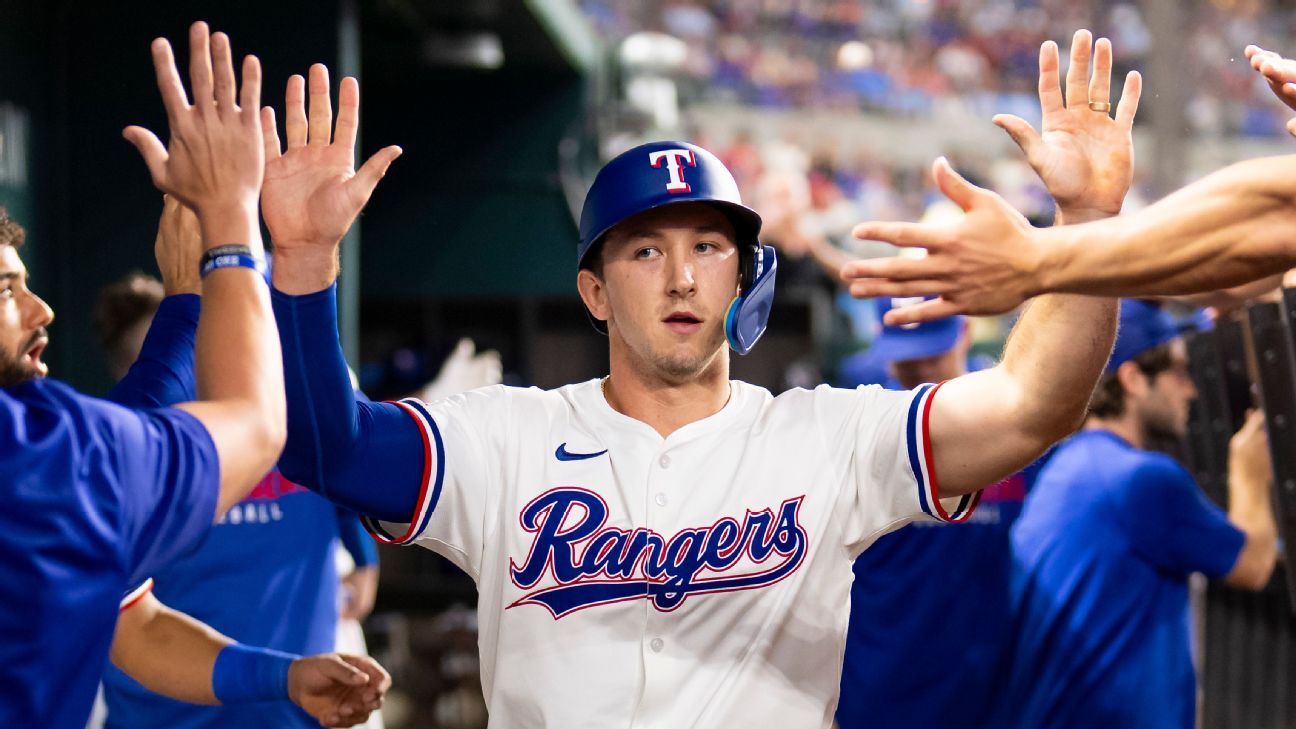
Just a couple of years ago, Texas Rangers outfielder Wyatt Langford landed at No. 4 on the top 100 prospects list of ESPN’s Kiley McDaniel. He had spent just 44 games in the minor leagues at that point, yet broke camp with the defending champions as their every-day left fielder. Many touted him as an American League Rookie of the Year candidate.
Langford, you might or might not be surprised to learn, wasn’t particularly aware of any of that. He didn’t have time to be.
“I really wasn’t in the minor league system that long,” Langford said. “I honestly didn’t really even understand the whole prospect thing. I think a lot of guys, they just don’t want to know about it. You kind of know that you’re valued when you spend that little amount of time in the minors, though, right?”
Whether he was aware of it or not, the hype and his rapid development meant heightened external expectations. Langford did well, too, ending up seventh in the 2024 Rookie of the Year balloting. In hindsight, that rookie race was where the overlooked phase of Langford’s career began, as he landed that seventh-place finish even though he had a higher bWAR (3.9) than any of the six who received more support.
The pattern continued in 2025, when his bWAR jumped to 5.6, 12th best in the AL. Yet Langford didn’t make the All-Star team despite ranking 18th in the league in bWAR at the break. This winter, when the Team USA rosters for the World Baseball Classic were put together, Langford was left out. His name surfaced as a possible replacement for injured Arizona Diamondbacks outfielder Corbin Carroll, but the spot went to Roman Anthony of the Boston Red Sox.
It bears asking: Did we get so enamored with how good we thought Langford could be that we overlooked how good he has already become?
“I think he’s tremendous,” Rangers president of baseball operations Chris Young said. “He made strides last year, and he’s only going to get better. But he’s already a really good player. I think he’s got the potential to be a great player.”
When ESPN released its most recent ranking of the top 100 players in baseball, Langford landed at No. 39. That’s pretty good, but there are a lot of reasons to think he was underrated.
First of all, that ranking places Langford 17th among AL players. As mentioned, he was 12th last season by bWAR, and that was despite missing 28 games because of injury. Second, and more importantly, he’s only 24 — still in the phase of his career where we can expect his trajectory to continue upward.
Indeed, as Opening Day approaches and people start speculating on this year’s pennant winners and award candidates in the usual slew of preview material, most of the attention for AL MVP will understandably center on Aaron Judge and Bobby Witt Jr. Many will ponder whether Cal Raleigh can contend for the award again.
It’s not hard to make a case that Langford is the one sleeper MVP candidate we seem to have forgotten to talk about. And Langford, more prone to lead by example than by oratory, isn’t likely to remind us with anything other than his play.
“Wyatt is a low-key personality who doesn’t draw a lot of attention to himself,” Young said. “Last year, our team didn’t perform at a level that got a lot of national attention. And so I think that’s why maybe he’s a little under the radar.”
Under the radar or not, Langford’s sophomore season was pretty special. That 5.6 bWAR was the 93rd best by a position player in his age-23 season — out of 7,757 such seasons. The number marks Langford as All-Star caliber, even as he continues to wait for his first actual Midsummer Classic selection.
The betting markets don’t agree precisely on Langford’s MVP hopes, but a consensus estimate gives him about a 2.2% chance to win. In other words, he’s getting overlooked there, too. Everyone is sleeping on the guy.
“There’s just so much more that you’re going to see, only because he’s still learning the big leagues,” first-year Rangers manager Skip Schumaker said. “He’s very good at adjusting on the fly, between at-bats, pitch to pitch. Those are the really good players, who can adjust and don’t have to wait a week or two at a time.”
The simplest way to think about it is that if Langford matches last season’s bWAR increase, he’d end up at 7.3. That’s an MVP candidate. Sure, you would need some cooperation in the health and/or performance departments from Judge and Witt, but you can be an MVP-level player without actually winning the award.
So how can Langford take that next step, the one that would put him squarely among the elite and force us to once again start fawning over him at the national level?
“I just want to be out there for 155 games plus,” Langford said. “That’s the goal.”
That was Langford’s response when asked what part of his game he’s focused on improving, and it’s telling that he has a particular number in mind. He has played in just 134 games in each of his first two seasons, losing time to a hamstring issue as a rookie and then enduring three injury-list stints in 2025 because of oblique strains.
“The biggest part where I didn’t really do as well as I wanted to was not staying healthy,” Langford said. “I was hurt a lot last year, [which] had more to do with the offseason, not doing the stuff I should have been doing. So I was able to learn that and then take care of it this offseason.”
If Langford hits his game target, that shortens the math for getting to MVP-level WAR. Last year’s total jumps to 6.5 if prorated to 155 games. But there is plenty of room for improvement for Langford beyond just staying in the lineup.
In some ways, Langford has already manifested a more complete arsenal of tools than his prospect grades suggested. He has power and speed, which we knew. But the speed part has translated to elite-level defensive metrics the last two years, good enough for him to play in center field from time to time. He’s a 30-steal candidate this season, and he has shown remarkable growth in his plate discipline, especially over the second half of 2025.
This cross section of skills makes Langford a high-floor player who provides first-division value even when his slash line isn’t popping. Now he just needs to attack his hit tool. Langford’s career average is a middling .247, and his strikeout rate went up in his sophomore year. But the overall profile is stronger and getting stronger, so expect him to feature prominently in the upper third of the Texas lineup.
“I see him as one of the best hitters in our lineup who I want up more often during the game,” Schumaker said. “I’ll take my chances when Wyatt Langford gets four or five at-bats in a game.”
Langford is a patient hitter, almost to a fault, but the problem isn’t how often he swings but how often he makes contact when he does, especially against off-speed pitches. If he shows gains in that area while staying healthy for a full season — look out, ceiling.
Spring training numbers should be taken with a grain of salt, but consider what Langford has done so far this spring. He has put up monster numbers in each of his three big league spring trainings, and this one has been no exception. But what really stands out is that he has struck out just four times in 39 plate appearances so far, which is a marked contrast to what he did in that area during his two previous Cactus League seasons. He has done that while slugging 1.000.
Carrying some of that over to the regular season is far from a given, but if it happens, keep an open spot on your MVP ballot.
There is a lot of history of players of Langford’s age and performance level turning into superstars in their age-24 seasons. Witt is one of them, going from 4.3 bWAR in his age-23 season to 9.4 the following campaign and a second-place finish in MVP voting. The history of age-23 players who have a bWAR of 4 or better would suggest Langford has about a 17% chance to jump over the seven-win level.
Development is seldom linear, and it’s certainly possible that Langford will plateau, or even take a step back. For a very stark recent example of an age-23 superstar veering in a different direction, consider what Cody Bellinger did in winning the NL’s MVP at that age in 2019 with a historic 8.7 bWAR. Rather than translating that to all-time greatness, Bellinger went into a three-year tailspin before reemerging as a very good (and well-paid) player.
So you never know, but there is a lot about Langford from an intangible standpoint that the Rangers like and that could contribute to him moving closer to the ceiling over the next season or two.
“There’s so many ways that he can change the game,” Schumaker said. “And I think there’s going to be more stolen bases. I think there’s going to be more first-and-thirds and doubles.
“But I just think it’s not all just a hit tool. I think what makes him so attractive as a real leader of a club is he does everything well.”
The Rangers’ offense was one of the most disappointing — and puzzling — units in baseball last year. Young’s strategy this offseason was to restyle the offense in an effort to be less volatile, in terms of home-to-road performance and in game-to-game consistency.
Whether or not this strategy pays off, perhaps the best hope for a Rangers offensive rebound comes from something a lot more straightforward. That is an offensive catalyst to emerge and complement established star Corey Seager, giving Texas a lethal one-two combo near the top of its lineup.
In other words, if Langford can take another big step like he did a year ago, that might do as much as any of the changes made this offseason to fix the Rangers’ hitting woes.
“It’s definitely a different look,” Langford said, “as far as who’s in the lineup and such. But we feel pretty good about it.”
If you’ve forgotten how good Wyatt Langford is, and was supposed to be, maybe all of this will jog your memory. Within the industry, both the Rangers and the teams they play are very aware of what Langford is — and what he can become.
“Everybody within the game understands how good he is,” Young said. “And the best is still yet to come.”


Leave a Reply