

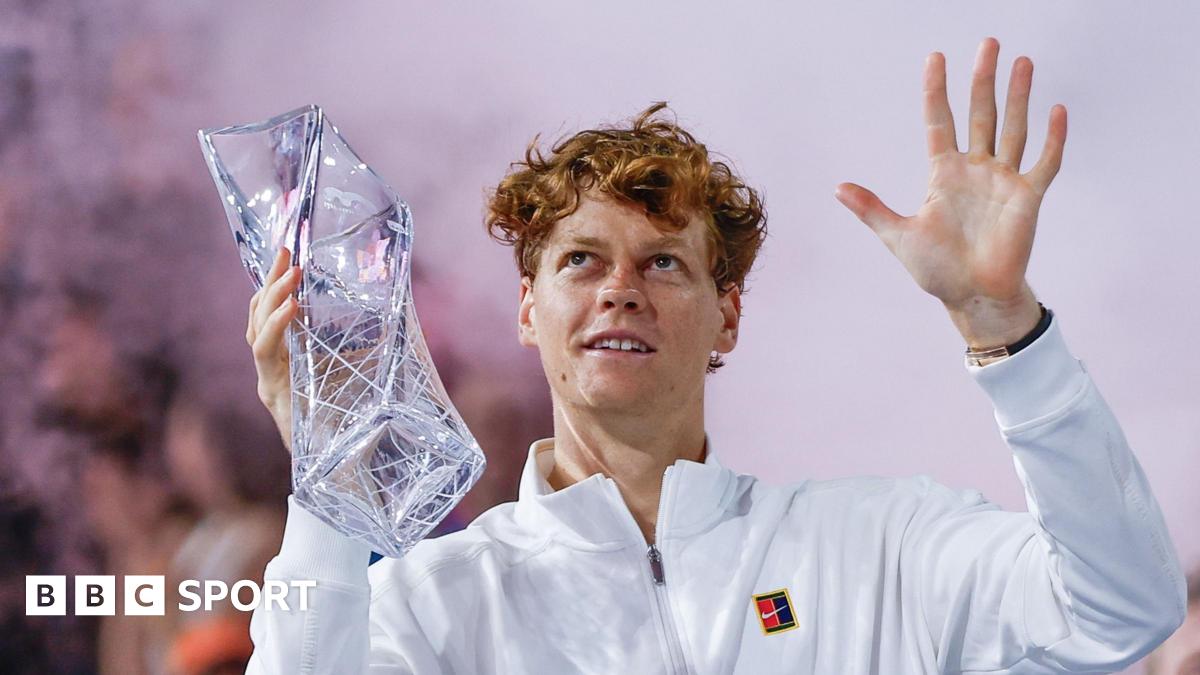
When Sinner lost to his Spanish rival in September’s US Open final, he candidly talked about needing to bring more variety and unpredictability to the court.
But since falling to Novak Djokovic in the Australian Open semi-finals, and then Jakub Mensik in Doha, Sinner’s success has come down to the improved reliability of his service game.
Metronomic precision with his opening shot laid the platform for his Miami victory.
Hitting 70 aces over six matches was the highest tally of his career in a three-set tournament. Only once did he drop a service game.
Against Lehecka, Sinner won 92% of his first-serve points. How he overcame his only moment of real peril underlined the effectiveness of his serve.
Trailing 0-40 and facing three break points when 2-1 up in the first set, Sinner pulled out five inch-perfect first serves which Lehecka could barely get a string on.
It was reminiscent of Roger Federer at his best, able to relieve pressure and deflate opponents by serving his way out of trouble.
No wonder some have claimed Sinner has entered his ‘servebot’ era.
That is not the only area where he is looking to make improvements, though.
Sinner was described as “one of the best ball strikers the game has ever seen” by Miami quarter-final opponent Frances Tiafoe – yet is still looking to increase aggression with his forehand.
That might seem ridiculous given the power and precision which Sinner already possesses from that wing.
As Sinner looked to secure the opening set against Lehecka, he twice dispatched first serves from the Czech with crushing cross-court forehands.
It was proof of Sinner’s desire to put his foot down at the right time and sent a clear message to his rivals.
“The guy has zero weakness – that’s why he has won so much,” said 2013 Wimbledon women’s champion Marion Bartoli, analysing the final for Sky Sports.




Leave a Reply