

Ramona Shelburne
Close
Ramona Shelburne
ESPN Senior Writer
- Senior writer for ESPN.com
- Spent seven years at the Los Angeles Daily News

Multiple Authors
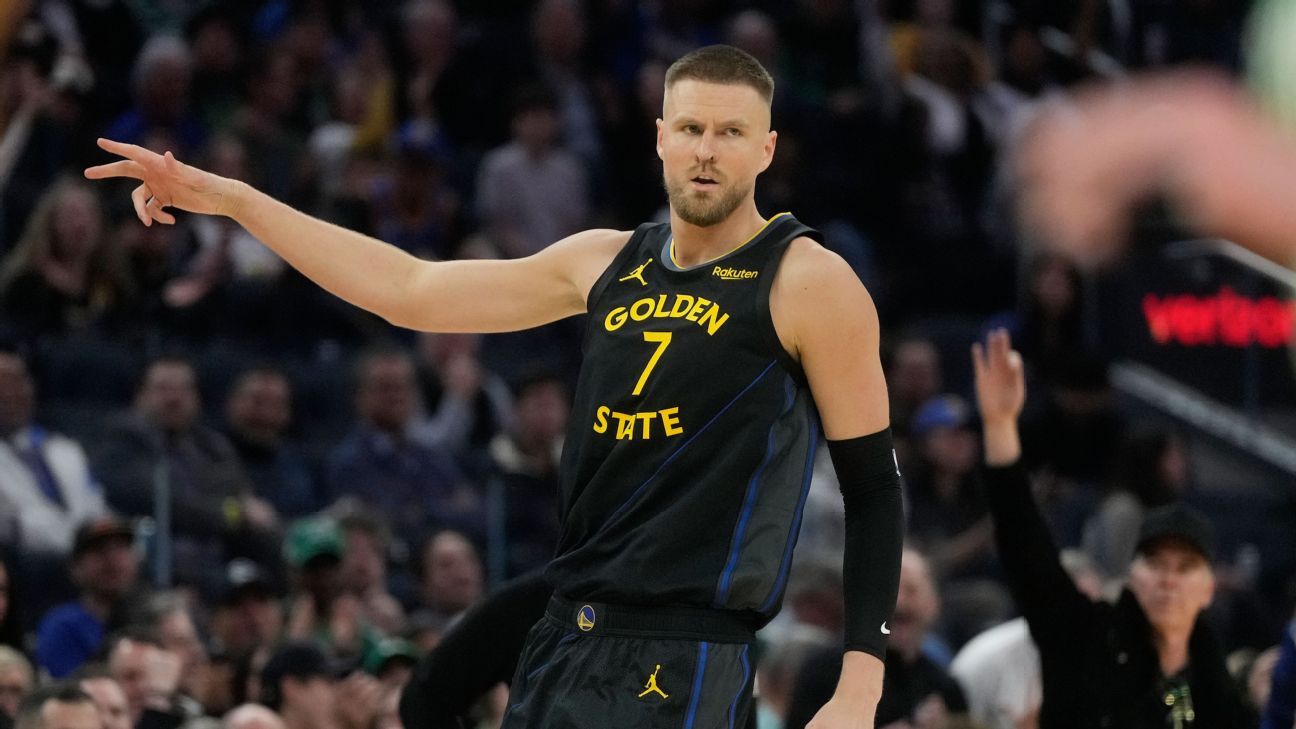
KRISTAPS PORZINGIS’ DEBUT with the Golden State Warriors on Feb. 19 went about as one would expect from a player who’d been sidelined more than a month. He was a little rusty, still wrapping his head around the team’s motion offense and his new surroundings.
But there were second-half flashes of his tantalizing potential. Porzingis poured in two post-up jumpers over a mismatch, drilled a 30-footer and volleyball spiked a Nikola Vucevic floater. The Warriors won the 9 minutes, 48 seconds that Porzingis played by 15 points.
Against the Boston Celtics — with whom he’d won a title in 2024 — Porzingis showed the floor-stretching, rim-protecting combination that earned him the “Unicorn” nickname as a rookie with the New York Knicks. This is what enticed the Warriors to trade for him midseason despite lingering questions about his ability to manage a mysterious condition that arose after he contracted a virus more than a year ago.
“[He brings] a size and presence we’ve been looking for a while,” Stephen Curry said of the tallest teammate he has ever had.
At his best, Porzingis is one of the top ceiling-raisers in the NBA in almost any scenario. Even in his brief 17-game stint with the Atlanta Hawks, where he landed after an offseason trade from the Celtics, they were a plus-49 with him on the court and minus-93 with him off it.
But the problem has never been ability; it has been availability. Porzingis has sat out 110 games combined the past 2½ seasons.
“I’m confident that I will [be able to stay on the court],” Porzingis said when he joined the Warriors. “I’ll just do everything right and I believe I will.
“I think it’s a great opportunity to turn a new page.”
But when Porzingis addressed reporters afterward, before the fifth question, he let out a yawn.
An uncontrollable, extended yawn. Porzingis apologized, as if to make sure he wasn’t being perceived as rude.
Then he yawned again, sending out a hidden reminder of the persistent exhaustion that is threatening to derail his NBA career: The 30-year-old former All-Star was diagnosed last year by Celtics doctors with postural orthostatic tachycardia syndrome (POTS), an autonomic condition that can dramatically increase heart rate and cause dizziness and fatigue.
“I felt all right. Far from being in perfect shape,” Porzingis said. “But I think for [the] first game back after a while, getting some energy back, feeling good. … I think it’s just a matter of time to get in a better rhythm.”
Three mornings later, Porzingis woke up sick in his team-provided San Francisco hotel room and called the training staff. He went from being the spotlight story of the ABC afternoon game against the Denver Nuggets to being so ill that he couldn’t even come to the arena.
Porzingis practiced with the team a week later. He was upgraded to questionable. The internal expectation was for Porzingis to return against the Los Angeles Lakers. But that Saturday afternoon, he was ruled out again with a general illness, continuing an absence that has now reached six consecutive games, during which he has rarely been seen in public.
It’s the latest blow to a Warriors’ season that is being extinguished into a whimper. Jimmy Butler tore his right ACL in January. Curry remains out indefinitely because of persistent right knee trouble. Combined with Porzingis, that’s $144.4 million in salary on the sideline while the Warriors remain trapped in a play-in spot.
It’s deeper for Porzingis. He’s an unrestricted free agent this summer, possessing both the talent to believe another big contract could be ahead but also a health question that has some league executives wondering whether he will have any market at all.
“It’s a little mysterious,” Warriors coach Steve Kerr said of Porzingis’ illness. “We’re obviously working with him and hoping that he can get some clarity. And he can kind of break through and get to a point where he’s consistently healthy, but that’s something that the medical staff is working hard on with him. I’m not going to even posit any medical theories anymore.”
THE HARDEST PART for everyone, especially Porzingis, is the lack of understanding of his condition and what he can do to solve it.
Doctors told him his POTS was probably caused by the upper respiratory viral illness he contracted while with the Celtics in late February 2025. He sat out eight consecutive games, telling reporters after his return that he was still dealing with “lingering fatigue” because of a lasting problem they weren’t able to identify yet.
In a twist, Kerr told local Bay Area radio last week that he called Hawks general manager Onsi Saleh, formerly in Golden State’s front office, after the trade and was told Porzingis wasn’t dealing with POTS. That declaration caused a stir within the Warriors, leading Kerr to walk back his comments at a pregame news conference the next day.
“It was a stupid mistake by me to talk about something that I’m not qualified to talk about,” he said. “I regret even trying to discuss the diagnosis. That was my mistake. I need to leave that to professionals.”
When feeling its ill effects, Porzingis has likened it to the type of exhaustion someone experiences after a full day of hard work. He has tried to manage it with proper hydration, nutrition and sleep.
During the playoffs last May, particularly in the lead-up and during the second-round loss to the Knicks, Porzingis tried everything to get his strength up but was limited to averaging 15.5 minutes in six games and didn’t reach double-digit points once.
“I don’t want to throw some — how is it called? — pity party for myself,” Porzingis said. “Oh, it just wasn’t perfect.”
But the summer brought hope. Porzingis rediscovered his rhythm and energy through a diligent training regimen and competed for Latvia in Eurobasket. He averaged 20.2 points, 8.7 rebounds and 1.7 blocks in six tournament games.
The momentum carried over to his latest NBA home. Porzingis played three preseason games for the Hawks and then appeared in seven of Atlanta’s first nine regular-season games and 12 of their first 19.
But another extended struggle with the illness came in December. Achilles tendinitis kept him sidelined most of January.
But as the Warriors explored the idea of trading for an inactive Porzingis, they said they did their “due diligence” on his medical history and felt comfortable making the move.
“The simple answer on that for me is I heavily rely and trust our medical group,” Warriors general manager Mike Dunleavy told ESPN. “So when they look at the stuff and they say, ‘We’re good, we feel comfortable with what we’re dealing with,’ then I’m on to the next thing from a basketball standpoint. So for that reason, we collectively are good with the decision and will go from there.”
The word from the Warriors in the hours after the Jonathan Kuminga for Porzingis swap was an expectation he’d be ready to debut imminently. After consulting with Rick Celebrini, the Warriors’ director of sports medicine and performance, upon meeting the team in Los Angeles, they decided to keep Porzingis in San Francisco during the All-Star break and ramp him up for a Feb. 19 return.
In the aftermath, a confident Porzingis — who said he was ready for a “surprisingly good post All-Star break period” — expressed a desire to crank up his minutes limit rapidly.
“Honestly, as quickly as possible,” Porzingis said. “Even if I am exhausted out there, I want to still push myself. … It’s always weird coming back after a while, but I’ve had my ups and downs in my career and I’ve been out for a bit and I’m kind of pretty good at jumping right back in.”
He did that during the Celtics’ championship run in 2024 — rejoining for 16 minutes in a decisive Game 5 win over the Dallas Mavericks — despite playing on a badly injured ankle that required offseason surgery.
Porzingis came back ahead of schedule from that ankle surgery and was excellent in the 32 games he played last season before contracting the virus.
But this experience has been wholly different. It’s not about toughness or resilience or pain or attitude. It’s just about his day-to-day health and what that could mean for his long-term future.
“I know usually I think there’s even a stat that players play better on their contract year or something,” Porzingis said on Feb. 7. “But I don’t play into that too much. I just want to finish the year strong. … I just want to finish the year really strong on a new team, new chapter and see where I go from there.”
Porzingis is on the Warriors’ current trip. He got in a full speed pregame workout Thursday night and could practice Friday as they try to gear him up again for a return.
1:53
Shams: Warriors’ pursuit of Giannis is over after Porzingis acquisition
Shams Charania breaks the news that the Warriors are trading Jonathan Kuminga and Buddy Hield to the Hawks in exchange for Kristaps Porzingis.
IN THE LEAD-UP to the NBA trade deadline on Feb. 5, the Warriors checked in on Jaren Jackson Jr., Giannis Antetokounmpo and were among the teams to make a call about Kawhi Leonard when it appeared the LA Clippers might be open for business, league sources said.
None of those deals materialized, so the Warriors pivoted to their backup option in return for the disgruntled Kuminga, who was on an expiring contract.
Porzingis had been on the franchise’s radar as an eventual trade target since last season, when it became clear the Celtics were careening toward a financial reckoning and would need to shed salary. The Warriors struck up conversations with the Hawks about Porzingis more than a month before February’s deadline, before Butler tore his ACL, viewing Porzingis initially as a complementary finishing piece to a fringe contender.
“In a perfect world, I would’ve loved to have Jimmy with him as well,” Dunleavy said. “But I think it works with or without Jimmy.”
The Hawks felt similarly about Porzingis’ ability to elevate any lineup, league sources said, trading for him last summer to give their young core an efficient rim-protecting 7-footer who could stretch the floor out to 30 feet.
The theory worked in practice. Porzingis averaged 17.1 points in only 24.1 minutes in his 17 games with the Hawks. They had a team-best 5.8 net rating in his 413 minutes. His presence led to better basketball.
But there’s a reason he was made available when the Warriors came calling. Porzingis’ presence was too infrequent due to Achilles tendinitis and the illness.
So a second team in eight months agreed to trade one of the league’s most distinctive talents. Atlanta absorbed Buddy Hield’s contract ($3 million guaranteed next season) to get a crack at Kuminga — a low-risk flier on a flexible contract — in exchange for Porzingis for the rest of the season, with a chance to re-sign him this summer.
“We see him as more than a rental,” Dunleavy said. “We feel he can help our team this year, better our playoff position, and then moving forward fits what we are looking for.”
One month after the trade, the optics haven’t tilted in Golden State’s favor. This past Sunday night, as Kuminga capped off a three-game Hawks explosion with a windmill dunk that had Hall of Famer Dominique Wilkins bellowing “Thank you, Golden State Warriors!” on the Atlanta broadcast, Porzingis was being ruled out for what would become the Warriors’ eighth loss in their past 12 games.
The Warriors are now closer to the 10th-place Portland Trail Blazers than the seventh-place Phoenix Suns in the standings, stuck in play-in purgatory. They’ve won too many games to reposition their strategy for prime draft positioning, but are too far from the top six to make a realistic push for a secure playoff spot.
That reality, combined with the prolonged absences of Butler, Curry and Porzingis, paint a bleak picture in the near term and present increased questions about the long-term viability of the aging core.
The Warriors maintain the ability to trade up to four of their future first-round picks this summer, allowing them to sweeten a trade chase for Antetokounmpo or any other big name who might become available. Porzingis, if he regenerates value, is also sign-and-trade eligible for salary matching purposes.
But it’s clear that at least a portion of the motivation for the Porzingis move was about the financial side. The team targeted an expiring deal and, if Porzingis walks, he’ll be viewed as a salary-dump move in retrospect.
“It gives us a little bit of flexibility moving into next year,” Dunleavy said. “We can control our books a little bit. … For us, with some of the free agents we have, Draymond [Green] with a player option, some of the uncertainty we have it’s just hard to know what apron we will be under.”
While the front office is grappling with financial uncertainty, the Warriors’ locker room isn’t rushing their newest teammate back onto the floor.
“When a guy is hurt or sick or whatever, there’s no one around here like pressuring you, like, ‘Yo, what’s going on?’ We don’t move like that,” Green said. “So I don’t think in this locker room, we feel the uncertainty as much as everyone else does, because that’s just not how we operate. We know if he’s healthy, he’s going to get back out there.
“We don’t sit around pressuring guys to make them feel this angst that they got to get back. No, you’ll get back when you can get back.”


Leave a Reply