

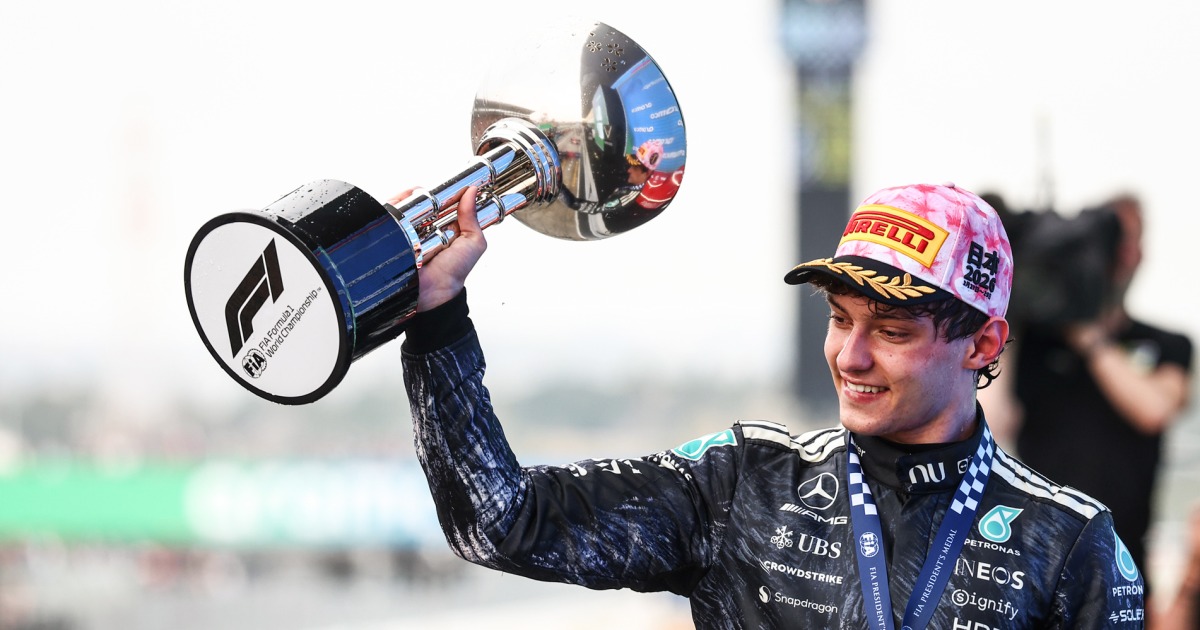
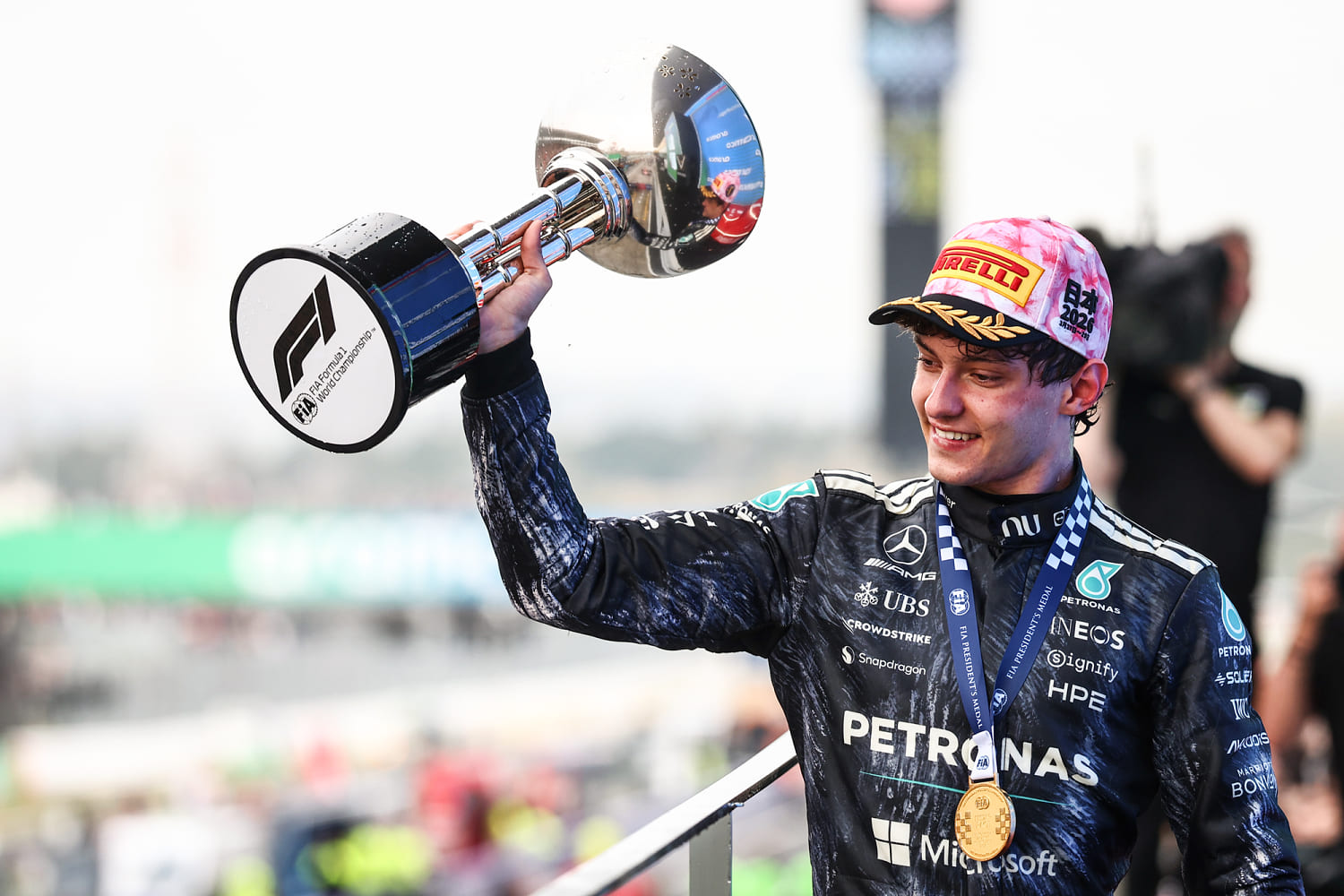
With a victory Sunday at the Japanese Grand Prix, Kimi Antonelli became the youngest championship leader in Formula 1 history.
The 19-year-old Italian took the lead in the standings with 72 points, overtaking fellow Mercedes driver George Russell, 28, who sits second with 63 points after finishing fourth on Sunday.
Antonelli is so young he was denied the customary Champagne at the podium celebration for being under Japan’s legal drinking age of 20. Instead he was given an unlabeled bottle that announcers speculated was sparkling water.
“It feels pretty good,” Antonelli said after the race, although with only three out of 22 races completed in the 2026 season, he added he’s not overinterpreting it.
“I’m not thinking too much about the championship. Of course it’s great, but it’s still a long way to go,” Antonelli said. “Need to keep raising the bar because, you know, George is very quick and for sure he’s going to be back at his usual level, and also competitors, eventually they will get closer. I think we need to keep our head down and keep raising the bar.”
Completing the podium were Oscar Piastri of McLaren in second place and Charles Leclerc of Ferrari in third.
Antonelli breaks a record set by Lewis Hamilton in 2007, when the 22-year-old led the world championship in his rookie season.
Antonelli qualified on pole position Saturday but fell from first to sixth on the opening lap after a poor start. He kept his composure, slowly clawed his way back and took advantage of a lucky “safety car” triggered by a crash to make a cheap pit stop and come out in the lead. At the restart, he drove off into the distance and won by nearly 14 seconds.
Russell, his teammate, pulled ahead of Antonelli at the start and challenged for the lead. But he was on the unlucky end of the safety-car sequence and lost positions after doing a normal and lengthier pit stop the lap before the crash.
“We’ve had a lot of bad luck this weekend and that is unfortunate as we were definitely in the fight for the win today,” Russell said in a postrace statement. “It was pretty frustrating but that’s the way racing goes sometimes.”
So far in 2026, Mercedes has established itself as the clear favorite for both the drivers’ and constructors’ championships. Russell began the season as the favorite for the title and solidified that after winning the opening race in Australia.
But Antonelli, who is racing in just his second F1 season, is now mounting a challenge of his own.
The race also provided some hope for McLaren, the reigning world champion, after a poor start to 2026 under the new regulations. Piastri, who failed to start either of the first two Grands Prix, was leading the race in Japan with a viable shot at victory before the safety car came out.
“It would have been really interesting to see what would have happened without that,” Piastri said. “I could keep George behind, and just before the stops we’re actually pulling away a little bit again. So yeah, a shame that we never got to see what would have happened. But I think for us at this point to be disappointed about finishing second is a pretty good place to be.”
Norris, the 2025 driver’s champion, finished fifth.
The massive crash that upended the race occurred on Lap 22, when Haas driver Ollie Bearman was closing in rapidly on Alpine’s Franco Colapinto and attempting an overtake. Colapinto moved to defend, but with a rapid closing speed, Bearman was forced to take evasive action before slipping onto the grass, losing control of his car and smashing into the barriers.
Officials reviewed the incident and cleared Colapinto of wrongdoing. And Bearman’s injuries were fortunately minor.
“Bearman suffered a 50G impact, and after extricating himself from the wreckage, underwent an X-ray in the medical center,” the Haas team said. “Bearman suffered a right knee contusion following the impact but was cleared of any further injuries and was swiftly released by the medical crew.”
The shocking crash sparked serious criticisms from F1 drivers after the race, who said the 2026 regulations — with the new electrical energy causing drivers to deploy and harvest power differently — made accidents like it more likely.
“First of all, everything is fine and I’m good. It was a scary moment out there, but everything is OK, which is the main thing,” Bearman said in a statement. “There was a massive overspeed — around 50 kph — which is a part of these new regulations, and we have to get used to it, but also I felt like I wasn’t given much space, given the huge excess speed I was carrying. We need to be a bit more lenient and a bit more prepared, as unfortunately this was the result of a massive delta speed, which we’ve not seen in Formula 1 before.”
A spokesperson for the FIA, the governing body of Formula 1, addressed the incident and said it had always planned to conduct “a structured review” of the new rules after “the opening phase of the season” and that meetings are scheduled next month ahead of the Miami Grand Prix on May 3.
There is a five-week gap until the Miami race after two races scheduled for April in Bahrain and Saudi Arabia were canceled due to the conflict in the Middle East.
“The FIA will continue to work in close and constructive collaboration with all stakeholders to ensure the best possible outcome for the sport and safety will always remain a core element of the FIA’s mission,” the FIA spokesperson added. “At this stage, any speculation regarding the nature of potential changes would be premature.”


Leave a Reply