


Paula Lavigne

Multiple Authors
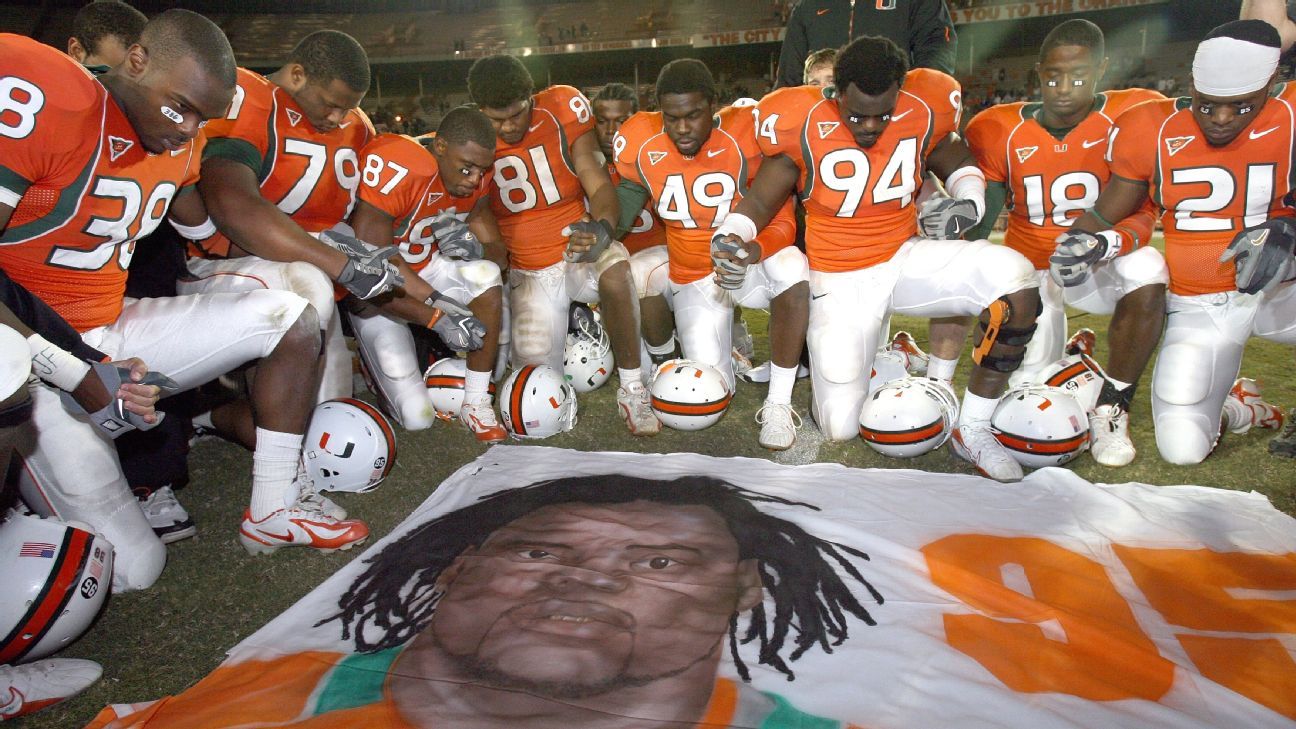
MIAMI — A judge declared a mistrial Monday in the murder trial of former Miami Hurricanes player Rashaun Jones, accused of shooting of his teammate Bryan Pata in 2006.
About an hour after the six jurors began their second day of deliberations, Florida 11th Circuit Court Judge Cristina Miranda came into the courtroom to address the attorneys, reading a statement from the jurors: “At this point we are deadlocked with no one willing to move.” Miranda instructed them to keep trying, but after about another hour, they again said they could not render a verdict.
Under Florida law, a mistrial means that prosecutors can try the case with a new jury, and a new trial must come within 90 days.
The deadlock came after five days of testimony in which nearly two dozen former teammates, coaches, law enforcement officers and others told jurors about prior fights between the two, tensions over a girlfriend, and Jones having a gun — a .38-caliber revolver — which a firearms expert said could have been used in the shooting.
Nearly all evidence against Jones, 40, was circumstantial amid a flurry of police missteps that came to light over the years, and Jones was not charged in the case until nearly 15 years after the killing. He had maintained his innocence and declined plea offers just before trial that would have limited his prison time instead of risking up to life in prison.
Prosecutors relied heavily on recorded testimony from former University of Miami instructor Paul Conner, who told police he encountered someone walking away from the apartment complex where Pata was killed shortly after the shooting.
Six jurors, after the three alternates were dismissed, deliberated for about six hours Thursday and XX hours Monday, after asking to review certain pieces of evidence, including Conner’s testimony and even the bullet retrieved from Pata’s body.
Jurors watched video testimony of Conner, who said he learned about the shooting on the news the morning after it happened and called to tell police about the man he’d passed while entering the complex the night before. He described the man to a forensic artist who generated a sketch. Seven months later, after police identified Jones as a suspect, Conner picked him out of a photo lineup.
In closing arguments Wednesday before Florida 11th Circuit Court Judge Cristina Miranda, defense attorney Christian Maroni offered a staccato list of what he said were shortcomings in Conner’s credibility: It was dark when the two passed. Conner had imperfect vision and didn’t know whether he had his glasses at the time. The encounter was only a few seconds. And the lineup identification came seven months later.
And Maroni noted that Jones’ friend and teammate Bruce Johnson said Jones had jagged teeth with some discoloration, whereas Conner described a man with “clean white teeth.”
Maroni also showed the forensic artist’s sketch to the jury, asking, “Does this look anything like Rashaun Jones?” and said Jones was a “misidentification” by Conner.
He pointed to what he said were flaws in the photo of Jones that Conner picked out of the lineup, noting that Jones was a “black blur.” “He’s the darkest one. He stands out because of the background and because of the quality of that picture,” Maroni said.
He also told jurors that of the several teammates — mostly Pata’s friends — who were interviewed, only two mentioned Jones had a gun.
Prosecutors questioned multiple witnesses — teammates, friends, coaches — to establish that Jones did not attend a mandatory team meeting after Pata was killed. Jones himself, in a post-interrogation video played for the jurors, acknowledged not attending, he said because he was upset over his two-game suspension earlier that day after a failed drug test.
“Because he didn’t go to that meeting, we’re here,” Maroni told jurors. “That one choice has snowballed out of control. To where an arrest hadn’t been made in 15 years, and all of a sudden now we go back, we look at the one person who didn’t go to that meeting for a completely innocent reason and try to paint this picture, try to use all of these innocent facts, to turn it into a murder.”
In her closing, Assistant State Attorney Cristina Diamond told jurors that multiple signs pointed to Jones and his motivation, including a two-game team suspension he received that day after a second failed drug test, cell phone records that contradicted what he said of his whereabouts, and a suspicious call he’d made to another athlete to ask for money.
“Ill will, hatred, spite and evil intent” had been boiling in Jones for years, Diamond said, and on the night of Nov. 7, 2006, “he chose to let jealousy overtake him and kill Bryan Pata.”
Prosecutors tried to establish that Jones had long-running hostility toward Pata after Pata started dating a woman, Jada Brody, with whom Jones had a prior intimate relationship. Former teammates and friends testified to varying degrees about the degree to which Brody caused tension between the two.
And defense attorneys told jurors Jones had another girlfriend at the time, and to remember there was “no testimony that Rashan was continuing to try … and be with Jada or get with Jada.”
Diamond told jurors that Jones’ attorneys, “want you to believe that the defendant is the unluckiest person alive,” and she told them about police interviewing 150 people, getting “tips from psychics” and “following up on everything” over the course of the investigation.
“And what happens? Every detail comes back to the defendant,” she said.
Throughout the trial, and even up to discussions about evidence that led to a shouting match between the attorneys Thursday before jurors were brought in for deliberations, both sides argued about how much jurors could be told about the breadth of the police investigation.
Defense attorneys tried multiple times to introduce evidence or elicit testimony regarding other leads that police had in the case, including some involving a nightclub fight, threats of harm, and statements about someone putting a “hit” on Pata.
Other questions related to failures by police in gathering evidence or in the defense called shortcomings in the process of eliminating those other leads. Prosecutors rejected those attempts, and Miranda more often than not sided with omitting those details.
Prosecutors tried to overcome questions as to why police waited to arrest Jones until 2021, even though he was identified as a subject almost immediately.
“It is not a reasonable doubt if you say the defendant is guilty, he’s the one who killed Bryan Pata, but he wasn’t arrested for 15 years. That is not a reasonable doubt. That is not something that you can take into consideration,” Diamond said.
Assistant State Attorney Kristen Rodriguez, in the state’s final rebuttal, told jurors that there is “no statute of limitation for murder” and that detectives routinely solve cold cases upon a closer review.
“Memories may fade, but in the end, everyone here experienced a trauma. Every single witness that testified experienced a trauma,” she said. “The big things stay with you.”
At the University of Miami, the 6-foot-4, 280-pound Pata was projected to be selected in the 2007 NFL draft. He was buried in the suit he had picked out for the event. His unsolved killing languished more than 10 years before ESPN began requesting police records in the case amid the Pata family’s growing frustration with investigators’ apparent inaction. Police had said publicly for years that they had no prime suspect and no single person of interest.
ESPN sued the Miami-Dade Police Department in 2020 for access to the complete and unredacted case records. During proceedings in that case, an officer supervising the investigation said police “have a strong belief who killed Bryan Pata” and had come close to arresting this person at least a decade earlier.
One officer said in court during that hearing that there could be an arrest “in the foreseeable future,” which police department attorneys said indicated the case was still active, and the records thus protected from disclosure under Florida law.
ESPN published a lengthy story about Pata’s killing in November 2020 that detailed the police record and included other new information about the case, including that police seemed to consider Jones the prime suspect. Jones was arrested about nine months later and has been jailed ever since.
The lead detective in the case, Juan Segovia, said in a 2024 deposition that police did not uncover any new evidence in the ensuing years that gave them probable cause to arrest Jones in 2021. He said, “It was there all along,” but back in 2007, the state attorney did not feel as though it was enough for an arrest.
ESPN’s investigation uncovered a multitude of leads that police pursued, including a nightclub fight involving possible gang members. The reporting also discovered three alleged murder confessions, including one relayed by federal immigration officials of a man who reportedly died in the 2010 earthquake in Haiti, and another from a jail inmate who said a fellow inmate told him he killed Pata for money.
One of the confessions allegedly came from Jones himself to a fellow prisoner while incarcerated after his arrest in 2021. According to documents and interviews with ESPN, that prisoner said Jones told him he confronted Pata out of rage but didn’t intend to kill him.
ESPN’s investigation also identified a number of missteps and inconsistencies by police, including leads that weren’t pursued to the end and people with connections to Pata and that evening who weren’t interviewed.
In the months leading up to trial, prosecutors also said they were unable to produce multiple documents in discovery that police and the county’s attorneys had previously provided to ESPN, including a polygraph report, and a “lead sheet” that police said listed all of the suspects they investigated. The lead sheet was eventually produced.
But much of that information did not make it to the jury. Judge Miranda decided not to allow evidence regarding the other possible theories and Pata’s other possible interpersonal conflicts, and she ruled to keep out any testimony from hearings over ESPN’s records lawsuit.
While Jones’ counsel argued that they should be able to question whether the police did enough to exclude the other theories, Judge Miranda said the defense failed to gather enough “credible evidence” to tie those leads to this case.
ESPN’s Dan Arruda and Scott Frankel contributed to this report.


Leave a Reply