

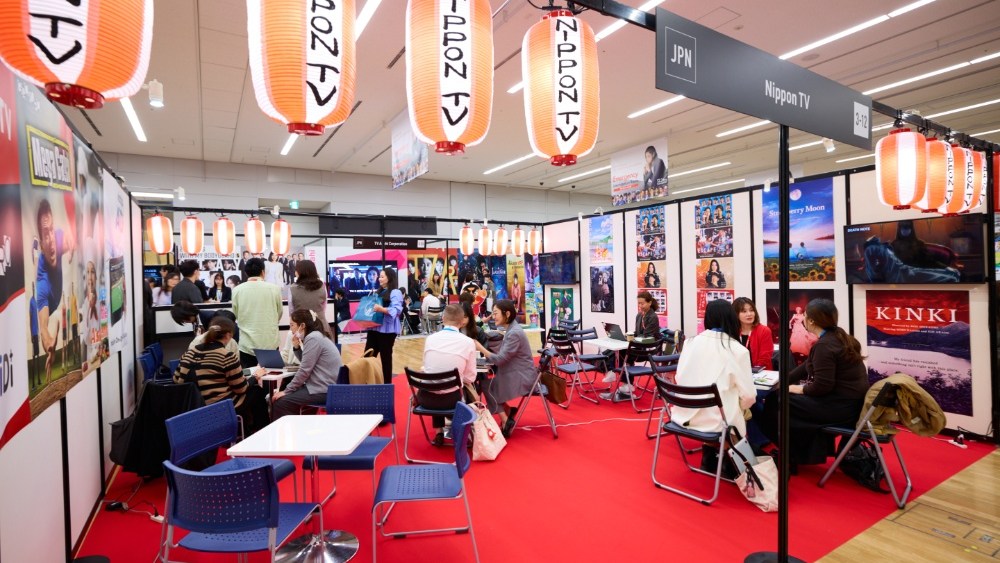
When the Hong Kong — Asia Film Financing Forum (HAF) opens its 24th edition alongside the 30th Hong Kong International Film & TV Market (FilMart), the most closely watched new addition will not come from within the city at all. For the first time, a dedicated Japanese section — Film Frontier — will place emerging Japanese filmmakers directly inside HAF’s project market, part of a broader Japanese presence this year that extends across all of the forum’s major strands.
Across HAF’s In-Development Projects, Works-in-Progress and the new Film Frontier sections, Japan accounts for seven projects in total — a figure that underscores how decisively Unijapan is pursuing an outward-facing strategy at the Forum.
Film Frontier has been introduced by HKIFF Industry in collaboration with the Japan Creator Support Fund and brings two projects to the inaugural showcase: “Hidari,” directed by Kawamura Masashi and Ogawa Iku, and produced by Matsumoto Noriko through Dwarf Studios; and “Unknown Face,” directed by Kusano Natsuka, and produced by Miyoshi Gohey, Anocha Suwichakornpong and Paul Mori through Matataki Films.
The initiative sits within a broader infrastructure that Unijapan has been quietly building over several years. For Mashima Kyoko, of Unijapan’s international promotion division, the core problem it addresses is one of visibility. “International attention toward Japanese cinema tends to spotlight well-established directors,” she says, “leaving emerging filmmakers with very limited opportunities to pitch their projects at the right place and time.”
The Japan Creator Support Fund, which backs Film Frontier, was designed specifically to close that gap — allowing promising young Japanese filmmakers to not only to develop their creative work but also to build cross-cultural communication skills and establish a global network that can sustain their careers beyond a single film. “Its mission is to empower promising young Japanese filmmakers not only to refine their creative [skills] but also to nurture their cross-cultural communication skills and build a global network, ensuring they can maintain a strong, long-term presence on the global stage,” Mashima says.
Selecting projects for the debut required a specific profile. Mashima says the team evaluated filmmakers actively seeking to develop their work as international co-productions, particularly in collaboration with Asian creators, weighing experience at overseas festivals alongside what she describes as a global perspective, flexibility and communication skills.
Beyond Film Frontier, Japan’s footprint is also substantial in HAF’s main In-Development Project strand. Four projects with Japanese involvement are in the selection this year. “The Blue Breaks,” directed by Uchiyama Takuya and produced by Satoh Naomi through Differentia, is one of two wholly Japanese IDP entries. The other is “Life Is Yours,” directed by Emma Kawawada and produced by Takahashi Naoya and Eiko Mizuno-Gray through Toei, one of Japan’s major studios, and Loaded Films, the Tokyo-based company behind Cannes selections “Renoir” and “Plan 75.”
Two further IDP projects involve Japan as a co-production territory. “The Funeral March” (Japan/China) is directed by Fujita Naoya and produced by Shiina Yasushi, Aiken Zou, Zou Lin and Fujita Kanako through shingles Y’s and Ahaverse; “38.83” (Hong Kong/Japan) is directed by Vincci Cheuk, with Koga Shunsuke as producer, through 2882 ProdCo.
In HAF’s Work-in-Progress strand, the three-territory co-production “My Mother” (Indonesia/Japan/Hong Kong), directed by Eddie Cahyono, represents Japan at the later stage of production. The film is produced by Tika Bravani and Isabelle Glachant through ANP Talenta Media, Knockonwood and Chinese Shadows.
The project presence at HAF connects directly to the Tokyo Intl. Film Festival Content Market (TIFFCOM), Japan’s primary content market, which Ikeda Kaori, TIFFCOM’s managing director, sees in regional rather than purely national terms. “While the name includes ‘Tokyo,’” she notes, “we position TIFFCOM as one of the Asian content markets.” The Asian region, in her view, is a growing collaborative partner for co-production and IP expansion, and TIFFCOM — along with platforms like HAF and FilMart — represents essential networking infrastructure to strengthen those ties.
Central to TIFFCOM’s operational role is the Tokyo Gap-Financing Market, now in its sixth year, which Ikeda describes as a hub for sharing co-production opportunities. Unijapan also serves as the secretariat for bilateral co-production treaties through the platform. Mashima points to a steady increase in Asian projects seeking to participate in TGFM, with more producers and professionals requesting meetings and growing interest in Japan-originated projects across both live-action and animation.
The ambitions of the market extend to its anniversary milestone. “Following in the footsteps of FilMart,” Ikeda says, “we aspire to reach our 30th anniversary.”
The HAF presence also sits within a wider moment of international momentum for Japanese cinema. Japan has been named Country of Honor at the Cannes Film Market for 2026, where its participation will include an industry summit, a special screening day and dedicated conference sessions. And Unijapan has unveiled dates for the 39th Tokyo Intl. Film Festival — Oct. 26–Nov. 4 — alongside TIFFCOM 2026, set for Oct. 28–30.
The market activity takes place against the backdrop of a festival in the midst of its own repositioning. TIFF, with its 40th edition on the horizon for 2027, has in recent years established a Women’s Empowerment section and an Asian Students’ Film Conference section as part of a deliberate effort to expand its identity.
Kikuchi Yusuke, promotion group director at TIFF, describes the next phase as being less about adding new competitive sections and more about the human connections the festival enables. “Film festivals are more than just screening movies,” he says. “Fostering interpersonal exchange through cinema is its vital element.”
The broader ambition — connecting TIFF’s programming function, TIFFCOM’s market function and Film Frontier’s talent development function into a single coherent system — is something Ikeda states plainly. “Exactly, that’s what we are aiming,” she says. “We see a shift where young creators and producers are now conscious of the global market from the early stage of development. Our mission is to create an environment where they can challenge by sharing information and hands-on experience.”
Content, too, is evolving. Ikeda acknowledges a new ecosystem emerging around Japanese material, one in which animation and genre cinema are supplemented by streaming-platform projects and accelerated by AI. Through all of it, she says, Japan’s core strength remains its storytelling. “The stable domestic box office also makes Japan more attractive as a market and a co-production partner,” she adds. The numbers support her case: Japan’s theatrical market hit a record JPY274.45 billion ($1.79 billion) in 2025, up 32% from approximately JPY206 billion ($1.34 billion) the previous year, according to the Motion Picture Producers Assn. of Japan (Eiren), with “Demon Slayer: Kimetsu no Yaiba — The Movie: Infinity Castle (Part 1)” anchoring the surge.
For now, the immediate test is in Hong Kong. Seven projects. A new dedicated section. A market presence built over years. Mashima puts the stakes in her own terms: “Early-stage participation significantly enhances the potential for creators to lead the next generation of Asian cinema.” Whether this week’s slate delivers on that promise will be judged over years, not days — but the infrastructure, project by project, is being put in place.












Leave a Reply